
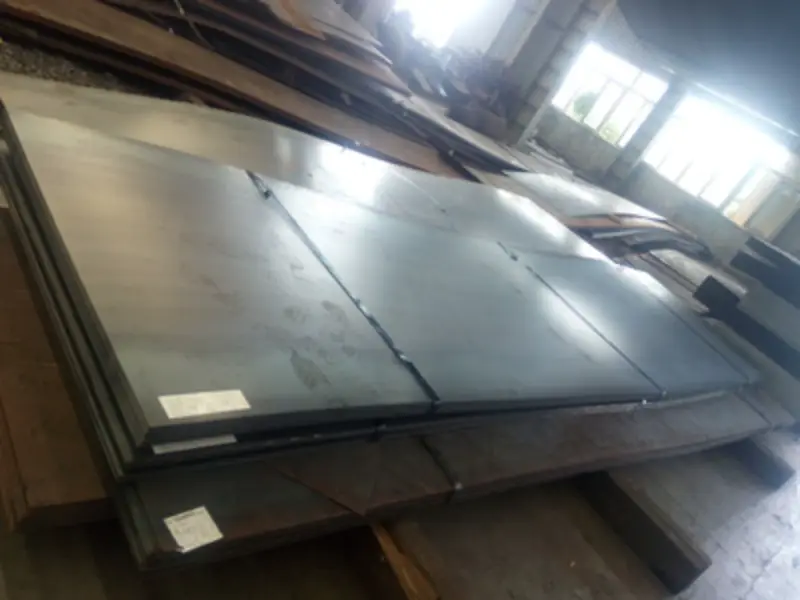
Austenitic 301LN (UNS S30153) Stainless Steel Plate/Coil
Austenitic 301LN (UNS S30153) Stainless Steel Plate/Coil - Comprehensive Material Data
Detailed material properties, chemical composition, mechanical and physical performance of 301LN (UNS S30153) stainless steel plate/coil per ASTM A240/A240M and A666, with equivalent grades and applications.
Hot rolling, cold rolling, annealing, pickling, skin‑pass, slitting, cutting, stamping, bending, deep drawing, welding (with ER308L or ER308LSi filler), stress relieving
- Phone : +8618037372205
- Email : [email protected]
- WhatsApp: Contact via Whtsapp
- WeChat: +8618037372205
Austenitic 301LN Stainless Steel Plate/Coil Introduction
UNS S30153, commonly known as 301LN, is a low‑carbon austenitic stainless steel with deliberate nitrogen addition. The reduced carbon content (≤0.03%) strongly improves resistance to intergranular corrosion after welding or high‑temperature exposure, while nitrogen (0.07–0.20%) compensates for strength loss and provides high work‑hardening capability. Compared to standard Type 301, 301LN offers better weldability without sacrificing the exceptional combination of strength and formability. The alloy is supplied as plate, coil, and strip, and can be cold‑rolled to a wide range of tempers—from annealed to full‑hard—to meet specific mechanical requirements. Its high strength‑to‑weight ratio, good corrosion resistance in mildly corrosive environments, and excellent fatigue life make it a preferred material for structural transportation components, industrial springs, clamps, and numerous high‑strength fabricated parts.
Austenitic 301LN Stainless Steel Plate/Coil Chemical Composition
The following table presents the chemical composition of 301LN (UNS S30153) as specified in ASTM A240/A240M for standard plate and coil. The low carbon maximum of 0.03% drastically reduces susceptibility to sensitization, while nitrogen (0.07–0.20%) acts as an austenite stabiliser and potent solid‑solution strengthener, enabling high cold‑worked tensile properties without compromising corrosion resistance.
| Element | Standard Value (%) | Remarks |
|---|---|---|
| Carbon (C) | ≤0.03 | Low carbon for enhanced intergranular corrosion resistance |
| Manganese (Mn) | ≤2.00 | Austenite stabilizer; improves hot workability |
| Phosphorus (P) | ≤0.045 | Impurity |
| Sulfur (S) | ≤0.030 | Impurity |
| Silicon (Si) | ≤1.00 | Deoxidizer; improves oxidation resistance |
| Chromium (Cr) | 16.00–18.00 | Primary element for corrosion resistance |
| Nickel (Ni) | 6.00–8.00 | Austenite stabilizer; enhances formability and ductility |
| Nitrogen (N) | 0.07–0.20 | Strengthener; compensates for low carbon |
| Iron (Fe) | Balance | Remainder |
Austenitic 301LN Stainless Steel Plate/Coil Thermal and Electrical Physical Properties
Physical property data for 301LN are comparable to those of standard Type 301. The values below are typical for the alloy in the annealed condition and are taken from published ASM and manufacturer references. The thermal expansion, conductivity, and specific heat vary with temperature; several commonly used ranges are listed. These properties are essential for design calculations involving thermal cycling, electrical resistance heating, or heat transfer.
| Property | Typical Value | Unit | Test Condition / Temperature |
|---|---|---|---|
| Density (ρ) | 7.9 | g/cm³ | Room temperature |
| Elastic Modulus (E) | 193 | GPa | 20 °C |
| Shear Modulus (G) | 74 | GPa | 20 °C (estimated) |
| Poisson's Ratio (ν) | 0.29 | dimensionless | Room temperature |
| Average Thermal Expansion Coefficient (α) | 16.9 | µm/m·°C | 0 to 100 °C |
| Average Thermal Expansion Coefficient (α) | 17.4 | µm/m·°C | 0 to 315 °C |
| Average Thermal Expansion Coefficient (α) | 18.1 | µm/m·°C | 0 to 538 °C |
| Thermal Conductivity (λ) | 16.2 | W/m·K | at 100 °C |
| Thermal Conductivity (λ) | 20.2 | W/m·K | at 300 °C |
| Thermal Conductivity (λ) | 21.5 | W/m·K | at 500 °C |
| Specific Heat Capacity (cp) | 500 | J/kg·K | 0–100 °C (typical) |
| Electrical Resistivity (ρ_e) | 0.72 | µΩ·m | at 20 °C |
Austenitic 301LN Stainless Steel Plate/Coil Mechanical Properties
Mechanical properties of 301LN strongly depend on the cold‑working condition. The table lists minimum requirements from ASTM A240/A240M for the annealed condition and typical guaranteed values for various cold‑rolled tempers according to ASTM A666. Values are measured at room temperature on standard test pieces. In the cold‑worked tempers, yield strength values are typical (not official minimums) but represent the expected performance range.
| Property | Typical / Min. Value | Unit | Test Condition |
|---|---|---|---|
| Tensile Strength (Rm) | ≥515 | MPa | Annealed (ASTM A240) |
| Yield Strength (ReH, 0.2% offset) | ≥205 | MPa | Annealed (ASTM A240) |
| Elongation (A, 50 mm) | ≥40 | % | Annealed (ASTM A240) |
| Hardness | ≤95 HRB (≤219 HB) | HRB / HB | Annealed (ASTM A240) |
| Tensile Strength (Rm) | ≥860 | MPa | 1/4 Hard (ASTM A666) |
| Yield Strength (ReH, 0.2% offset) | ≥515 (typical) | MPa | 1/4 Hard (typical) |
| Elongation (A, 50 mm) | ≥25 | % | 1/4 Hard (ASTM A666) |
| Tensile Strength (Rm) | ≥1035 | MPa | 1/2 Hard (ASTM A666) |
| Yield Strength (ReH, 0.2% offset) | ≥760 (typical) | MPa | 1/2 Hard (typical) |
| Elongation (A, 50 mm) | ≥10 | % | 1/2 Hard (ASTM A666) |
| Tensile Strength (Rm) | ≥1205 | MPa | 3/4 Hard (ASTM A666) |
| Yield Strength (ReH, 0.2% offset) | ≥930 (typical) | MPa | 3/4 Hard (typical) |
| Elongation (A, 50 mm) | ≥7 | % | 3/4 Hard (ASTM A666) |
| Tensile Strength (Rm) | ≥1275 | MPa | Full Hard (ASTM A666) |
| Yield Strength (ReH, 0.2% offset) | ≥965 (typical) | MPa | Full Hard (typical) |
| Elongation (A, 50 mm) | ≥8 (longitudinal), ≥5 (transverse) | % | Full Hard (ASTM A666) |
Austenitic 301LN Stainless Steel Plate/Coil Fully Equivalent International Standards and Suggested Replacement Grades
| Country / Region | Standard | Grade | Remarks |
|---|---|---|---|
| United States | ASTM A240/A240M, ASTM A666, ASME SA‑240 | 301LN (UNS S30153) | Original grade |
| European Union | EN 10088-2, EN 10088-3 | 1.4318 (X2CrNiN18-7) | Identical composition and mechanical properties |
| Japan | JIS G4305, JIS G4304 | SUS301L | Approximate equivalent; low-carbon 301, nitrogen may not be specified; verify exact composition match |
| International | ISO 15510 | X2CrNiN18-7 | Compositionally identical to 1.4318 |
Austenitic 301LN Stainless Steel Plate/Coil Application Introduction
301LN excels in applications requiring high strength, good fatigue behaviour and moderate corrosion resistance. Its low carbon content makes it suitable for welded assemblies without post‑weld annealing, and the wide range of available tempers allows tailoring of mechanical properties. Typical industries and product forms are listed below.
Product Applications: Lightweight railcar bodyshells and roof panels, Automotive body‑in‑white stamped parts, Hose clamps, constant‑force springs, flat springs, Flexible metal bellows and expansion joints, Overhead catenary fittings for electric railways, Metal diaphragms for pressure sensors, Decorative automotive trim and wheel covers, Thin‑walled welded tubes for furniture and structures
Processed into products: Roll‑formed structural channels and beams, Stamped brackets, reinforcements and supports, Cold‑headed fasteners, rivets and screws, Press‑formed trays, containers and housings, Deep‑drawn cylindrical shells and cups, Chemical reactor internal baffles (after corrosion assessment), Precision thin‑walled tubing for instrumentation, Welded assemblies (e.g. frames, base plates) requiring post‑weld corrosion resistance
Application industries: Railway and mass transit (railcar bodies, structural frames, undercarriage components), Automotive (body panels, structural reinforcements, trim, springs, clamps), Aerospace (springs, clamps, brackets, metal bellows), Food and beverage processing equipment, Chemical and petrochemical plant components (moderate corrosion service), Medical devices and surgical instruments, Architecture and construction (roofing, cladding, curtain wall connectors), Electronics (spring contacts, connectors, lead frames)
Austenitic 301LN Stainless Steel Plate/Coil Similar or Substitutional Stainless Steel Grades
| Country / Region | Standard | Grade | Remarks |
|---|---|---|---|
| United States | ASTM A240/A240M | 301 (UNS S30100) | Higher carbon (≤0.15%), similar strength work‑hardening ability; lower intergranular corrosion resistance when welded |
| United States | ASTM A240/A240M | 304 (UNS S30400) | Higher nickel (8.0–10.5%), lower strength in cold‑worked conditions; superior general corrosion resistance |
| United States | ASTM A240/A240M | 201 (UNS S20100) | Economy grade with higher manganese and lower nickel; similar work‑hardening but less corrosion resistance |
| European Union | EN 10088-2 | 1.4310 (X10CrNi18-8) | Standard 301 type with higher carbon; used for springs but with reduced weldability |
Notes:
301LN exhibits excellent weldability using all common fusion and resistance welding processes. The low carbon content minimises carbide precipitation in the heat‑affected zone, therefore post‑weld annealing is normally unnecessary for most service environments. The alloy cannot be hardened by heat treatment; high strength levels are exclusively achieved through cold working. During machining, the material's high work‑hardening rate demands rigid setups, sharp carbide tooling and adequate coolant. Maximum service temperature in oxidising atmospheres is approximately 870 °C (1600 °F) for intermittent exposure and 925 °C (1700 °F) for continuous service. Stress‑corrosion cracking can occur in chloride‑rich environments above about 60 °C; design attention is required if exposure to chlorides is anticipated. For severe corrosion conditions, higher‑alloyed stainless steels should be considered.
- Share



