
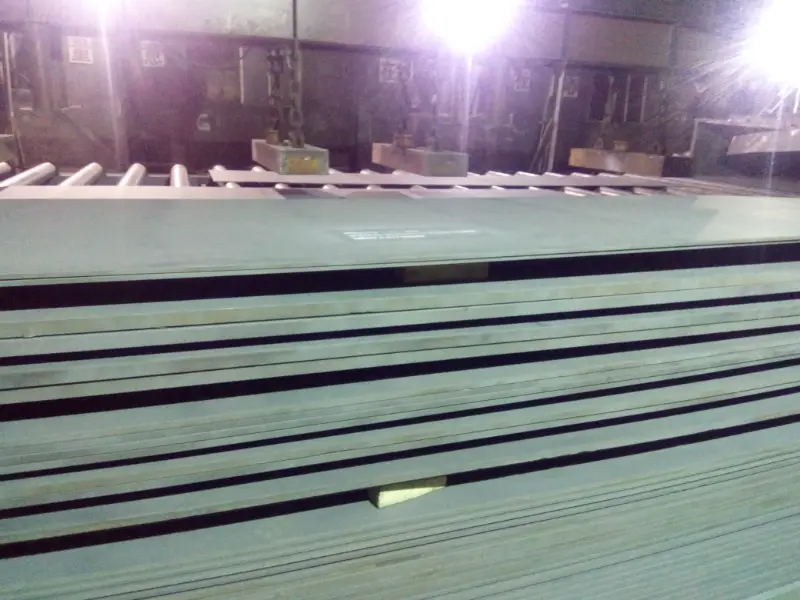
Austenitic 316L (S31603) Stainless Steel Plate/Coil
Austenitic 316L (S31603) Stainless Steel Plate/Coil: Low-Carbon, High-Corrosion Resistance for Critical Applications
Complete technical data for 316L (S31603) stainless steel plate and coil, including chemical composition, mechanical and physical properties, equivalent grades, and application guide.
Hot rolling, cold rolling, forming, welding, machining (with work-hardening considerations)
- Phone : +8618037372205
- Email : [email protected]
- WhatsApp: Contact via Whtsapp
- WeChat: +8618037372205
Austenitic 316L Stainless Steel Plate/Coil Introduction
Austenitic 316L (UNS S31603) stainless steel is a low-carbon (max 0.03%) molybdenum-bearing variant of 316, offering superior corrosion resistance, particularly against chlorides and other industrial solvents. It is non-hardenable by heat treatment and maintains excellent toughness even at cryogenic temperatures. The low carbon content minimizes carbide precipitation during welding, making it suitable for heavy-gauge welded components without post-weld annealing. It combines high strength, excellent formability, and good elevated-temperature properties.
Austenitic 316L Stainless Steel Plate/Coil Chemical Composition
The chemical composition of 316L is carefully controlled to achieve its low-carbon, molybdenum-enhanced corrosion resistance. Molybdenum (2.00–3.00%) provides increased resistance to pitting and crevice corrosion. Low carbon prevents sensitization. Values are ladle analysis per ASTM A240.
| Element | Standard Value | Remarks |
|---|---|---|
| Carbon (C) | ≤ 0.030 | Low carbon for improved as-welded corrosion resistance |
| Manganese (Mn) | ≤ 2.00 | - |
| Phosphorus (P) | ≤ 0.045 | - |
| Sulfur (S) | ≤ 0.030 | - |
| Silicon (Si) | ≤ 1.00 | Usually 0.50 nominal for flat products |
| Chromium (Cr) | 16.00 – 18.00 | Primary element for passivity |
| Nickel (Ni) | 10.00 – 14.00 | Stabilizes austenitic structure |
| Molybdenum (Mo) | 2.00 – 3.00 | Enhances chloride pitting resistance |
| Nitrogen (N) | ≤ 0.10 | - |
| Iron (Fe) | Balance | - |
Austenitic 316L Stainless Steel Plate/Coil Thermal and Electrical Physical Properties
Typical physical properties of 316L stainless steel at ambient and elevated temperatures. These values are representative for annealed material and assist in design and thermal analysis. Low thermal conductivity and high expansion coefficient must be considered in welding and thermal cycling applications.
| Property | Standard Value | Unit | Test Condition |
|---|---|---|---|
| Density (ρ) | 8.00 | g/cm³ | 20 °C |
| Modulus of Elasticity (E) | 193 | GPa | 20 °C |
| Shear Modulus (G) | 74 | GPa | 20 °C (calculated) |
| Poisson's Ratio (ν) | 0.29 – 0.30 | - | 20 °C |
| Coefficient of Thermal Expansion (α) | 16.5 | 10⁻⁶/K | 20 – 100 °C |
| Coefficient of Thermal Expansion (α) | 17.5 | 10⁻⁶/K | 20 – 300 °C |
| Coefficient of Thermal Expansion (α) | 18.5 | 10⁻⁶/K | 20 – 500 °C |
| Thermal Conductivity (λ) | 16.2 | W/m·K | 100 °C |
| Thermal Conductivity (λ) | 21.5 | W/m·K | 500 °C |
| Specific Heat Capacity (cp) | 500 | J/kg·K | 0 – 100 °C |
| Electrical Resistivity (ρe) | 0.74 | µΩ·m | 20 °C |
| Melting Range | 1370 – 1400 | °C | - |
| Magnetic Permeability | < 1.02 (essentially non-magnetic) | - | Annealed |
Austenitic 316L Stainless Steel Plate/Coil Mechanical Properties
Mechanical properties of 316L plate/coil at room temperature per ASTM A240. Values apply to solution-annealed condition. For thickness > 3/8 in. (9.53 mm), higher minimum yield strength applies. High ductility (elongation typically 40% or higher) allows severe forming operations.
| Property | Standard Requirement | Unit | Test Condition |
|---|---|---|---|
| Tensile Strength (Rm) | ≥ 485 (70) | MPa (ksi) | Ambient temperature, transverse specimen |
| Yield Strength (ReH, 0.2% offset) | ≥ 170 (25) | MPa (ksi) | Ambient temperature |
| Elongation (A, 2 in. or 50 mm) | ≥ 40 | % | Ambient temperature, standard gauge |
| Hardness | ≤ 217 HBW / ≤ 95 HRB | - | Annealed condition |
| Bend Test | Not normally required for A240 sheet/plate; formability is adequate | - | - |
| Impact Toughness (KV) | Not specified in ASTM A240; typical > 100 J at room temperature | J | Charpy V-notch (typical value) |
Austenitic 316L Stainless Steel Plate/Coil Complete Equivalent Material Standards and Substitute Grades
| Country/Region | Standard | Grade | Remarks |
|---|---|---|---|
| Europe | EN 10088-2/3 | 1.4404 (X2CrNiMo17-12-2) | Identical low-carbon Mo-bearing grade |
| Japan | JIS G4304/G4305 | SUS316L | Equivalent composition and properties |
| China | GB/T 3280, GB/T 4237 | 022Cr17Ni12Mo2 (S31603) | Direct equivalent |
| International | ISO 15510 | X2CrNiMo17-12-2 | Matches UNS S31603 |
| Russia | GOST 5632 | 03Ch17N14M3 (03Х17Н14М3) | Similar low-carbon Mo grade |
| Korea | KS D3698/D3705 | STS316L | Equivalent to SUS316L |
Austenitic 316L Stainless Steel Plate/Coil Application Introduction
316L stainless steel plate and coil are widely used where corrosion resistance, weldability, and formability are essential. The low carbon content excels in welded constructions. It is suitable for a broad range of corrosive media, including atmospheric, fresh water, and mild chemical environments. While resistant to many chlorides, it is not recommended for stagnant seawater or strong reducing acids.
Product Applications: Storage tanks and vessels, Heat exchanger plates and shells, Reactors and columns, Pharmaceutical processing equipment (CIP systems), Food preparation surfaces and conveyors, Architectural cladding and roofing, Condenser tubing and evaporators, Flue gas desulfurization components
Processed into products: Flanges, fittings, and valves, Welded pipes and tubes, Custom-fabricated pressure vessel parts, Agitators and mixers, Springs and fasteners (by cold working), Pump casings and impellers, Laboratory equipment and spatulas, Surgical instruments and orthopedic implants
Application industries: Chemical and Petrochemical Processing, Pharmaceutical and Biotechnology, Food and Beverage Processing, Marine and Offshore Engineering, Pulp and Paper Industry, Medical Device Manufacturing, Architectural and Construction, Heat Exchangers and Pressure Vessels
Austenitic 316L Stainless Steel Plate/Coil Similar/Alternative Materials Recommendation
| Country/Region | Standard | Grade | Remarks |
|---|---|---|---|
| USA | ASTM A240 | 316 (UNS S31600) | Higher carbon (0.08 max), risk of sensitization in welds |
| USA | ASTM A240 | 316Ti (UNS S31635) | Titanium stabilized for improved intergranular corrosion resistance |
| USA | ASTM A240 | 317L (UNS S31703) | Higher Mo (3.0-4.0) for superior corrosion resistance |
| Europe | EN 10088 | 1.4571 (X6CrNiMoTi17-12-2) | Ti-stabilized 316 variant |
| Europe | EN 10088 | 1.4438 (X2CrNiMo18-15-4) | Higher Ni and Mo for severe environments |
| Any | - | 904L (UNS N08904) | Superaustenitic, much higher Ni and Mo, excellent corrosion resistance |
Notes:
Additional notes: 316L must not be exposed to temperatures between 425°C and 860°C for prolonged periods to avoid embrittlement. For cryogenic applications, it retains excellent toughness down to -196°C. When machining, use sharp tools, adequate feeds, and coolant due to work-hardening behavior. Intergranular corrosion resistance is superior in the welded condition without annealing. Magnetic permeability can increase slightly after cold working.
- Share



