
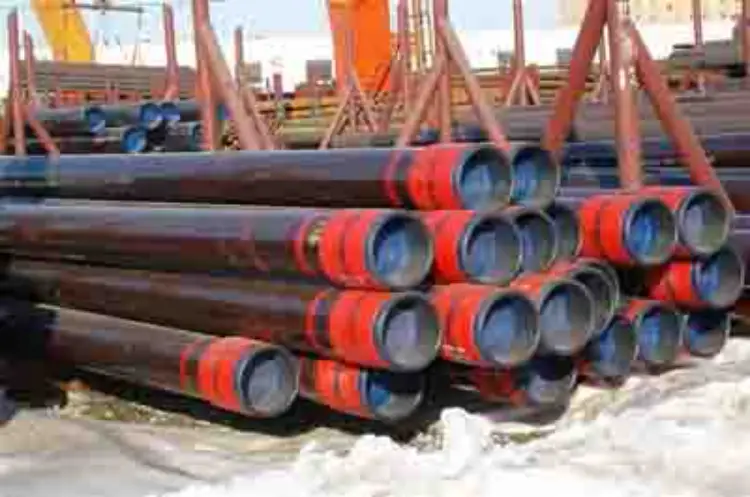
JIS G3459 SUS 321 HTP Stainless Steel Pipe
JIS G3459 SUS 321 HTP Stainless Steel Pipe – Properties, Equivalents & Applications
Complete material data for JIS G3459 SUS 321 HTP stainless steel pipe: chemistry, mechanical & thermal properties, international equivalents, similar grades, and application guide.
Welding, hot working, cold working, machining, bending, flaring
- Phone : +8618037372205
- Email : [email protected]
- WhatsApp: Contact via Whtsapp
- WeChat: +8618037372205
JIS G3459 SUS 321 HTP Stainless Steel Pipe Introduction
JIS G3459 SUS 321 HTP is a titanium-stabilized austenitic stainless steel pipe primarily used for high-temperature and corrosion-resistant applications. The 'HTP' designation typically refers to Heat Treated Pipe, indicating that the material is supplied in the solution-annealed condition for optimum ductility and intergranular corrosion resistance.
Belonging to the 18/8 Cr-Ni family, the addition of titanium (Ti ≥ 5 × C) prevents chromium carbide precipitation during welding or service at 425–850 °C, maintaining resistance to intergranular attack. This grade offers excellent weldability, good high-temperature strength, and resistance to oxidation up to approximately 800 °C.
Commonly used in chemical processing, heat exchangers, boiler tubes, and power generation, SUS 321 HTP complies with Japanese industrial standard JIS G3459 and is internationally recognized as an equivalent to ASTM A312 TP321 or EN 1.4541.
JIS G3459 SUS 321 HTP Stainless Steel Pipe Chemical Composition
The chemical requirements for JIS G3459 SUS 321 HTP are in accordance with JIS G3459 standards. Titanium is added at a minimum of five times the carbon content to stabilize the structure against intergranular corrosion. These limits apply to both heat and product analysis.
Typical residual elements are controlled to ensure full corrosion resistance and weldability.
| Chemical Element | Standard Value | Remarks |
|---|---|---|
| Carbon (C) | ≤0.08 % | Maximum |
| Silicon (Si) | ≤1.00 % | Maximum |
| Manganese (Mn) | ≤2.00 % | Maximum |
| Phosphorus (P) | ≤0.045 % | Maximum |
| Sulfur (S) | ≤0.030 % | Maximum |
| Chromium (Cr) | 17.00 – 19.00 % | Core element for corrosion resistance |
| Nickel (Ni) | 9.00 – 13.00 % | Stabilizes austenite |
| Titanium (Ti) | ≥ 5 × C % (typically ≤0.70 %) | Stabilizing element; excess Ti ensures TiC formation |
| Iron (Fe) | Balance | Remaining balance |
JIS G3459 SUS 321 HTP Stainless Steel Pipe Thermal and Electrical Physical Properties
The physical properties of SUS 321 HTP are typical for 18Cr-10Ni-Ti austenitic stainless steel and are valid for the solution-annealed condition. These values are not part of the mandatory JIS G3459 requirements but are essential for design in high-temperature service.
| Property | Standard Value | Unit | Test Condition / Remarks |
|---|---|---|---|
| Density (ρ) | 7.9 | g/cm³ | At 20 °C |
| Modulus of Elasticity (E) | 193 | GPa | At 20 °C |
| Shear Modulus (G) | 74 | GPa | Calculated from E and ν |
| Poisson's Ratio (ν) | 0.30 | — | At 20 °C |
| Thermal Expansion Coefficient (α) | 16.6 | 10⁻⁶/K | 20–100 °C |
| Thermal Expansion Coefficient (α) | 17.3 | 10⁻⁶/K | 20–300 °C |
| Thermal Expansion Coefficient (α) | 18.5 | 10⁻⁶/K | 20–500 °C |
| Thermal Conductivity (λ) | 16.3 | W/m·K | At 100 °C |
| Thermal Conductivity (λ) | 21.0 | W/m·K | At 500 °C |
| Specific Heat Capacity (cp) | 500 | J/kg·K | At 20 °C |
| Electrical Resistivity (ρe) | 720 | nΩ·m | At 20 °C |
JIS G3459 SUS 321 HTP Stainless Steel Pipe Mechanical Properties
The mechanical properties listed below are the minimum required values for JIS G3459 SUS 321 HTP pipes as per JIS G3459, unless otherwise noted. Tensile tests are performed on longitudinal specimens. Bend test is carried out only when specified. Hardness values are typical for the solution-annealed condition.
| Property | Standard Required Value | Unit | Test Condition / Remarks |
|---|---|---|---|
| Tensile Strength (Rm) | ≥520 | MPa | Room temperature, longitudinal strip or full section |
| Yield Strength (ReH, 0.2% offset) | ≥205 | MPa | Room temperature |
| Elongation (A) | ≥35 | % | Gauge length 50 mm, longitudinal; applies to OD≥10 mm, wall thickness <8 mm |
| Hardness (Brinell) | ≤187 | HBW | Typical for solution-annealed condition (not mandatory per G3459, reference only) |
| Hardness (Rockwell B) | ≤90 | HRB | Typical |
| Hardness (Vickers) | ≤200 | HV | Typical |
| Bend Test (Bend diameter) | No cracks at 2t | — | 180° bending, bend diameter = twice wall thickness (t), when required |
JIS G3459 SUS 321 HTP Stainless Steel Pipe Completely Equivalent Material Standards and Substitute Grades
| Country/Region | Standard | Grade | Remarks |
|---|---|---|---|
| Japan (origin) | JIS G3459 | SUS 321 HTP | Heat treated pipe, Ti-stabilized |
| USA | ASTM A312 / ASME SA312 | TP321 | Seamless/welded pipe for high-temperature service |
| Europe | EN 10216-5 | 1.4541 (X6CrNiTi18-10) | Seamless tube for pressure purposes |
| China | GB/T 14976 | 06Cr18Ni11Ti (new) / 0Cr18Ni10Ti (old) | Seamless stainless steel pipe |
| International | ISO 2604-2 | TS60 | Seamless tubes for pressure purposes |
| Russia | GOST 9941 | 08Х18Н10Т | Stainless steel seamless pipes |
| France (retired) | NF A49-217 | Z6CNT18-10 | Equivalent to 1.4541 |
JIS G3459 SUS 321 HTP Stainless Steel Pipe Application Introduction
SUS 321 HTP is engineered for demanding environments where elevated temperatures and corrosive conditions coexist. Its titanium stabilization makes it the material of choice for welded structures operating in the sensitization range (425–850 °C). The HTP heat treatment guarantees a homogeneous, fully softened microstructure that can withstand thermal cycling without premature failure.
- Excellent resistance to intergranular corrosion in as-welded condition.
- Good oxidation resistance in intermittent service up to 870 °C and continuous service up to 925 °C.
- HTP condition ensures stable mechanical properties after fabrication.
- Suitable for both shop and field welding using filler metals matching 321 or 347.
Product Applications: Seamless and welded pipes for high-temperature process lines, Heat exchanger tubes and U-bend tubes, Boiler and superheater coil sections, Expansion bellows and flexible connectors, Furnace and reformer tubes, High-pressure steam piping, Instrument tubing in corrosive environments
Processed into products: Heat exchanger tubesheets and baffles, Welded pipe spools and fabricated elbows, Thermowell protection tubes, Flanges and stub ends for high-temperature gaskets, Piping system reducers and tees, Pressure vessel nozzles, Gas turbine exhaust ducting
Application industries: Chemical & Petrochemical Processing, Oil & Gas (refinery piping, furnace tubes), Power Generation (boiler, superheater, reheater tubes), Heat Exchanger Manufacturing, Pharmaceutical & Food Processing (high-temperature CIP), Aerospace Ducting & Exhaust Systems, Thermal Solar Power Plants
JIS G3459 SUS 321 HTP Stainless Steel Pipe Similar / Alternative Material Grades for Comparison
| Country/Region | Standard | Grade | Remarks |
|---|---|---|---|
| Japan | JIS G3459 | SUS 304 TP | Basic 18-8 stainless, no Ti; lower IGC resistance; less suitable for welded high-temp service |
| Japan | JIS G3459 | SUS 316 TP | 18-12-Mo stainless, better pitting/crevice corrosion resistance; no Ti stabilization |
| Japan | JIS G3459 | SUS 347 TP | Stabilized with Nb+Ta; similar IGC resistance; 347 often used interchangeably with 321 |
| Japan | JIS G3459 | SUS 321H TP | Higher carbon (0.04–0.10) version; enhanced high-temperature strength above 500 °C |
| USA | ASTM A312 | TP304 / TP304L | Non-stabilized; L-grade has extra-low carbon for weldability |
| Europe | EN 10216-5 | 1.4301 (X5CrNi18-10) | Standard 304; not stabilized, cheaper but risk of sensitization |
Notes:
Heat treatment: Solution annealing is typically performed at 1010–1150 °C followed by rapid quenching in water or air. HTP signifies that the pipe has been properly heat treated and can be used directly in high-temperature service.
Welding: No post-weld heat treatment is generally required for full corrosion resistance because Ti stabilizes the structure. If stress relief is needed, heat at 850–900 °C, hold, and air cool.
Non-standard requirements: Additional tests such as intergranular corrosion (e.g., ASTM A262 Practice E), ultrasonic examination, and eddy current testing may be specified by the purchaser.
Sensitization note: Long-term exposure between 500 and 850 °C may eventually cause sigma-phase embrittlement; design should consider this for extended service at 600–800 °C.
- Share



