
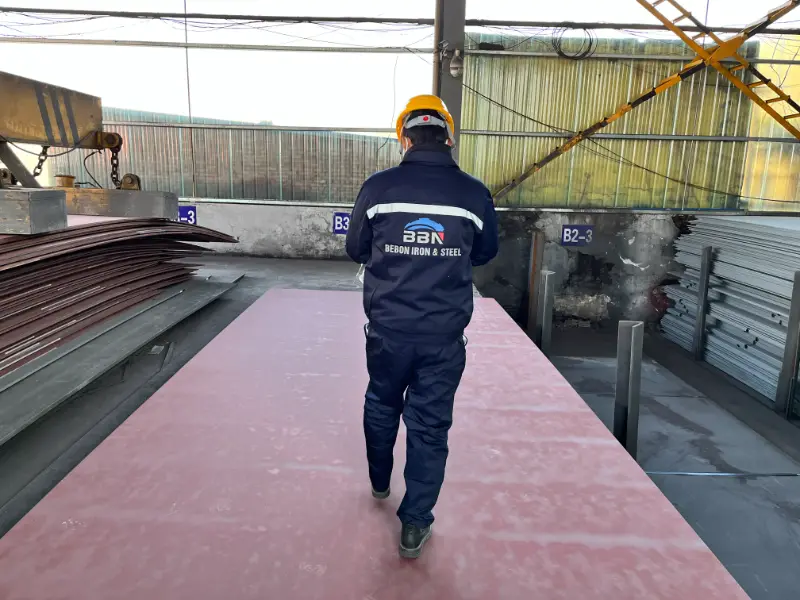
Austenitic 310HCb (S31041) Stainless Steel Plate/Coil
Austenitic 310HCb (S31041) Stainless Steel Plate/Coil - High-Temperature Heat-Resistant Alloy
Comprehensive material data sheet for austenitic 310HCb (UNS S31041) stainless steel plate and coil, including chemical composition, mechanical properties, thermal properties, and application guide.
Hot rolled, cold rolled, solution annealed, pickled, skin pass
- Phone : +8618037372205
- Email : [email protected]
- WhatsApp: Contact via Whtsapp
- WeChat: +8618037372205
Austenitic 310HCb Stainless Steel Plate/Coil Introduction
UNS S31041, commonly known as 310HCb, is a high-carbon, niobium-stabilized austenitic stainless steel designed for elevated-temperature service. It offers excellent oxidation resistance up to 2000°F (1093°C) and superior creep strength compared to standard 310S. The niobium addition provides stabilization against sensitization and intergranular corrosion in the 800–1500°F (425–815°C) range. This grade is supplied in the solution-annealed condition per ASTM A240/A240M, making it ideal for furnace components, radiant tubes, and heat treatment equipment. Typical applications include burner nozzles, retorts, muffles, and structural parts exposed to cyclic heating.
Austenitic 310HCb Stainless Steel Plate/Coil Chemical Composition
Chemical composition as specified in ASTM A240/A240M for 310HCb (S31041).
- Niobium (Columbium) content is controlled between 10×C min and 1.10% max to provide stabilization.
- All values are weight percent maximum unless a range is indicated.
| Element | Specified Value (%) | Notes |
|---|---|---|
| Carbon (C) | 0.04 – 0.10 | |
| Manganese (Mn) | ≤ 2.00 | |
| Phosphorus (P) | ≤ 0.045 | |
| Sulfur (S) | ≤ 0.030 | |
| Silicon (Si) | ≤ 0.75 | |
| Chromium (Cr) | 24.0 – 26.0 | |
| Nickel (Ni) | 19.0 – 22.0 | |
| Niobium (Nb/Cb) | 10×C min – 1.10 max | Stabilizing addition |
Austenitic 310HCb Stainless Steel Plate/Coil Thermal and Electrical Physical Properties
Typical physical properties at room temperature unless otherwise stated. These values are representative for 310HCb and closely match stabilized 310S grades.
- Density may vary slightly with actual composition.
- Thermal expansion and conductivity are essential for high-temperature design and life assessment.
| Property | Value | Unit | Condition |
|---|---|---|---|
| Density (ρ) | 8.0 | g/cm³ | 20°C |
| Modulus of Elasticity (E) | 200 | GPa | 20°C |
| Shear Modulus (G) | 77 | GPa | 20°C |
| Poisson's Ratio (ν) | 0.30 | – | 20°C |
| Coefficient of Thermal Expansion (α) | 16.0 | 10⁻⁶/°C | 20–100°C |
| Coefficient of Thermal Expansion (α) | 17.8 | 10⁻⁶/°C | 20–600°C |
| Coefficient of Thermal Expansion (α) | 18.5 | 10⁻⁶/°C | 20–1000°C |
| Thermal Conductivity (λ) | 14.2 | W/m·K | 100°C |
| Thermal Conductivity (λ) | 21.5 | W/m·K | 500°C |
| Specific Heat Capacity (c) | 500 | J/kg·K | 20°C |
| Electrical Resistivity (ρ_e) | 0.85 | μΩ·m | 20°C |
Austenitic 310HCb Stainless Steel Plate/Coil Mechanical Properties
Minimum mechanical properties at room temperature in solution-annealed condition, per ASTM A240/A240M.
- Yield strength is determined by 0.2% offset method.
- Elongation requirements vary with thickness; values below apply to standard plate/coil products.
| Property | Value (min) | Unit | Condition/Notes |
|---|---|---|---|
| Yield Strength (ReH, 0.2% offset) | 205 | MPa | annealed |
| Tensile Strength (Rm) | 515 | MPa | annealed |
| Elongation (A) in 50 mm (2 in.) | 40 | % | Thickness ≤ 19.0 mm (0.75 in.) |
| Elongation (A) in 50 mm (2 in.) | 35 | % | Thickness > 19.0 mm (0.75 in.) |
Austenitic 310HCb Stainless Steel Plate/Coil Fully Equivalent Material Standards and Substitute Grades
| Country/Region | Standard | Grade | Notes |
|---|---|---|---|
| USA | ASTM A240/A240M | 310HCb (UNS S31041) | Original plate/sheet/strip standard |
| USA | ASME SA-240 | 310HCb (UNS S31041) | Pressure vessel and boiler code |
| Universal | UNS | S31041 | Unified numbering system identifier |
Austenitic 310HCb Stainless Steel Plate/Coil Application Introduction
310HCb is optimally suited for long-term high-temperature service in oxidizing or mildly reducing atmospheres. It is widely fabricated into components for heat-treatment, petrochemical, and power generation industries. The niobium stabilization permits exposure in the carbide precipitation range without intergranular attack, enabling reliable operation in equipment that cycles through critical temperatures.
Product Applications: Furnace radiant tubes and muffles, Heat treatment baskets, trays, and fixtures, Burner nozzles and combustion chambers, Retorts and annealing boxes, Reformer tubes and pigtails
Processed into products: Plate/coil fabricated into ducts, boxes, and vessels, Rolled and welded tubular components, Press-formed burner heads, Laser-cut heat-resistant parts, Custom machined high-temperature fixtures
Application industries: Petrochemical & Refining, Heat Treatment & Furnace Construction, Power Generation, Chemical Processing, Automotive (exhaust systems)
Austenitic 310HCb Stainless Steel Plate/Coil Similar/Alternative Materials
| Country/Region | Standard | Grade | Notes |
|---|---|---|---|
| USA | ASTM A240/A240M | 310S (UNS S31008) | Lower carbon, no Nb stabilization. Comparable oxidation resistance but reduced creep strength. Adequate for moderate high-temperature service. |
| Europe | EN 10095 / 10028-7 | X8CrNi25-21 (1.4845) | Identical Cr-Ni base without Nb. Susceptible to sensitization in the 425–815°C range. Assess before substitution. |
| USA | ASTM A240/A240M | 347H (UNS S34709) | Nb-stabilized with 18Cr-10Ni chemistry. Higher strength and lower oxidation resistance; maximum service temperature ~816°C (1500°F). |
Notes:
- Welding: Use ER310 or E310Cb filler metals. Post-weld heat treatment is optional; solution annealing restores optimum corrosion resistance.
- Forming: Good formability in annealed condition; cold working raises strength and may necessitate intermediate annealing.
- Scaling temperature: Continuous service up to 2000°F (1093°C) in oxidizing environments.
- Corrosion: Resistant to many sulfur-containing gases, but not recommended for highly carburizing or nitriding atmospheres without protective measures.
- Share



