
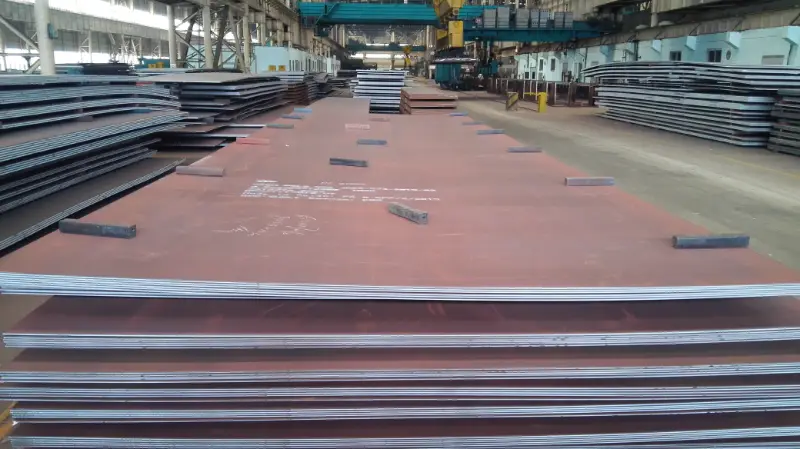
LR FH50 Shipbuilding Steel
LR FH50 Shipbuilding Steel: High-Strength -60°C Impact Toughness for Arctic Hull Structures
Comprehensive data sheet for LR FH50 shipbuilding steel coil: chemical composition, mechanical properties, thermal and electrical physical properties, equivalent grades, and application guidance for ship hulls and offshore structures.
Hot rolling, TMCP, normalizing, welding, cutting, forming
- Phone : +8618037372205
- Email : [email protected]
- WhatsApp: Contact via Whtsapp
- WeChat: +8618037372205
LR FH50 Shipbuilding Steel Introduction
LR FH50 is a high-strength shipbuilding structural steel grade certified by Lloyd's Register, designed for critical welded structures in ship hulls and offshore engineering. It offers a minimum yield strength of 490 MPa and guaranteed impact toughness down to -60°C, making it suitable for Arctic and cold-climate service. The steel is typically supplied in normalized or thermo-mechanically controlled processed (TMCP) condition, with excellent weldability and formability. Key characteristics include fine grain structure, low carbon equivalent, and compliance with IACS unified requirements for extra high-strength steels.
LR FH50 Shipbuilding Steel Chemical Composition
The chemical composition of LR FH50 is designed to achieve high strength and excellent low-temperature toughness while maintaining good weldability. Key alloying elements such as manganese, niobium, vanadium, and titanium are used for grain refinement and precipitation strengthening. Maximum limits are specified for residuals to prevent detrimental effects on weldability and toughness.
- Typical ladle analysis based on LR/IACS specifications and steel mill practices.
- Carbon equivalent (Ceq) is typically controlled below 0.43% for improved weldability.
| Element | Standard Value (%) | Remarks |
|---|---|---|
| C (Carbon) | ≤ 0.18 | max |
| Si (Silicon) | ≤ 0.55 | max |
| Mn (Manganese) | 1.00 – 1.60 | range |
| P (Phosphorus) | ≤ 0.025 | max |
| S (Sulfur) | ≤ 0.020 | max |
| Cr (Chromium) | ≤ 0.20 | residual |
| Ni (Nickel) | ≤ 0.40 | residual |
| Mo (Molybdenum) | ≤ 0.08 | residual |
| Cu (Copper) | ≤ 0.35 | residual |
| Nb (Niobium) | 0.02 – 0.05 | microalloy |
| V (Vanadium) | 0.05 – 0.10 | microalloy |
| Ti (Titanium) | ≤ 0.02 | microalloy |
| Al (Aluminum) total | ≥ 0.015 | min, acid-soluble |
| N (Nitrogen) | ≤ 0.012 | max |
| Ceq (IIW) | ≤ 0.43 (typical) | C + Mn/6 + (Cr+Mo+V)/5 + (Ni+Cu)/15 |
LR FH50 Shipbuilding Steel Thermal and Electrical Physical Properties
Physical properties are typical for low-alloy structural steels and depend on composition and heat treatment. Values are provided at room temperature unless specified otherwise. These data are representative for engineering calculations and are not mandatory in the standard.
| Property | Typical Value | Unit | Test Condition |
|---|---|---|---|
| Density (ρ) | 7.85 | g/cm³ | 20°C |
| Young's modulus (E) | 205 – 210 | GPa | 20°C |
| Shear modulus (G) | 79 – 81 | GPa | 20°C, estimated from E and ν |
| Poisson's ratio (ν) | 0.29 – 0.30 | — | 20°C |
| Thermal expansion (α) | 11.5 – 12.5 | 10⁻⁶/K | 20 – 200°C |
| Thermal expansion (α) | 12.5 – 13.5 | 10⁻⁶/K | 20 – 400°C |
| Thermal conductivity (λ) | 42 – 48 | W/(m·K) | 20°C |
| Specific heat capacity | 460 – 500 | J/(kg·K) | 20°C |
| Electrical resistivity (ρ_e) | 0.20 – 0.25 | μΩ·m | 20°C |
LR FH50 Shipbuilding Steel Mechanical Properties
Mechanical properties are determined on transverse test pieces unless otherwise agreed. The minimum values correspond to LR/IACS requirements for FH50 grade in delivery condition (N or TMCP). Thickness range typically up to 100 mm for plates.
- Yield strength: minimum 490 MPa for thickness ≤ 100 mm.
- Tensile strength: 570-720 MPa.
- Elongation varies with specimen type (gauge length 5.65√S₀).
- Charpy V-notch impact test at -60°C: min 33 J longitudinal, 22 J transverse.
| Property | Standard Value | Unit | Test Condition |
|---|---|---|---|
| Yield strength (ReH) | ≥ 490 | MPa | Ambient temperature, thickness ≤ 100 mm |
| Tensile strength (Rm) | 570 – 720 | MPa | Ambient temperature |
| Elongation (A) | ≥ 18 (longitudinal) | % | Gauge length 5.65√S₀ |
| Elongation (A) | ≥ 16 (transverse) | % | Gauge length 5.65√S₀ |
| Charpy impact (KV) longitudinal | ≥ 33 | J | -60°C |
| Charpy impact (KV) transverse | ≥ 22 | J | -60°C |
| Bend test (diameter) | 3t for t ≤ 25 mm; 4t for t > 25 mm | — | 180° bending, no cracks |
LR FH50 Shipbuilding Steel Completely Equivalent Material Standards and Substitute Grades
| Country / Region | Standard | Grade | Remarks |
|---|---|---|---|
| International (IACS) | IACS UR W11 | FH51 (equivalent to 50 kg/mm²) | Minor strength tolerance; 51 kg/mm² grade covers 490 MPa |
| USA | ABS Rules | FH50 | Practically identical requirements |
| Norway/Germany | DNV Rules | FH50 | Same chemical and mechanical limits |
| France | BV Rules | FH50 | Same grade designation |
| China | CCS Rules | FH50 | China Classification Society |
| Japan | NK Rules | FH50 | Nippon Kaiji Kyokai |
| South Korea | KR Rules | FH50 | Korean Register |
| Italy | RINA Rules | FH50 | Registro Italiano Navale |
LR FH50 Shipbuilding Steel Application Introduction
LR FH50 is predominantly used in shipbuilding and offshore constructions where high strength and reliable low-temperature impact resistance are mandatory. It is particularly suited for ice-class vessels and structures operating in polar environments. The steel can be fabricated by conventional welding and cutting processes.
- Approved for main structural members such as shell plating, strength decks, and bottom longitudinals.
- Recommended welding consumables: low-hydrogen electrodes matching the strength level (e.g., AWS E11018M).
- Preheating may be required for thick sections; typical preheat temperature 75–125°C.
Product Applications: Hull plates and coils for shell, deck, and bottom structures, Longitudinal and transverse bulkheads, Web frames and stiffeners, Deck girders and hatch coamings, Offshore module support beams
Processed into products: Ice belt plating for Arctic vessels, Rudder horns and shaft brackets, Bilge keels, Heavy-duty foundation plates for engines and winches, Hull inserts under high stress concentration zones
Application industries: Shipbuilding (ice-class ships, LNG carriers, container ships), Offshore engineering (platforms, FPSO modules), Marine construction (heavy-lift crane vessels, dredgers), Polar equipment and structural components
LR FH50 Shipbuilding Steel Similar / Alternative Substitute Materials
| Country / Region | Standard | Grade | Remarks |
|---|---|---|---|
| International | IACS | EH50 | Identical strength but impact test at -40°C; less Arctic toughness |
| International | IACS | FH47 | Lower yield strength (460 MPa); similar -60°C toughness |
| International | IACS | FH36 | Lower strength (355 MPa) but outstanding toughness; used for less stressed hull parts |
| Europe | EN 10025-6 | S500QL | Quenched and tempered steel with 500 MPa yield and -60°C impact option; not certified for shipbuilding unless approved |
| Japan | JIS G 3106 | SM570 | 590 MPa tensile class; normalised; comparable strength but requires special approval for hull use |
Notes:
- FH50 is the designation from Lloyd's Register; other classification societies maintain identical requirements under the same grade name.
- For thicknesses above 50 mm, special agreement on properties may be required.
- Supplementary ultrasonic testing according to EN 10160 or ASTM A578 is often specified for critical applications.
- When ordering, the delivery condition (N or TMCP) and any supplementary requirements (e.g., Z-direction properties, through-thickness testing) must be clearly indicated.
- Share



