
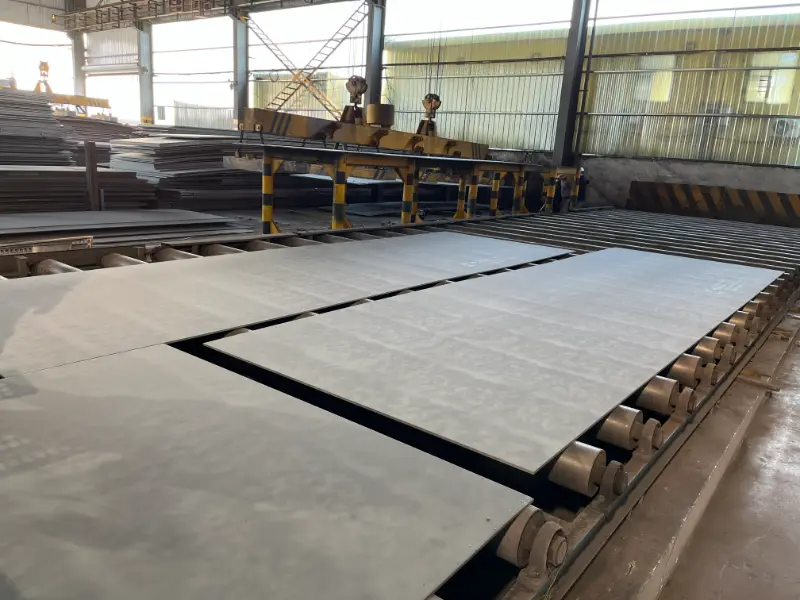
Austenitic 309HCb (S30941) Stainless Steel
Austenitic 309HCb (S30941) Stainless Steel Data Sheet: Chemistry, Properties & Equivalents
Comprehensive technical data for 309HCb (UNS S30941) stainless steel: chemical composition, mechanical and physical properties, international equivalents, similar grades, and application guide.
Hot rolling, cold rolling, solution annealing, welding, forming
- Phone : +8618037372205
- Email : [email protected]
- WhatsApp: Contact via Whtsapp
- WeChat: +8618037372205
Austenitic 309HCb Stainless Steel Introduction
309HCb (UNS S30941) is a niobium-stabilized austenitic chromium-nickel stainless steel designed for elevated-temperature service. The addition of niobium (columbium) minimizes carbide precipitation during welding or high-temperature exposure, improving intergranular corrosion resistance and creep strength compared to standard 309 grades. It offers excellent oxidation resistance up to approximately 1000°C (1832°F) and good resistance to sulfur-containing atmospheres. Typical applications include furnace components, heat exchangers, and chemical processing equipment. It is supplied as plate, sheet, and coil in the solution-annealed condition.
Austenitic 309HCb Stainless Steel Chemical Composition
As per ASTM A240/A240M for UNS S30941 (309HCb). Single values are maximum unless a range is given. The niobium content is tied to carbon to ensure stabilization, typically Nb ≥ 10×C up to 1.10%.
| Element | Standard Value | Remarks |
|---|---|---|
| Carbon (C) | 0.04 - 0.10 | |
| Manganese (Mn) | max 2.00 | |
| Silicon (Si) | max 1.00 | |
| Phosphorus (P) | max 0.045 | |
| Sulfur (S) | max 0.030 | |
| Chromium (Cr) | 22.0 - 24.0 | |
| Nickel (Ni) | 12.0 - 15.0 | |
| Columbium (Cb) / Niobium (Nb) | 10×C min / max 1.10 | Stabilization element |
| Iron (Fe) | Balance |
Austenitic 309HCb Stainless Steel Physical Properties
Typical data for 309HCb in the annealed condition. Physical properties may vary slightly with processing. These values are representative for design calculations, based on published data for the 309 family and Nb-stabilized grades.
| Property | Typical Value | Unit | Test Conditions |
|---|---|---|---|
| Density (ρ) | 7.9 | g/cm³ | 20°C |
| Elastic Modulus (E) | 193 | GPa | 20°C |
| Shear Modulus (G) | 77 | GPa | 20°C |
| Poisson's Ratio (ν) | 0.28 | - | 20°C |
| Thermal Expansion (α) | 14.9 | µm/m·K | 20 – 100°C |
| Thermal Expansion (α) | 17.3 | µm/m·K | 20 – 500°C |
| Thermal Expansion (α) | 18.7 | µm/m·K | 20 – 1000°C |
| Thermal Conductivity (λ) | 15.6 | W/m·K | 100°C |
| Thermal Conductivity (λ) | 21.5 | W/m·K | 500°C |
| Specific Heat Capacity (c) | 500 | J/kg·K | 20°C |
| Electrical Resistivity (ρe) | 0.78 | µΩ·m | 20°C |
Austenitic 309HCb Stainless Steel Mechanical Properties
Minimum requirements per ASTM A240 for plates, sheets and strips in solution-annealed condition. These values reflect the room-temperature tensile and hardness requirements. Bend testing is applicable for cold forming evaluation.
| Property | Standard Requirement | Unit | Test Conditions |
|---|---|---|---|
| Tensile Strength (Rm) | min 515 | MPa | Ambient |
| Yield Strength (ReH, 0.2% offset) | min 205 | MPa | Ambient |
| Elongation (A) | min 30 | % | Gauge length 50 mm (2 in.) |
| Hardness | max 95 HRB / 217 HBW | - | Ambient |
| Bend Test (cold) | 180° bend, d = t (t ≤ 19 mm) | - | No cracks required |
Austenitic 309HCb Stainless Steel Directly Equivalent Material Standards and Substitute Grades
| Country / Region | Standard | Designation | Remarks |
|---|---|---|---|
| USA | ASTM A240/A240M | 309HCb (UNS S30941) | Primary standard for plate/coil |
| Europe | EN 10088-2 | X8CrNiNb23-13 (1.4872) | Equivalent chemistry; C max 0.08 slightly lower |
| International | ISO 15510 | X8CrNiNb23-13 | Thermodynamically equivalent |
| Japan (JIS) | JIS G4304/G4305 | SUS309Nb (UNS S30940) | Chemistry very close, C max 0.08 |
Austenitic 309HCb Stainless Steel Application Introduction
309HCb is specially designed for applications requiring high-temperature oxidation resistance, intergranular corrosion resistance after welding or thermal cycling, and good structural stability. It is widely used in industrial heating, power generation, and petrochemical sectors due to its niobium stabilization which preserves corrosion resistance in the heat-affected zone. Typical service temperatures reach 1000°C (1832°F) under oxidizing conditions. It should be solution annealed after heavy forming to restore optimum properties.
Product Applications: Furnace muffles, retorts, and radiant tubes, Heat exchanger plates and tube sheets, Boxes, baskets, and trays for heat treating, Kiln liners and burners, Catalytic converter shells, Oil refinery heater tubes and hangers
Processed into products: Welded pressure vessel components, High-temperature ducting and expansion joints, Thermocouple protection tubes, Burner tips and flame arrestors, Support structures in annealing furnaces, Tube hangers and supports for fired heaters
Application industries: Petrochemical and refining, Power generation (boilers, superheaters), Industrial furnace construction, Chemical processing equipment, Automotive (exhaust systems, thermal management), Waste incineration and pollution control
Austenitic 309HCb Stainless Steel Similar / Near-Equivalent Materials for Reference
| Country / Region | Standard | Designation | Remarks |
|---|---|---|---|
| USA | ASTM A240 | 309S (UNS S30908) | Without Nb; lower high-temperature strength |
| USA | ASTM A240 | 309 (UNS S30900) | Higher carbon; less stabilization |
| Europe | EN 10088-2 | 1.4833 (X12CrNi23-13) | Similar base composition without Nb |
| China | GB/T 4237 | 12Cr23Ni13 (1.4833 equivalent) | No Nb; lower creep resistance |
Notes:
This grade may be supplied with additional testing per customer requirements, including intergranular corrosion testing (e.g., ASTM A262 Practice E), high-temperature tensile tests, or ultrasonic examination. Welding: Use ER309 or ER309Nb filler metals, ensuring sufficient Nb to maintain stabilization. Post-weld heat treatment is not usually required, but solution annealing can be applied to restore full corrosion resistance if service conditions demand. Forming: Good ductility allows bending, deep drawing, and spinning; however, higher strength than plain 304 requires increased forming forces. All data based on published ASTM specifications and typical producer data; verify for critical applications.
- Share



