
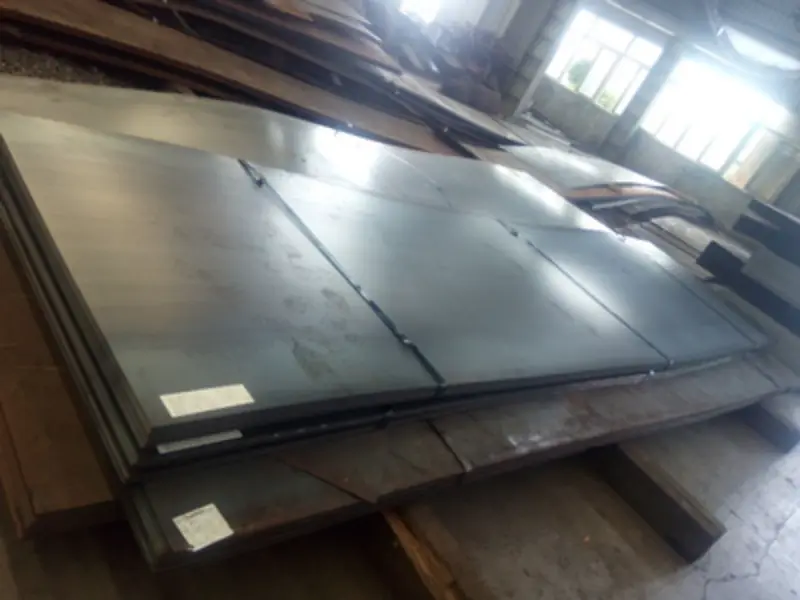
ASTM A240 410S (S41008) Stainless Steel
ASTM A240 410S (UNS S41008) Stainless Steel Pipe: Low-Carbon Weldable Martensitic Steel
Explore the properties of ASTM A240 410S (S41008) stainless steel pipe, a low-carbon 13% Cr martensitic alloy offering good corrosion resistance and excellent weldability in the annealed condition. Ideal for petrochemical, automotive and structural applications.
Hot rolling, cold rolling, annealing, pickling, welding, bending, forming
- Phone : +8618037372205
- Email : [email protected]
- WhatsApp: Contact via Whtsapp
- WeChat: +8618037372205
ASTM A240 410S Stainless Steel Introduction
ASTM A240 410S (UNS S41008) is a low-carbon modification of the standard Type 410 martensitic stainless steel. The reduced carbon content (≤0.08%) minimizes the formation of austenite at elevated temperatures, resulting in a predominantly ferritic microstructure after annealing and preventing air-hardening during welding. This makes 410S highly weldable without preheating or post-weld heat treatment for many applications. It combines good corrosion resistance in mild environments, moderate strength, and excellent ductility. 410S is commonly supplied as plate, sheet, strip, and pipe, and is used where a combination of weldability, oxidation resistance (up to 705°C / 1300°F), and corrosion resistance is required.
ASTM A240 410S Stainless Steel Chemical Composition
The chemical composition of ASTM A240 410S conforms to the requirements for UNS S41008. Stringent control of carbon ensures a microstructure that is predominantly ferritic in the annealed condition, preventing hardening during cooling after welding. The chromium content provides corrosion and oxidation resistance.
| Element | Standard Value (%) | Remarks |
|---|---|---|
| Carbon (C) | ≤ 0.08 | Low carbon avoids martensite formation during weld cooling |
| Manganese (Mn) | ≤ 1.00 | Deoxidizer and strength contributor |
| Phosphorus (P) | ≤ 0.040 | Impurity control |
| Sulfur (S) | ≤ 0.030 | Improves machinability but controlled for toughness |
| Silicon (Si) | ≤ 1.00 | Deoxidizer, enhances oxidation resistance |
| Chromium (Cr) | 11.5 – 13.5 | Primary element for corrosion and oxidation resistance |
| Nickel (Ni) | ≤ 0.60 | Residual, limited to maintain ferritic nature |
ASTM A240 410S Stainless Steel Thermal and Electrical Properties
The following physical properties are typical for ASTM A240 410S in the annealed condition. These values are not mandated by the standard but are representative data useful for engineering calculations. They can vary slightly based on exact composition and processing.
| Property | Typical Value | Unit | Test Condition / Remarks |
|---|---|---|---|
| Density (ρ) | 7.7 | g/cm³ | Room temperature |
| Modulus of Elasticity (E) | 200 | GPa | Room temperature, tension |
| Shear Modulus (G) | 77 | GPa | Estimated from E and Poisson's ratio |
| Poisson's Ratio (ν) | 0.27 – 0.30 | - | Room temperature |
| Thermal Expansion Coefficient (α) | 10.0 | µm/m·°C | 20–100 °C average |
| Thermal Expansion Coefficient (α) | 10.5 | µm/m·°C | 20–300 °C average |
| Thermal Expansion Coefficient (α) | 11.0 | µm/m·°C | 20–500 °C average |
| Thermal Conductivity (λ) | 25.0 | W/m·K | at 100 °C |
| Thermal Conductivity (λ) | 26.0 | W/m·K | at 500 °C |
| Specific Heat Capacity | 460 | J/kg·K | 0–100 °C |
| Electrical Resistivity (ρ_e) | 0.57 | µΩ·m | Room temperature |
ASTM A240 410S Stainless Steel Mechanical Properties
The mechanical properties are required by ASTM A240 for plate, sheet, and strip in the annealed condition. The low carbon content results in moderate strength with excellent ductility. These values apply to room temperature tensile testing; hardness is not a mandatory requirement but is commonly specified.
| Property | Standard Requirement | Unit | Test Condition |
|---|---|---|---|
| Tensile Strength (Rm) | ≥ 415 | MPa | Transverse or longitudinal, room temperature |
| Yield Strength (ReH) 0.2% offset | ≥ 205 | MPa | Transverse or longitudinal, room temperature |
| Elongation (A) in 50 mm (2 in.) | ≥ 20 | % | Gauge length 50 mm, room temperature |
| Elongation (A) in 50 mm (2 in.) | ≥ 22 | % | For strip < 0.050 in. (1.27 mm), longitudinal only |
| Rockwell Hardness (HRB) | ≤ 95 | - | Typical maximum for annealed product |
| Brinell Hardness (HB) | ≤ 217 | - | Typical maximum for annealed product |
| Bend Test (for plate, sheet, strip) | 180°, no cracks | - | Diameter = thickness (for thickness ≤ 1 in.) |
ASTM A240 410S Stainless Steel Completely Equivalent Material Standards and Replacement Grades
| Country/Region | Standard | Grade | Remarks |
|---|---|---|---|
| Europe | EN 10088-2 / EN 10088-3 | 1.4000 (X6Cr13) | Identical chemistry (C ≤0.08, Cr 12.0-14.0); fully interchangeable with 410S |
| Japan | JIS G4304 / G4305 | SUS 410S | Same chemistry limits and mechanical properties as ASTM 410S |
| China | GB/T 3280 / GB/T 4237 | 06Cr13 (S11306) | Equivalent to 410S; C ≤0.08, Cr 11.5-13.5 |
| International | ISO 15510 | X6Cr13 | Chemically identical to 1.4000 and 410S |
| USA | UNS | S41008 | Standard UNS designation for 410S |
ASTM A240 410S Stainless Steel Application Introduction
ASTM A240 410S is selected for applications requiring a weldable, oxidation-resistant, and corrosion-resistant material in mildly aggressive environments. Its ferritic nature after annealing eliminates the risk of hydrogen embrittlement commonly associated with high-strength martensitic steels.
- Key selection drivers: Good ductility and formability in the annealed condition, excellent weldability without preheating, moderate corrosion resistance, continuous service up to 705°C.
- Limitations: Not suitable for highly corrosive media (e.g., chlorides, strong acids); cannot be hardened by heat treatment.
Product Applications: Welded and seamless pipes for corrosive fluid transport, Heat exchanger tubes and tube sheets, Pressure vessel plates and heads, Furnace muffles, radiant tubes, and hardware, Automotive catalytic converter shells and exhaust tubing, Structural sections in corrosive atmospheres (e.g., handrails, grating)
Processed into products: Fractionating tower trays and valve parts, Annealing boxes and quenching fixtures, Automotive exhaust flanges and exhaust manifolds (non-severe service), Turbine blades (for steam and gas turbines in low-stress areas), Chemical storage tank linings and low-pressure vessels, Expansion joints and bellows, Valve stems and seats (for moderate corrosion service), Radiant heating elements and burner components
Application industries: Petrochemical and oil refining (tubes, liners, fractionating trays), Automotive (exhaust systems, thermal reactors, sensor bodies), Industrial furnaces and heat treatment (annealing boxes, quench racks, burner nozzles), Power generation (turbine blades, steam valve components), Food processing (conveyor parts, storage vessels for mildly corrosive products), Pharmaceutical equipment (non-critical components)
ASTM A240 410S Stainless Steel Similar / Alternative Materials with Comparable Performance
| Country/Region | Standard | Grade | Remarks |
|---|---|---|---|
| USA | ASTM A240 | Type 410 (S41000) | Higher carbon (≤0.15%) enables hardening; lower weldability, requires preheating and PWHT |
| USA | ASTM A240 | Type 430 (S43000) | Ferritic, 16-18% Cr, better corrosion resistance but lower toughness; non-hardenable |
| USA | ASTM A240 | Type 409 (S40900) | Lower Cr (10.5-11.75%), titanium stabilized; mainly for automotive exhaust, lower cost |
| Europe | EN 10088-2 | 1.4003 (X2CrNi12) | Weldable 12% Cr steel with improved toughness; higher weldability and corrosion resistance than 410S |
| Europe | EN 10088-2 | 1.4512 (X2CrTi12) | Ti-stabilized ferritic, similar to 409; use for deep drawing and exhaust applications |
Notes:
410S is not hardenable by conventional heat treatment due to its low carbon content; attempts to harden through quenching may result in unwanted martensite only at higher carbon levels. For improved pitting corrosion resistance in chloride environments, consider upgrading to Type 430 or duplex stainless steels. When processing, avoid prolonged exposure to 400–550°C range to prevent 475°C embrittlement typical for ferritic grades. All data are based on ASTM A240/A240M and publicly available technical references; no proprietary or unverified parameters are included.
- Share



