
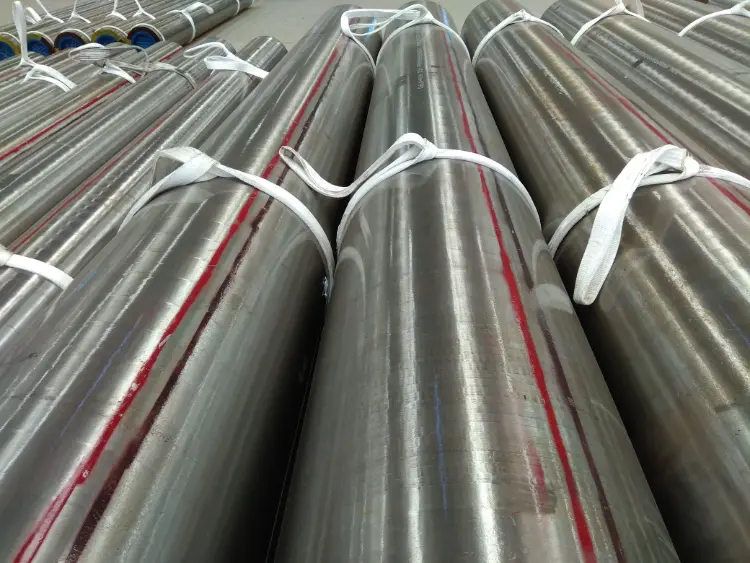
ASTM A789 S32205 Stainless Steel Pipe
ASTM A789 S32205 Stainless Steel Pipe: Comprehensive Material Data & Analysis
In-depth analysis of ASTM A789 S32205 duplex stainless steel pipes, including chemical composition, mechanical and physical properties, international equivalents, and application guidance.
Hot forming, cold forming, welding (GTAW, GMAW, PAW, SMAW), machining (with carbide tools), solution annealing followed by rapid quenching
- Phone : +8618037372205
- Email : [email protected]
- WhatsApp: Contact via Whtsapp
- WeChat: +8618037372205
ASTM A789 S32205 Stainless Steel Pipe Introduction
ASTM A789 S32205 is a duplex (ferritic-austenitic) stainless steel grade widely used for general-purpose seamless and welded pipes. It offers a balanced microstructure of approximately equal parts austenite and ferrite, providing an excellent combination of high strength, good corrosion resistance, and improved weldability.
- Key features: Yield strength more than double that of standard austenitic grades (like 304L/316L), excellent resistance to stress corrosion cracking (SCC) in chloride-containing environments, and good pitting and crevice corrosion resistance (PREN typically 33-35).
- Typical applications: Oil & gas piping, chemical process equipment, heat exchangers, marine systems, and desalination plants.
- Delivered condition: Normally solution annealed and quenched to achieve optimal corrosion resistance and mechanical properties.
The enhanced nitrogen content (0.14-0.20%) distinguishes S32205 from the earlier S31803 grade, ensuring improved as-welded toughness and corrosion resistance.
ASTM A789 S32205 Stainless Steel Pipe Chemical Composition
The chemical composition of ASTM A789 S32205 is formulated to ensure a balanced duplex microstructure and enhanced corrosion resistance. High chromium, molybdenum, and controlled nitrogen provide high pitting resistance equivalent number (PREN). The nitrogen addition significantly improves weld zone properties compared to early grades.
- Values according to ASTM A789/A789M for UNS S32205.
- Single values are maximum unless a range is given.
| Chemical Element | Standard Value (%) | Remarks |
|---|---|---|
| Carbon (C) | ≤ 0.030 | Maximum |
| Manganese (Mn) | ≤ 2.00 | Maximum |
| Silicon (Si) | ≤ 1.00 | Maximum |
| Phosphorus (P) | ≤ 0.030 | Maximum |
| Sulfur (S) | ≤ 0.020 | Maximum |
| Chromium (Cr) | 22.0 – 23.0 | Principal ferrite former |
| Nickel (Ni) | 4.5 – 6.5 | Austenite stabilizer |
| Molybdenum (Mo) | 3.0 – 3.5 | Pitting resistance enhancer |
| Nitrogen (N) | 0.14 – 0.20 | Critical for phase balance and strength |
| Iron (Fe) | Balance | Approximately 63-67% |
ASTM A789 S32205 Stainless Steel Pipe Thermal and Electrical Physical Properties
The physical properties of S32205 duplex stainless steel are provided for design considerations.
- Data represent typical values for solution-annealed material and may vary slightly with exact composition and heat treatment.
- Thermal conductivity is higher than austenitic stainless steels; thermal expansion is lower, which is advantageous in cyclic thermal applications.
- Values are for 20°C unless specified otherwise.
| Property | Standard Value | Unit | Test Condition |
|---|---|---|---|
| Density (ρ) | 7.80 – 7.85 | g/cm³ | 20°C (room temperature) |
| Elastic Modulus (E) | 200 (190–210) | GPa | Tension, at 20°C |
| Shear Modulus (G) | 77 | GPa | Approximately, at 20°C |
| Poisson's Ratio (ν) | 0.30 | — | At 20°C |
| Thermal Expansion Coefficient (α) | 13.0 | µm/(m·°C) | 20–100°C |
| Thermal Expansion Coefficient (α) | 13.5 | µm/(m·°C) | 20–200°C |
| Thermal Expansion Coefficient (α) | 14.0 | µm/(m·°C) | 20–300°C |
| Thermal Conductivity (λ) | 15 | W/(m·K) | 20°C |
| Thermal Conductivity (λ) | 16 | W/(m·K) | 100°C |
| Thermal Conductivity (λ) | 17 | W/(m·K) | 200°C |
| Thermal Conductivity (λ) | 18 | W/(m·K) | 300°C |
| Specific Heat Capacity (cp) | 500 | J/(kg·K) | 20°C (approx.) |
| Electrical Resistivity (ρ_e) | 0.80 (80) | µΩ·m (µΩ·cm) | 20°C |
ASTM A789 S32205 Stainless Steel Pipe Mechanical Properties
The following mechanical properties are typical for ASTM A789 S32205 pipes in the solution-annealed condition.
- Minimum tensile and yield requirements per ASTM A789/A789M are listed. Hardness is required but exact value depends on product form; typical maximums are shown.
- Impact toughness (Charpy) values are based on literature data for reference; the standard does not mandate minimum impact energy for pipes unless specified by supplementary requirements (e.g., S6 – impact test).
- Elongation requirement applies to wall thickness ≥ 5/16 in. (7.94 mm); for thinner walls, minimum elongation may be slightly lower per ASTM A789 table notes.
| Property | Standard Required Value | Unit | Test Condition |
|---|---|---|---|
| Tensile Strength (Rm) | ≥ 655 | MPa (ksi) | Room temperature, longitudinal strip specimen (tube thickness test) |
| Yield Strength (ReH 0.2% offset) | ≥ 450 | MPa (ksi) | Room temperature, longitudinal strip specimen |
| Elongation after fracture (A) | ≥ 25 (standard gauge length 50 mm or 2 in.) | % | Wall thickness ≥ 5/16 in. (7.94 mm); for thinner walls see standard |
| Hardness (Brinell) | ≤ 290 | HBW | As required by ASTM A789; typical for annealed material |
| Hardness (Rockwell C) | ≤ 30 | HRC | For reference, max typical value |
| Charpy Impact Energy (KV2) | > 100 (typical; not mandatory) | J | Tested at -50°C (-58°F), V-notch transverse, for heavy-wall pipe under supplementary orders |
ASTM A789 S32205 Stainless Steel Pipe Fully Equivalent Material Standards and Substitute Grades
| Country/Region | Standard | Grade Name/Number | Remarks |
|---|---|---|---|
| USA | ASTM A789/A789M, ASTM A240, ASTM A276, ASME SA-789 | UNS S32205 | The base specification; also covered by double certification with EN grades |
| Europe | EN 10088-1/2/3, EN 10216-5/10217-7 | 1.4462 (X2CrNiMoN22-5-3) | Chemically and mechanically equivalent; widely used for pressure pipes and plates |
| International | ISO 15510, ISO 9328-5/7 | X2CrNiMoN22-5-3 | ISO designation matching EN 1.4462 |
| China | GB/T 24511, NB/T 47010 | S22053 (022Cr22Ni5Mo3N) / S22253 | Chinese standard equivalent to EN 1.4462 and ASTM S32205 |
| Japan | JIS G4304, G4303 | SUS329J3L (closest, N-controlled) | May require verification of nitrogen; JIS SUS329J3L generally corresponds to S31803 but many suppliers dual certify to S32205 |
| Korea | KS D3706, KS D3698 | STSD329L (close) | Often dual certified with ASTM S32205 |
ASTM A789 S32205 Stainless Steel Pipe Application Introduction
ASTM A789 S32205 duplex stainless steel pipe is engineered for demanding environments where high strength and corrosion resistance are required. Its excellent resistance to chloride stress corrosion cracking and localized corrosion makes it a cost-effective alternative to austenitic 316L and in some cases to higher nickel alloys.
- Processing: Machining requires higher forces than austenitic grades; carbide tooling and adequate cooling are essential. Welding must be performed with over-alloyed filler (e.g., 22.8.3.L) and moderate heat input to maintain phase balance.
- Design note: Due to high strength, wall thickness can often be reduced, saving weight without compromising pressure rating. The alloy is approved for use in sour service (NACE MR0175/ISO 15156) under specific hardness limits.
Product Applications: Seamless and welded pipes for process industries, Heat exchanger tubes and boiler tubes, Instrumentation tubing, Mechanical and structural hollow sections, Line pipe for sour service (NACE compliant), Downhole production tubing and casing, Umbilical tubing for subsea control systems
Processed into products: Pipe spools and flanged connections, Welded elbows, tees, reducers (butt-weld fittings), Forged flanges and blind flanges, Valve bodies and stems, Pump shafts and impellers, Couplings and adapters, Process instrumentation manifolds, Strainers and filter housings, Expansion joints and bellows, Seawater lift pump columns
Application industries: Oil & Gas (flowlines, manifolds, subsea equipment), Chemical & Petrochemical (reactors, piping, heat exchangers), Marine & Offshore (seawater cooling pipes, firewater systems, desalination), Pulp & Paper (digesters, bleach plants, evaporators), Power Generation (feedwater heaters, pollution control equipment), Water Treatment (reverse osmosis, brine concentrators), Architecture & Construction (exposed structural elements, bridges)
ASTM A789 S32205 Stainless Steel Pipe Similar/Comparable Materials and Analysis
| Country/Region | Standard | Grade Name/Number | Remarks |
|---|---|---|---|
| USA | ASTM A789, A240 | S31803 (UNS S31803) | The earlier 2205 grade with 0.08-0.20% N; S32205 replaced S31803 for better corrosion resistance and as-welded toughness; still widely available |
| USA | ASTM A789/A790 | S32750 (Super Duplex) | Higher alloyed (Cr, Mo, N) offering even greater pitting resistance (PREN >40), but more expensive; suitable for extreme chloride environments |
| USA/Europe | ASTM A789 / EN 10088 | S31260 / 1.4460 | Leaner duplex (Cr 25%, Mo 1.7%, no intentional N) – lower cost option for general wet corrosion but not as strong |
| Sweden/Global | ASTM A789/A790, Sandvik | SAF 2304 (S32304) | Lean duplex with lower alloy content; good corrosion resistance and strength, but less than S32205; can replace 304L/316L in many applications |
| Europe | EN 10088-3 | 1.4362 (X2CrNiN23-4) | Economical duplex with lower Ni and Mo; sometimes used as a substitute for S32205 in less aggressive environments |
Notes:
Additional notes for ASTM A789 S32205 pipe:
- Weldability: Excellent for common arc welding methods. Post-weld heat treatment is not required for most applications if welding procedure qualification shows adequate corrosion resistance and impact toughness. However, a solution anneal may be applied for severe corrosive service.
- Heat treatment: Solution annealing must be followed by rapid cooling (water quenching) to avoid formation of harmful intermetallic phases (sigma, chi) that can occur during slow cooling between 300-1000°C (570-1830°F).
- Corrosion resistance: The PREN (Pitting Resistance Equivalent Number) for S32205 is typically 33-35, calculated as %Cr + 3.3(%Mo) + 16(%N), making it highly resistant to pitting and crevice corrosion in marine and chloride-containing media. It is also resistant to intergranular corrosion as per ASTM A262 Practice E.
- Availability: Pipes are supplied in the solution-annealed and descaled condition, with ends plain, beveled, or threaded as per order. Standard dimensions follow ASME B36.19 (stainless steel pipe) or relevant metric standards.
- Certification: Most mills offer dual certification to ASTM A789 S32205 / EN 10216-5 1.4462, simplifying global procurement.
- Share



