
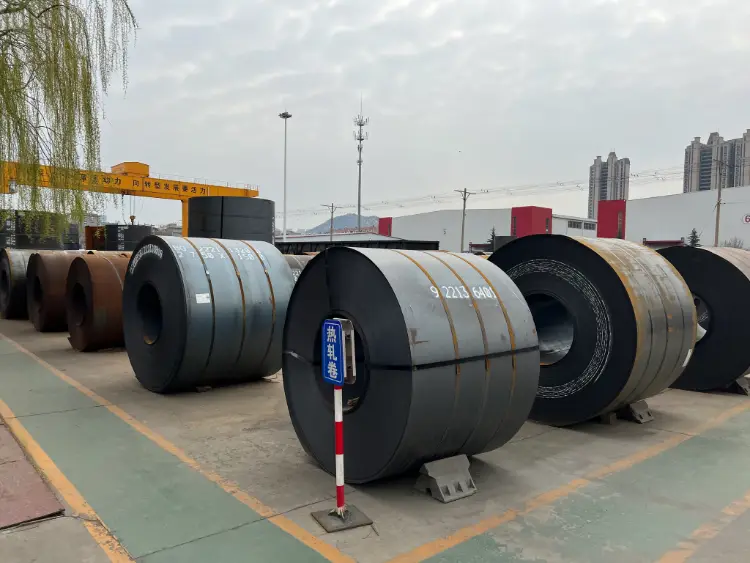
GL F690 Shipbuilding Steel Coil
GL F690 Shipbuilding Steel Coil - High Strength Quenched & Tempered Extra Tough Steel for Marine Structures
GL F690 is an extra high strength shipbuilding steel with minimum yield strength of 690 MPa, excellent low‑temperature toughness (F‑grade, –60°C) and good weldability. Supplied as coil or plate under Germanischer Lloyd / DNV GL rules.
Basic oxygen furnace or electric arc furnace → ladle refining → continuous casting → hot rolling → quenching + tempering (QT) or TMCP with subsequent tempering
- Phone : +8618037372205
- Email : [email protected]
- WhatsApp: Contact via Whtsapp
- WeChat: +8618037372205
GL F690 Shipbuilding Steel Coil Introduction
GL F690 is a quenched and tempered, fine‑grain structural steel designated for critical ship and offshore applications. It combines high yield strength (≥690 MPa) with outstanding notch toughness at temperatures as low as –60°C, making it suitable for arctic and deep‑sea environments. The grade is produced via controlled rolling and subsequent QT heat treatment, ensuring a uniform tempered martensitic/bainitic microstructure. Main features:
- Reliable weldability with low carbon equivalent (CEV typically ≤0.55)
- Resistance to brittle fracture even in thick sections
- Compliance with DNV GL (former Germanischer Lloyd) ship classification rules
The steel is delivered in normalized or as QT condition, primarily in coil form for further cutting and forming.
GL F690 Shipbuilding Steel Coil Chemical composition
The chemical composition is balanced to achieve high strength and toughness. All elements are tightly controlled to keep the carbon equivalent low for good weldability. Values are ladle analysis according to DNV GL rules for grade F690. Note: Fine‑grain elements such as Nb, V, Ti and Al are added for grain refinement, while Cr, Ni, Mo provide hardenability. Maxima are indicated unless a range is given.
| Element | Standard value (%) | Remarks |
|---|---|---|
| C | ≤0.20 | Ladle analysis |
| Si | ≤0.55 | |
| Mn | ≤1.70 | May be increased subject to CEV limits |
| P | ≤0.025 | |
| S | ≤0.025 | |
| Cr | ≤1.50 | |
| Ni | ≤2.00 | |
| Mo | ≤0.70 | |
| Cu | ≤0.50 | |
| V | ≤0.10 | Grain refiner; also combines with N |
| Nb | ≤0.06 | Grain refiner |
| Ti | ≤0.05 | Microalloying for grain refinement |
| Al (total) | ≥0.020 | Fine‑grain, killing element |
| N | ≤0.020 | Kept low to avoid strain ageing |
| CEV (typical) | ≤0.55 | Carbon equivalent = C+Mn/6+(Cr+Mo+V)/5+(Ni+Cu)/15 |
GL F690 Shipbuilding Steel Coil Thermal and electrical physical properties
Physical properties are not part of the delivery standard; the values given are typical for a quenched and tempered fine‑grain structural steel. They serve as approximate design guidelines. Note: Properties can vary slightly with exact heat treatment and composition.
| Property | Typical value | Unit | Test condition |
|---|---|---|---|
| Density (ρ) | 7.85 | g/cm³ | 20°C |
| Modulus of elasticity (E) | 210 | GPa | 20°C |
| Shear modulus (G) | 81 | GPa | 20°C |
| Poisson's ratio (ν) | 0.3 | – | 20°C |
| Thermal expansion coefficient (α) | 12×10⁻⁶ | K⁻¹ | 20–100°C |
| Thermal conductivity (λ) | 42 | W/(m·K) | 20°C |
| Specific heat capacity (cp) | 0.46 | kJ/(kg·K) | 20°C |
| Electrical resistivity (ρ_e) | 0.25×10⁻⁶ | Ω·m | 20°C |
GL F690 Shipbuilding Steel Coil Mechanical properties
The mechanical properties are verified on test pieces taken in accordance with DNV GL rules. Values apply to thickness ≤50 mm unless otherwise stated. Testing conditions: Specimens are prepared in the longitudinal direction; transverse values may be slightly lower. Impact testing is carried out at –60°C (F‑grade).
| Property | Standard requirement | Unit | Test condition |
|---|---|---|---|
| Yield strength (ReH) | ≥690 | MPa | Ambient temperature |
| Tensile strength (Rm) | 770–940 | MPa | Ambient temperature |
| Elongation (A) | ≥14 | % | Gauge length 5.65√S₀ |
| Impact energy (KV₂) long. | ≥27 | J | –60°C, longitudinal, average of 3 |
| Impact energy (KV₂) transv. | ≥20 | J | –60°C, transverse, average of 3 |
| Bend test (180°) | No cracks | Bend diameter = 4×thickness (t) |
GL F690 Shipbuilding Steel Coil Full equivalent material standards & replaceable grades
| Country/Region | Standard | Grade | Remarks |
|---|---|---|---|
| DNV (ex‑GL) | DNV GL Pt.2 Ch.2 | NV F690 | Same chemistry and mechanical properties; direct replacement |
| ABS | ABS Rules Part 2 | EQ70 | Yield 690 MPa, toughness F‑grade (–60°C) |
| Bureau Veritas | BV Rules NR216 | F690 | Identical designation, same requirements |
| Lloyd's Register | LR Rules | FH70 | F‑grade toughness, yield 690 MPa |
| CCS (China) | CCS Rules | F690 | Adopts DNV GL requirements |
| EN (Europe) | EN 10025‑6 | S690QL | Quenched and tempered steel, similar strength, not class‑certified for ships |
| ASTM (USA) | ASTM A514/A514M | Grade Q (mod.) | Yield 690 MPa, QT, suitable with supplementary toughness testing |
GL F690 Shipbuilding Steel Coil Application Introduction
GL F690 is engineered for demanding marine and offshore structural applications where high strength and excellent low‑temperature toughness are essential. It is widely used in welded constructions requiring reduced weight and good fatigue resistance. Key industries and products:
Product Applications: Hull plates (deck, bottom, side shell, bulkheads), Stiffeners, frames, girders, Legs and spudcans of jack‑up rigs, Booms and jibs of heavy‑duty cranes, Transition pieces and foundations for offshore wind turbines, Reinforced panels for blast‑resistant structures
Processed into products: Longitudinal and transverse beams, Watertight doors and hatches, Padeyes, brackets, and doubler plates, Weldments for very low temperature service (–60°C), Shafts and pins in heavy machinery (after suitable machining)
Application industries: Shipbuilding (commercial and naval), Offshore oil & gas (platforms, FPSOs, subsea structures), Renewable marine energy (wind turbine installation vessels, jackets), Heavy lifting equipment (cranes for ports and offshore), Arctic and ice‑class vessels, Pressure vessel and boiler construction (with additional certification)
GL F690 Shipbuilding Steel Coil Similar / alternative material recommendations
| Country/Region | Standard | Grade | Remarks |
|---|---|---|---|
| ISO | ISO 4954 | E690 | High strength QT steel for construction |
| Japan | JIS G 3128 | SHY685 | High yield strength steel for welded structures, similar strength, check toughness |
| USA | ASTM A517/A517M | Grade Q | Pressure vessel quality QT steel, 690 MPa yield |
| Sweden | SS‑EN 10025‑6 | S690QL | European harmonised standard, close mechanical properties |
Notes:
GL F690 is often supplied with a certificate from a recognised classification society (e.g., DNV GL). Weldability is good when preheating and interpass temperatures are controlled according to recommended practice. Post‑weld heat treatment (PWHT) is generally not required for sections up to 50 mm, but stress relieving may be applied at 530–580°C if needed. For coil products, de‑coiling and levelling must be carried out with care to avoid strain ageing. Designers should consider that properties in the through‑thickness direction (Z‑quality) require additional testing. The steel is also available in thermomechanical rolled (TMCP) condition with similar properties, designated GL F690 TMCP.
- Share



