
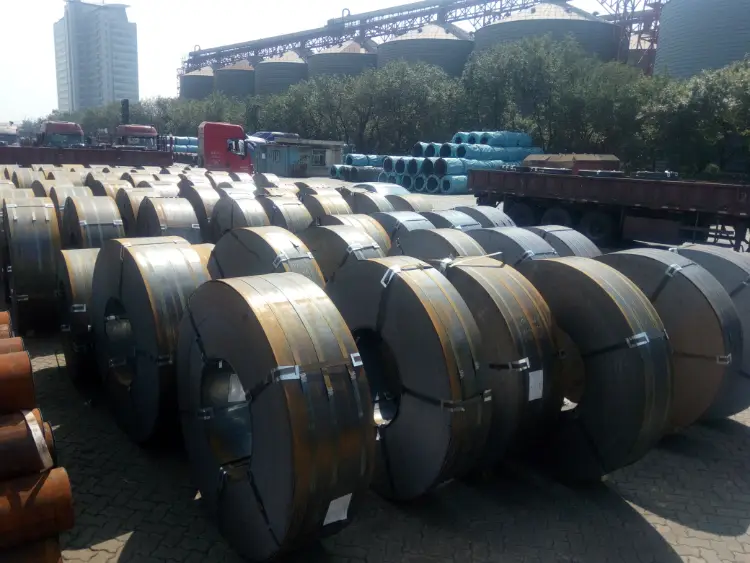
ASTM A709 HPS 100W High-Performance Bridge Steel Coil Properties & Equivalents
ASTM A709 HPS 100W High-Performance Bridge Steel Coil Properties & Equivalents
Comprehensive technical data for ASTM A709 HPS 100W carbon and low-alloy high-strength steel coil, including chemical composition, mechanical properties, physical properties, and equivalent grades for bridge construction.
Hot rolling, thermomechanical controlled rolling (TMCP), normalizing, or quenching and tempering (Q&T), depending on thickness and required properties.
- Phone : +8618037372205
- Email : [email protected]
- WhatsApp: Contact via Whtsapp
- WeChat: +8618037372205
ASTM A709 HPS 100W High-Performance Bridge Steel Coil Properties & Equivalents Introduction
ASTM A709/A709M HPS 100W is a high-performance, low-alloy structural steel primarily designed for welded bridge construction. It belongs to the High-Performance Steel (HPS) family, offering a minimum yield strength of 100 ksi (690 MPa) with excellent notch toughness, weldability, and corrosion resistance. The chemistry is carefully balanced with additions of copper, nickel, chromium, and molybdenum to achieve improved weathering resistance and strength through controlled rolling or quenching and tempering. Its superior low-temperature impact properties and fracture toughness make it ideal for critical bridge components in demanding environments.
ASTM A709 HPS 100W High-Performance Bridge Steel Coil Properties & Equivalents Chemical Composition as per ASTM A709/A709M
The chemical composition is tightly controlled to achieve high strength and toughness. Copper, nickel, chromium, and molybdenum contribute to weathering resistance and hardenability, while low carbon and sulfur levels ensure good weldability and impact properties.
| Element | Standard Value (wt%) | Remarks |
|---|---|---|
| C | ≤0.08 | Maximum |
| Mn | 0.95 – 1.50 | Range |
| P | ≤0.015 | Maximum |
| S | ≤0.006 | Maximum |
| Si | 0.15 – 0.40 | Range |
| Cu | 0.90 – 1.20 | Range |
| Ni | 0.65 – 0.90 | Range |
| Cr | 0.40 – 0.65 | Range |
| Mo | 0.40 – 0.65 | Range |
| V | 0.04 – 0.08 | Range |
| Al | 0.020 – 0.050 | Total aluminum |
| N | ≤0.015 | Maximum |
ASTM A709 HPS 100W High-Performance Bridge Steel Coil Properties & Equivalents Thermal and Electrical Physical Properties
The following physical properties are representative of HPS 100W steel at room temperature (20°C unless noted). Density, elastic modulus, and thermal expansion are essential for design calculations in bridge engineering.
| Property | Typical Value | Unit | Test Condition |
|---|---|---|---|
| Density (ρ) | 7850 | kg/m³ | 20°C |
| Elastic Modulus (E) | 205 | GPa | 20°C |
| Shear Modulus (G) | 80 | GPa | 20°C (estimated from E and ν) |
| Poisson's Ratio (ν) | 0.3 | – | 20°C, elastic range |
| Thermal Expansion Coefficient (α) | 11.7 x 10⁻⁶ | /K | 20 – 100°C |
| Thermal Conductivity (λ) | 42 | W/(m·K) | 20°C |
| Specific Heat Capacity | 486 | J/(kg·K) | 20°C |
| Electrical Resistivity (ρ_e) | 0.22 x 10⁻⁶ | Ω·m | 20°C |
ASTM A709 HPS 100W High-Performance Bridge Steel Coil Properties & Equivalents Mechanical Properties
Mechanical properties are determined on test specimens taken from the coil, representing the finished thickness. Values depend on the plate thickness and test direction. Charpy impact tests are performed according to the specified temperature zone. Below are the requirements according to ASTM A709/A709M.
| Property | Standard Requirement | Unit | Test Condition |
|---|---|---|---|
| Yield Strength (ReH) | ≥ 100 (690) | ksi (MPa) | Thickness ≤ 4 in. (100 mm) |
| Tensile Strength (Rm) | 110 – 130 (760 – 895) | ksi (MPa) | All thicknesses |
| Elongation (A) in 8 in. (200 mm) | ≥ 18 | % | Thickness > 3/4 in. (20 mm) |
| Elongation (A) in 2 in. (50 mm) | ≥ 21 | % | Thickness ≤ 3/4 in. (20 mm) |
| Bend Test (D = bend diameter, t = thickness) | 180° D=2t | – | Thickness ≤ 3/4 in. (20 mm) |
| Bend Test | 180° D=3t | – | Thickness > 3/4 in. to 2 in. (20–50 mm) |
| Bend Test | 180° D=4t | – | Thickness > 2 in. to 4 in. (50–100 mm) |
| Charpy V‑Notch Impact (KV) – Zone 1 | Average ≥ 20 (27) at 32°F (0°C) | ft·lbf (J) | Longitudinal, full-size specimen |
| Charpy V‑Notch Impact (KV) – Zone 2 | Average ≥ 20 (27) at 0°F (-18°C) | ft·lbf (J) | Longitudinal, full-size specimen |
| Charpy V‑Notch Impact (KV) – Zone 3 | Average ≥ 20 (27) at -30°F (-34°C) | ft·lbf (J) | Longitudinal, full-size specimen |
ASTM A709 HPS 100W High-Performance Bridge Steel Coil Properties & Equivalents Fully Equivalent Standards and Substitution Grades
| Country/Region | Standard | Grade | Remarks |
|---|---|---|---|
| – | – | No fully identical international grade exists | HPS 100W is a proprietary ASTM composition; other standards provide grades with similar strength and toughness but different alloying philosophies. |
ASTM A709 HPS 100W High-Performance Bridge Steel Coil Properties & Equivalents Application Introduction
ASTM A709 HPS 100W steel coil is the preferred material for modern steel bridge construction due to its high strength-to-weight ratio, excellent fracture toughness, and inherent atmospheric corrosion resistance. The coil form allows efficient fabrication of long, continuous members through roll-forming, press-braking, or cutting to sheet/plate. Typical delivery conditions (TMCP or Q&T) provide a uniform fine-grain microstructure that meets stringent sub-zero impact requirements. It is widely specified for welded plate girders, box girders, and orthotropic decks. Designers benefit from reduced steel weight compared to lower-strength grades, and the weathering characteristic often eliminates the need for painting in many environments.
Product Applications: Steel plate girders (I-girders, box girders), Orthotropic steel bridge decks, Rolled beam and column sections built-up from coil, Bridge bearings and stiffeners, Truss bridges and arch bridge components
Processed into products: Main girder webs and flanges, Cross-beams and diaphragms, Longitudinal and transverse stiffeners, Splice plates and gusset plates, Deck plates and trough ribs, Anchorages and supporting frames
Application industries: Bridge Engineering (Highway, Railway, Pedestrian), Heavy Civil/Marine Structures, Offshore Platforms and Wind Towers (where atmospheric corrosion resistance is valued), Industrial Building Frames, Pressure Vessel Support Structures
ASTM A709 HPS 100W High-Performance Bridge Steel Coil Properties & Equivalents Similar/Alternative Materials Recommendation
| Country/Region | Standard | Grade | Remarks |
|---|---|---|---|
| Europe | EN 10025-6 | S690Q / S690QL | Comparable minimum yield strength (690 MPa) and impact toughness; chemical composition differs (higher Cr, Mo in some cases). Suitable for structural use. |
| China | GB/T 16270 | Q690D / Q690E | High-strength quenched and tempered steel with 690 MPa yield; impact properties at -20°C / -40°C. Use after verifying weldability and weathering performance. |
| Japan | JIS G 3128 | SHY685 | High yield strength steel for welded structures; 685 MPa class, good toughness. Not a direct weathering grade; supplementary corrosion protection may be needed. |
| United States | ASTM A514/A514M | Grade F (or other grades) | 100 ksi yield strength quenched and tempered alloy steel; not optimized for weathering but offers similar strength. Use with protective coating. |
Notes:
Welding: Low carbon equivalent (typically ≤0.50 CEV) ensures excellent weldability with low-hydrogen processes. Preheating may be required for thick sections (>1.5 in.). Weathering: The copper–nickel–chromium content provides an adherent protective rust patina, allowing for unpainted use in many environments (Class C exposure per FHWA guidelines). Fabrication: The material can be cold-formed and machined; post-forming stress relief is generally not required if bending radii meet ASTM recommendations. Inspection: Ultrasonic testing is often specified for internal soundness in critical tension members.
- Share



