
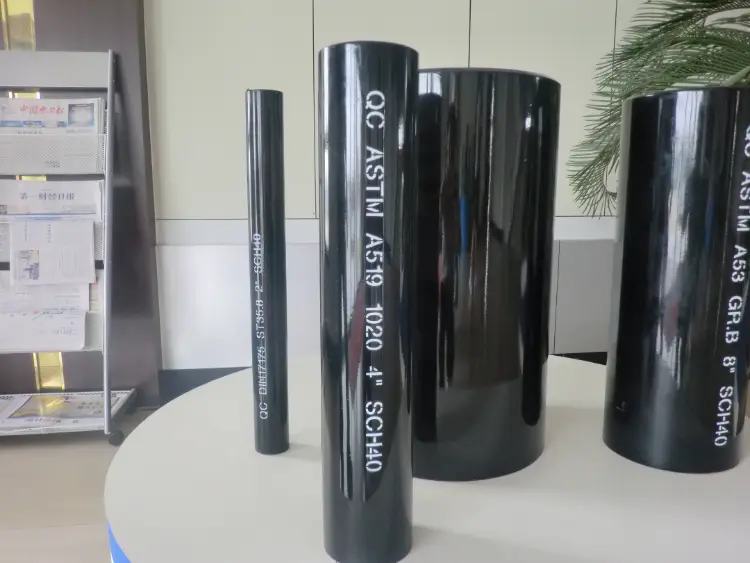
ASTM A519 4140 Mechanical Tubing
ASTM A519 4140 Mechanical Tubing Data: Chemical & Physical Properties
Explore ASTM A519 4140 seamless carbon and alloy steel mechanical tubing: chemical composition, mechanical & thermal properties, equivalent grades, and application guidance.
Cold drawing, hot finishing, machining, heat treatment (quenching & tempering, annealing, normalizing), welding (precautions needed)
- Phone : +8618037372205
- Email : [email protected]
- WhatsApp: Contact via Whtsapp
- WeChat: +8618037372205
ASTM A519 4140 Mechanical Tubing Introduction
ASTM A519 4140 is a chromium-molybdenum alloy steel grade used for seamless mechanical tubing. It offers high tensile strength, good hardenability, and excellent toughness. It is widely applied in automotive, machinery, and oil & gas industries. The steel can be heat treated to obtain a range of mechanical properties. Key features include:
- High strength and toughness
- Good fatigue resistance
- Wear resistance
- Good machinability in normalized and tempered condition
Typical applications include shafts, gears, couplings, and oil country tubular goods. The material conforms to ASTM A519 specification for seamless carbon and alloy steel mechanical tubing.
ASTM A519 4140 Mechanical Tubing Chemical Composition
The chemical composition as specified in ASTM A519 for grade 4140. All values are in weight percent. Other elements may be present as residuals.
| Element | Standard Value | Remarks |
|---|---|---|
| Carbon (C) | 0.38 - 0.43 | Core element |
| Manganese (Mn) | 0.75 - 1.00 | Deoxidizer and strength enhancer |
| Phosphorus (P) | ≤ 0.035 | Max impurity |
| Sulfur (S) | ≤ 0.040 | Max impurity |
| Silicon (Si) | 0.15 - 0.35 | Deoxidizer |
| Chromium (Cr) | 0.80 - 1.10 | Hardenability and corrosion resistance |
| Molybdenum (Mo) | 0.15 - 0.25 | Hardenability and high-temperature strength |
ASTM A519 4140 Mechanical Tubing Thermal and Electrical Physical Properties
Physical properties of 4140 alloy steel at room temperature and elevated temperatures. Data are typical for quenched and tempered material and may vary slightly with specific heat treatment.
| Property | Typical Value | Unit | Condition/Test Details |
|---|---|---|---|
| Density (ρ) | 7.85 | g/cm³ | Room temperature |
| Modulus of Elasticity (E) | 205 | GPa | Room temperature |
| Shear Modulus (G) | 80 | GPa | Room temperature |
| Poisson's Ratio (ν) | 0.29 | - | Room temperature |
| Thermal Expansion (α, 20-100°C) | 12.2 | 10⁻⁶/°C | 20-100°C |
| Thermal Expansion (α, 20-200°C) | 12.8 | 10⁻⁶/°C | 20-200°C |
| Thermal Expansion (α, 20-400°C) | 13.9 | 10⁻⁶/°C | 20-400°C |
| Thermal Conductivity (λ) | 42.6 | W/m·K | At 100°C |
| Thermal Conductivity (λ) | 37.7 | W/m·K | At 250°C |
| Specific Heat Capacity | 477 | J/kg·K | Room temperature |
| Electrical Resistivity (ρ_e) | 0.22 | µΩ·m | Room temperature |
ASTM A519 4140 Mechanical Tubing Mechanical Properties
Mechanical properties depend on heat treatment and section size. Values below are typical for 4140 tubing under different conditions. Quenched & Tempered: austenitized at 845°C, oil quenched, tempered at 540°C. Annealed: heated to 830°C, slow cooled. These are representative values, not minimum requirements per ASTM A519, which leaves properties to agreement between manufacturer and purchaser.
| Property | Standard Value | Unit | Condition |
|---|---|---|---|
| Yield Strength (Rp0.2) | ≥ 785 | MPa | Quenched & Tempered (845°C / 540°C) |
| Yield Strength (Rp0.2) | ≥ 415 | MPa | Annealed |
| Tensile Strength (Rm) | ≥ 980 | MPa | Quenched & Tempered |
| Tensile Strength (Rm) | ≥ 655 | MPa | Annealed |
| Elongation (A, 50 mm) | ≥ 12 | % | Quenched & Tempered |
| Elongation (A, 50 mm) | ≥ 20 | % | Annealed |
| Reduction of Area (Z) | ≥ 45 | % | Quenched & Tempered |
| Hardness, Brinell | 285 - 340 | HBW | Quenched & Tempered |
| Hardness, Brinell | ≤ 241 | HBW | Annealed |
| Impact Toughness (KV2) | ≥ 40 | J | Quenched & Tempered (20°C) |
ASTM A519 4140 Mechanical Tubing Fully Equivalent Material Standards and Substitutable Grades
| Country/Region | Standard | Grade | Remarks |
|---|---|---|---|
| USA | ASTM A519 | 4140 | Seamless mechanical tubing |
| International | ISO 683-1 | 42CrMo4 | Alloy steel for quenching and tempering |
| Europe | EN 10297-1 | 42CrMo4 (1.7225) | Seamless circular steel tubes for mechanical and general engineering |
| Germany | DIN 17204 (withdrawn) | 42CrMo4 (1.7225) | Quenched and tempered steel |
| Japan | JIS G3441 | SCM440TK | Alloy steel tubes for machine structural purposes |
| China | GB/T 8162 | 42CrMo | Seamless steel tubes for structural purposes |
| United Kingdom | BS 970-1 | 708M40 | Wrought steel for mechanical and allied engineering (bars) |
ASTM A519 4140 Mechanical Tubing Application Introduction
4140 steel tubing finds extensive use in demanding applications requiring high strength, toughness, and wear resistance. Typical industries and products include:
Product Applications: Drive shafts, Axle tubes, Hydraulic cylinder barrels, Drill collars, Tool joints, BOP rams, Rolling mill rolls, High-pressure piping
Processed into products: Gears, Shafts, Spindles, Couplings, Bolts and studs, Crankshafts, Connecting rods, Landing gear components
Application industries: Automotive, Oil & Gas, Machinery Manufacturing, Power Generation, Aerospace (structural parts)
ASTM A519 4140 Mechanical Tubing Similar / Alternative Material Recommendations
| Country/Region | Standard | Grade | Remarks |
|---|---|---|---|
| USA | ASTM A519 | 4142 | Slightly higher carbon (0.40-0.45), higher hardenability |
| USA | ASTM A519 | 4145 | Higher carbon and chromium, commonly used for drill collars |
| USA | ASTM A519 | 4340 | Ni-Cr-Mo steel, higher toughness and deeper hardenability, alternative for heavy sections |
| Europe | EN 10297-1 | 34CrMo4 (1.7220) | Lower carbon, somewhat lower strength but better weldability |
| Japan | JIS G3441 | SCM435TK | Lower carbon than SCM440, equivalent to 4135 type |
| China | GB/T 8162 | 35CrMo | Similar but lower carbon, suitable for welded structures |
Notes:
Welding: Preheating (200-300°C) and post-weld heat treatment are required to avoid cracking. Heat treatment: Austenitizing at 830-860°C, oil quench for sections up to 25 mm thickness; temper at 400-600°C to achieve desired hardness. Machinability: Best in normalized and tempered or annealed condition (approx. 55-65% of 1112 steel). Corrosion resistance: Limited; protective coatings recommended for corrosive environments.
- Share



