
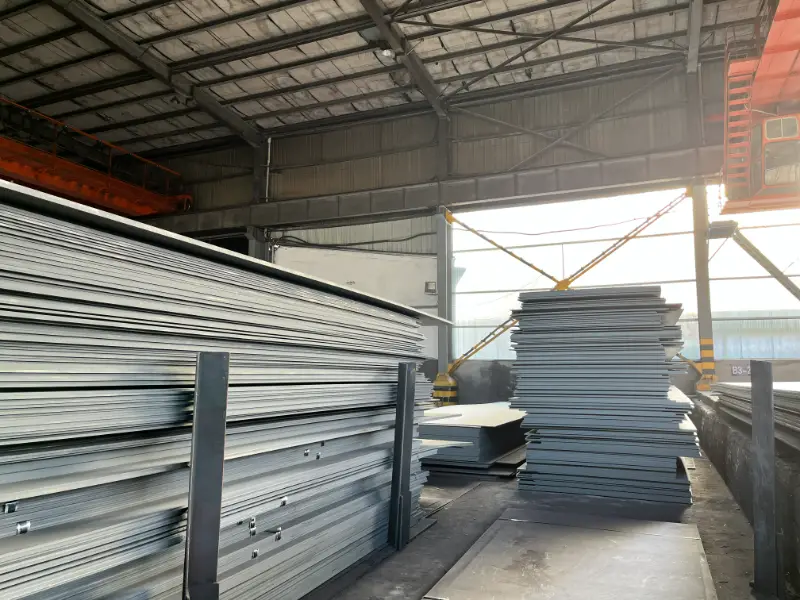
ASTM A656 Grade 70 High-Strength Low-Alloy Steel Plate
ASTM A656 Grade 70 High-Strength Low-Alloy Steel Plate - Properties & Equivalents
Comprehensive technical data for ASTM A656 Grade 70 (A656GR70) carbon and low-alloy high-strength steel plate, including chemistry, mechanical properties, physical characteristics, and international equivalents.
Hot rolling, controlled rolling, thermomechanical controlled processing (TMCP); the steel can be subsequently cold formed, sheared, punched, drilled, welded, and painted.
- Phone : +8618037372205
- Email : [email protected]
- WhatsApp: Contact via Whtsapp
- WeChat: +8618037372205
ASTM A656 Grade 70 High-Strength Low-Alloy Steel Plate Introduction
ASTM A656 Grade 70 is a hot-rolled, high-strength low-alloy (HSLA) structural steel plate with a minimum yield strength of 70 ksi (485 MPa). It offers an excellent combination of high strength, good formability, and weldability, making it suitable for weight-critical structural applications. The steel is typically microalloyed with elements such as niobium, vanadium, or titanium to achieve its mechanical properties without the need for heat treatment. This grade is widely used in truck frames, crane booms, railcars, and other heavy-duty structural components. It conforms to ASTM A656/A656M and is available in various thicknesses, providing reliable performance in both static and dynamic loading conditions.
ASTM A656 Grade 70 High-Strength Low-Alloy Steel Plate Chemical Composition
Chemical requirements for ASTM A656 Grade 70 steel as specified in ASTM A656/A656M. The steel may contain additions of niobium, vanadium, titanium, or other microalloying elements at the manufacturer's discretion to meet mechanical properties. If copper-bearing steel is specified, the minimum copper content is 0.35% for Grade 70.
| Element | Standard Value (max, unless noted) | Remarks |
|---|---|---|
| C | 0.20% | Carbon maximum |
| Mn | 1.65% (thickness ≤ 3/4 in.) / 1.20% (thickness > 3/4 in. to 2 in.) | Manganese limit depends on plate thickness |
| P | 0.030% | Phosphorus maximum |
| S | 0.030% | Sulfur maximum |
| Si | 0.60% | Silicon maximum |
| Cu | 0.35% min (if copper-bearing steel is specified) | For Grade 70, when copper steel is ordered |
| Nb, V, Ti, etc. | Not specified; added as needed | Microalloying elements may be present to achieve required strength |
ASTM A656 Grade 70 High-Strength Low-Alloy Steel Plate Physical and Thermal Properties
The following physical properties are generic for low-carbon structural steel and are not specific to ASTM A656 Grade 70. They are provided for design guidance. The actual values may vary slightly depending on composition and manufacturing route. No electrical or thermal limits are imposed by the material standard.
| Property | Typical Value | Unit | Condition / Reference |
|---|---|---|---|
| Density (ρ) | 7.85 | g/cm³ | Room temperature |
| Modulus of Elasticity (E) | 200–210 | GPa | Tension, room temperature |
| Shear Modulus (G) | 80 | GPa | Calculated from E and ν |
| Poisson's Ratio (ν) | 0.3 | — | Elastic range |
| Thermal Expansion Coefficient (α) | 11.7 × 10⁻⁶ | K⁻¹ | 20–100 °C |
| Thermal Expansion Coefficient (α) | 12.5 × 10⁻⁶ | K⁻¹ | 20–300 °C |
| Thermal Conductivity (λ) | 51 | W/(m·K) | At 20 °C |
| Specific Heat Capacity (c) | 486 | J/(kg·K) | At 20–100 °C |
| Electrical Resistivity (ρₑ) | 0.142 × 10⁻⁶ | Ω·m | At 20°C |
| Melting Point (approximate) | 1425–1540 | °C | Typical for low-alloy steel |
ASTM A656 Grade 70 High-Strength Low-Alloy Steel Plate Mechanical Properties
Tensile properties for ASTM A656 Grade 70 based on standard requirements. Values apply to full-thickness specimens taken from the as-rolled or control-rolled plate. Elongation requirements vary with specimen gauge length and plate thickness. Bend testing is not mandated by this standard but may be performed by agreement.
| Property | Required Value | Unit | Test Condition |
|---|---|---|---|
| Yield Strength (ReH) | 70 min (485 min) | ksi (MPa) | 0.2% offset, all thicknesses |
| Tensile Strength (Rm) | 80–100 (550–690) | ksi (MPa) | For plates up to 1.5 in. (38 mm) thick |
| Elongation (A) – 8 in. (200 mm) gauge | 14 min | % | Thickness 0.180–0.500 in. (4.6–12.5 mm) |
| Elongation (A) – 8 in. (200 mm) gauge | 12 min | % | Thickness >0.500–1.500 in. (12.5–38 mm) |
| Elongation (A) – 2 in. (50 mm) gauge | 17 min | % | Thickness 0.180–0.500 in. (4.6–12.5 mm) |
| Elongation (A) – 2 in. (50 mm) gauge | 16 min | % | Thickness >0.500–1.500 in. (12.5–38 mm) |
| Bend Test | Not specified | — | Usually not required; cold bending formability is generally good |
| Impact Toughness (KV) | Not a standard requirement | — | May be specified by supplementary agreement if Charpy V-notch values are needed |
ASTM A656 Grade 70 High-Strength Low-Alloy Steel Plate Perfect Material Equivalents and Replacements
| Country/Region | Standard | Designation | Remarks |
|---|---|---|---|
| USA | ASTM A656/A656M | Grade 70 | Primary designation |
| International (ISO) | — | No direct ISO equivalent | Closest ISO 500MC grade (see similar materials) |
| Europe | EN 10149-2 | S500MC | Thermomechanically rolled, similar strength and chemistry, but minimum yield 500 MPa, slightly higher than 485 MPa |
| Japan | JIS G3134 | SPFH540 | Hot-rolled high-strength steel sheet with min tensile 540 MPa, no exact yield match |
| China | GB/T 1591 | Q460C/D (note: Q460 has min yield 460 MPa) | Strength category differs; Q500D (min yield 500 MPa) closer but often quenched and tempered |
ASTM A656 Grade 70 High-Strength Low-Alloy Steel Plate Application Introduction
ASTM A656 Grade 70 is designed for structural applications requiring high strength-to-weight ratio and good cold formability. Its weldability allows it to be integrated into large fabricated assemblies. Typical uses include mobile equipment, transportation, and building structures. The steel is readily available in plate form and can be formed, welded, and machined with standard practices.
Product Applications: Truck frames, chassis, and trailer bodies, Mobile crane booms and outrigger beams, Structural members of railcars, Dump bodies and earthmoving buckets, Agricultural sprayer booms and tillage tools, Offshore platform grating and walkways, Bridge structural elements (when specified)
Processed into products: Longitudinal frame rails and cross-members (trucks), Lattice boom chords and lacings (cranes), High-strength formed stiffeners and brackets, Cut and bent flanges for welded beams, Plow discs and heavy-duty cutting edges (agriculture), Ribbed and gusseted plates for heavy machinery, Welded tubular sections for construction equipment
Application industries: Transportation and heavy vehicle manufacturing, Construction and infrastructure, Crane and lifting equipment, Agricultural machinery, Mining and earthmoving equipment, Shipbuilding and offshore structures (non-critical zones), Railcar and locomotive components
ASTM A656 Grade 70 High-Strength Low-Alloy Steel Plate Similar or Alternative Materials
| Country/Region | Standard | Designation | Key Features and Remarks |
|---|---|---|---|
| USA | ASTM A572/A572M | Grade 65 | Minimum yield 65 ksi (450 MPa), slightly lower strength; good weldability |
| USA | ASTM A514/A6M (Q&T) | Grade B | High-strength quenched & tempered steel, yield 100 ksi (690 MPa), significantly stronger |
| Europe | EN 10025-4 | S460M | Thermomechanical rolled, min yield 460 MPa, excellent toughness |
| Europe | EN 10025-6 | S500Q | Quenched and tempered, yield 500 MPa, higher carbon equivalent, good for heavy sections |
| Japan | JIS G3106 | SM490A | Min yield 325 MPa (t≤16 mm), lower strength but widely used structural steel |
| Japan | JIS G3101 | SS540 | Min tensile 540 MPa but no specified yield, general structural grade |
| China | GB/T 1591 | Q500D | Min yield 500 MPa, may be TMCP or Q+T, close substitute with careful welding |
Notes:
Additional Requirements: ASTM A656 Grade 70 may be ordered with optional supplementary requirements such as Charpy V-notch impact testing (e.g., at -20°F), controlled sulfur for improved inclusion shape, or tighter flatness tolerances. The steel is typically not intended for pressure vessel or boiler applications. For welding, low-hydrogen practices are recommended, and preheat may be needed depending on thickness and carbon equivalent. The data provided here is based on ASTM A656/A656M-19 and typical physical constants; always refer to the current standard for exact specifications.
- Share



