
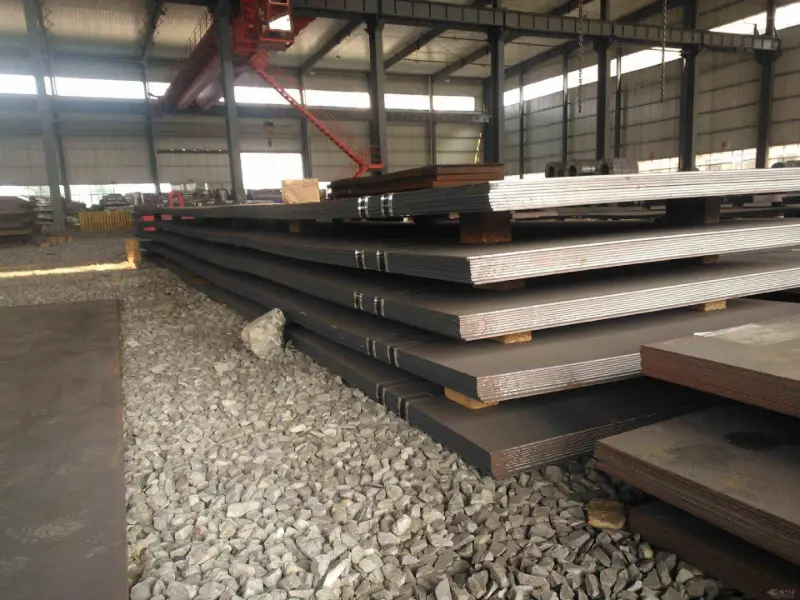
ASTM A537 Class 3 (A537CL3) Pressure Vessel & Boiler Steel Plate
ASTM A537 Class 3 (A537CL3) Pressure Vessel & Boiler Steel Plate - Quenched and Tempered High-Strength C-Mn-Si Steel
Complete material data for ASTM A537 Class 3 (A537CL3), a quenched and tempered carbon‑manganese‑silicon steel plate for pressure vessels and boilers, including chemical composition, mechanical properties, thermal and electrical properties, international equivalents, and application guidance.
Cutting, cold forming, hot forming, welding (with preheating and post‑weld heat treatment as required), machining
- Phone : +8618037372205
- Email : [email protected]
- WhatsApp: Contact via Whtsapp
- WeChat: +8618037372205
ASTM A537 Class 3 Pressure Vessel & Boiler Steel Plate Introduction
ASTM A537 Class 3 (A537CL3) is a heat‑treated carbon‑manganese‑silicon steel plate intended for fusion‑welded pressure vessels and boilers. Class 3 is supplied in the quenched and tempered (Q&T) condition, providing high strength and good toughness.
- Minimum yield strength of 415 MPa (60 ksi) in thicknesses up to 65 mm.
- Tensile strength in the range 550–690 MPa (80–100 ksi).
- Excellent weldability with proper procedures, coupled with reliable low‑temperature notch toughness when supplementary specifications are applied.
- Widely used in the construction of pressure vessels, storage tanks, and boilers for the petrochemical, power generation, and process industries.
Typical applications include shells, heads, and other critical components subjected to moderate to high operating pressures.
ASTM A537 Class 3 Pressure Vessel & Boiler Steel Plate Chemical Composition
The chemical composition of ASTM A537 Class 3 is controlled to achieve the required strength and toughness after quenching and tempering. Manganese is the principal strengthening element, while carbon is limited to ensure good weldability. Residual elements such as chromium, nickel, and molybdenum are restricted to maintain predictable hardenability.
- Values are maximum unless a range is shown.
- Fine‑grain practice is mandatory and aluminium or other grain‑refining elements are typically added.
| Element | Standard Value (max, %) | Remarks |
|---|---|---|
| Carbon (C) | 0.24 | Max |
| Manganese (Mn) | 0.70 – 1.60 | For thickness ≤ 40 mm: 0.70–1.35; > 40 to 65 mm: 1.00–1.60 |
| Phosphorus (P) | 0.025 | Max |
| Sulfur (S) | 0.025 | Max |
| Silicon (Si) | 0.15 – 0.50 | Range |
| Copper (Cu) | 0.35 | Max |
| Nickel (Ni) | 0.25 | Max |
| Chromium (Cr) | 0.25 | Max |
| Molybdenum (Mo) | 0.08 | Max |
| Vanadium (V) | 0.08 | Max when added as grain refiner (optional) |
| Columbium (Nb) | 0.05 | Max when added as grain refiner (optional) |
| Aluminium (Al) | ≥ 0.020 (soluble) or other grain‑refining element | Required for fine‑grain practice |
ASTM A537 Class 3 Pressure Vessel & Boiler Steel Plate Thermal and Electrical Physical Properties
Physical property data are typical for heat‑treated carbon‑manganese‑silicon steel of the A537 Class 3 type. Values are provided for general engineering calculations. Thermal conductivity decreases with rising temperature, while electrical resistivity and specific heat increase moderately. The coefficient of thermal expansion remains fairly stable up to about 300 °C.
| Property | Typical Value | Unit | Condition / Remarks |
|---|---|---|---|
| Density (ρ) | 7.85 | g/cm³ | Ambient temperature |
| Modulus of Elasticity (E) | 205 | GPa | Ambient temperature |
| Shear Modulus (G) | 80 | GPa | Estimated from E and ν |
| Poisson's Ratio (ν) | 0.29 | - | Ambient temperature |
| Coefficient of Thermal Expansion (α) | 11.7 × 10⁻⁶ | K⁻¹ | 20–100 °C |
| Coefficient of Thermal Expansion (α) | 12.2 × 10⁻⁶ | K⁻¹ | 20–200 °C |
| Coefficient of Thermal Expansion (α) | 12.8 × 10⁻⁶ | K⁻¹ | 20–300 °C |
| Thermal Conductivity (λ) | 52 | W/(m·K) | At 20 °C |
| Thermal Conductivity (λ) | 51 | W/(m·K) | At 100 °C |
| Thermal Conductivity (λ) | 48 | W/(m·K) | At 200 °C |
| Specific Heat (cp) | 460 | J/(kg·K) | 20–100 °C approximate |
| Specific Heat (cp) | 500 | J/(kg·K) | 20–300 °C approximate |
| Electrical Resistivity (ρe) | 0.15 | µΩ·m | Ambient temperature (typical for C‑Mn steel) |
ASTM A537 Class 3 Pressure Vessel & Boiler Steel Plate Mechanical Properties
Tensile and bend properties are determined in accordance with ASTM A20/A20M requirements. Plates are tested in the transverse direction unless otherwise agreed. Yield strength and tensile strength values apply to the full thickness range of Class 3 (max. 65 mm). Elongation depends on the gage length. Bend test specimens are cold bent through 180° without cracking: the mandrel diameter is a function of the actual tensile strength of the plate.
| Property | Required Value | Unit | Test Condition |
|---|---|---|---|
| Yield Strength (ReH) | ≥ 415 | MPa | Thickness ≤ 65 mm, 0.2 % offset or 0.5 % extension under load |
| Yield Strength (ReH) | ≥ 60 | ksi | Thickness ≤ 2.5 in. |
| Tensile Strength (Rm) | 550 – 690 | MPa | Thickness ≤ 65 mm |
| Tensile Strength (Rm) | 80 – 100 | ksi | Thickness ≤ 2.5 in. |
| Elongation (A) | ≥ 18 | % | Gage length 200 mm (8 in.) |
| Elongation (A) | ≥ 22 | % | Gage length 50 mm (2 in.) |
| Bend Test (180°) | Mandrel diameter ≤ 2t | - | When tensile strength ≤ 655 MPa (95 ksi) |
| Bend Test (180°) | Mandrel diameter ≤ 3t | - | When tensile strength > 655 MPa (95 ksi), t = specimen thickness |
ASTM A537 Class 3 Pressure Vessel & Boiler Steel Plate Full Equivalents – International Standards and Substitute Grades
| Country/Region | Standard | Grade / Designation | Remarks |
|---|---|---|---|
| Europe | EN 10028‑6 | P460Q (1.8868) | Quenched and tempered fine‑grain steel for pressure purposes, similar strength but chemistry may differ slightly. |
| Japan | JIS G3115 | SPV490 | Steel plates for pressure vessels for intermediate and moderate temperature service, comparable strength. |
| China | GB/T 713 | 13MnNiMoR | High‑strength boiler and pressure vessel steel. Strength range 570–720 MPa; intended for similar applications. |
| International | ISO 4978 | P460Q | ISO equivalent of EN 10028‑6 P460Q, compatible with A537 CL3 requirements. |
ASTM A537 Class 3 Pressure Vessel & Boiler Steel Plate Application Introduction
ASTM A537 Class 3 is designed for welded pressure vessels and boilers where a combination of high strength, good toughness, and reasonable fabricability is required. Typical service conditions include moderate to low temperatures, often with supplementary impact testing for sub‑zero applications.
- It is ideal for vessels operating under high internal pressure, offering weight savings over lower‑strength grades.
- Welding must follow established procedures with attention to preheat, interpass temperature control, and post‑weld heat treatment (PWHT) to avoid cracking and maintain toughness.
- Forming can be performed in the hot or cold condition, but hot forming above the tempering temperature requires re‑heat treatment.
Product Applications: Vertical and horizontal pressure vessels, Boiler drums and steam separators, Spheres and bullets for LPG/ammonia storage, High‑pressure autoclaves and reactors, Heat exchanger shells and channel covers, Knock‑out drums and process columns
Processed into products: Shell courses and vessel body, Dished heads (elliptical, hemispherical, torispherical), Manhole and nozzle reinforcing pads, Tube sheets (subject to appropriate thickness and weldability considerations), Flanges (integral and loose type), Support saddles and skirts, Baffle plates and internal trays
Application industries: Petrochemical and chemical processing plants, Oil and gas production (onshore and offshore), Power generation (boilers, heat recovery steam generators), Nuclear equipment (secondary side components, not reactor pressure boundary), Compressed gas storage and transportation, Industrial machinery and heavy equipment
ASTM A537 Class 3 Pressure Vessel & Boiler Steel Plate Similar / Closely Related Substitute Materials
| Country/Region | Standard | Grade / Designation | Remarks |
|---|---|---|---|
| USA | ASTM A537/A537M | Class 1 | Lower strength (yield ≥ 345 MPa) normalized C‑Mn‑Si plate; same standard, less stringent requirements. |
| USA | ASTM A537/A537M | Class 2 | Quenched and tempered, higher strength (yield ≥ 415 MPa for ≤ 65 mm, but with different C and Mn limits; tension range 550–690 MPa) |
| USA | ASTM A516/A516M | Grade 70 | Moderate‑strength C‑Mn‑Si plate, supplied in as‑rolled or normalized condition, yield ≥ 260 MPa; used for pressure vessels where high strength is not required. |
| Europe | EN 10028‑3 | P460NH | Normalized fine‑grain steel with similar strength, suitable for pressure vessels, easier to weld, but may require thicker sections due to lower strength. |
Notes:
ASTM A537 Class 3 plates are normally ordered with supplementary requirements such as S5 (Charpy V‑notch impact testing) or S17 (Vacuum carbon‑deoxidized steel) to guarantee low‑temperature toughness. For service at temperatures below −20 °C, impact testing at the design minimum temperature is essential. Ultrasonic examination per ASTM A578/A578M or A435/A435M is often specified for critical applications. Maximum thickness is 2.5 in. (65 mm); for greater thicknesses, an alternative grade such as ASME SA‑533 Type B or SA‑537 Class 1 may be considered. Post‑weld heat treatment (stress relief) is typically performed at 595–650 °C, with holding time depending on thickness.
- Share



