
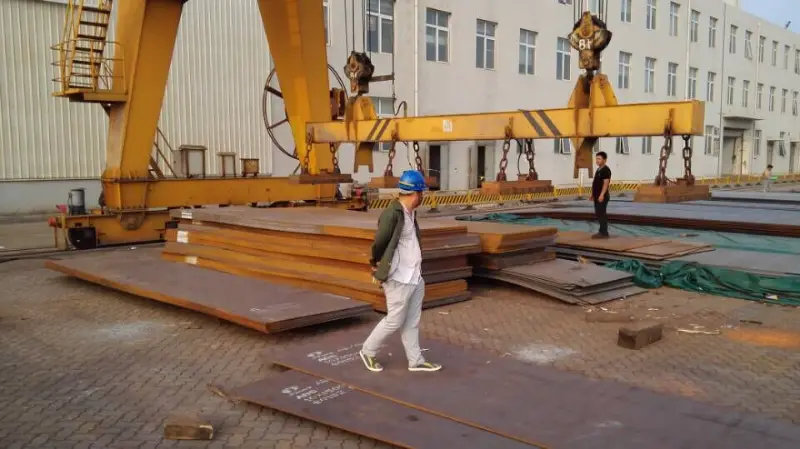
ASTM A533 Grade A Class 2 Pressure Vessel Steel Plate
ASTM A533 Grade A Class 2 Quenched & Tempered Mn-Mo Steel for Pressure Vessels & Boilers
Comprehensive technical data for ASTM A533 Type A Class 2 pressure vessel steel plate: chemical composition, mechanical properties, physical properties, equivalent materials, and application guidance.
Welding (SMAW, SAW, GMAW), hot forming, cold forming, machining, cutting
- Phone : +8618037372205
- Email : [email protected]
- WhatsApp: Contact via Whtsapp
- WeChat: +8618037372205
ASTM A533 Grade A Class 2 Pressure Vessel Steel Plate Introduction
ASTM A533 Grade A Class 2 (Type A) is a quenched and tempered manganese-molybdenum alloy steel plate specified in ASTM A533/A533M. It is intended primarily for the fabrication of welded pressure vessels and boilers, especially for moderate and low-temperature service where high strength and good toughness are required. Key characteristics include:
- Excellent strength and toughness after quenching and tempering.
- Good weldability with proper preheat and post-weld heat treatment.
- Resistant to brittle fracture at low temperatures when supplementary Charpy impact requirements are applied.
- Widely used in the petrochemical, power generation, and nuclear industries for critical pressure-containing components.
ASTM A533 Grade A Class 2 Pressure Vessel Steel Plate Chemical Composition
Chemical requirements as specified in ASTM A533/A533M for Type A plates. Values are for ladle analysis; product analysis tolerances apply. Maxima or ranges are indicated. The composition is typical of a Mn-Mo alloy steel with controlled impurities for superior toughness and weldability.
| Element | Standard Value (wt.%) | Remarks |
|---|---|---|
| Carbon, C | 0.25 max | Ladle analysis |
| Manganese, Mn | 1.15 – 1.50 | Ladle analysis |
| Phosphorus, P | 0.025 max | Ladle analysis |
| Sulfur, S | 0.025 max | Ladle analysis |
| Silicon, Si | 0.15 – 0.40 | Ladle analysis |
| Molybdenum, Mo | 0.45 – 0.60 | Ladle analysis |
| Carbon, C | 0.27 max | Product analysis |
| Manganese, Mn | 1.07 – 1.62 | Product analysis |
| Phosphorus, P | 0.025 max | Product analysis |
| Sulfur, S | 0.025 max | Product analysis |
| Silicon, Si | 0.13 – 0.45 | Product analysis |
| Molybdenum, Mo | 0.41 – 0.64 | Product analysis |
ASTM A533 Grade A Class 2 Pressure Vessel Steel Plate Thermal and Electrical Physical Properties
Typical physical properties for quenched and tempered Mn-Mo steel at ambient or indicated temperature ranges. These values are not mandatory in ASTM A533/A533M but are representative for design calculations. Actual properties may vary with specific heat treatment and thickness.
| Property | Typical Value | Unit | Test Condition |
|---|---|---|---|
| Density (ρ) | 7850 | kg/m³ | At 20°C |
| Elastic modulus (E) | 196 | GPa | At 20°C |
| Shear modulus (G) | 77 | GPa | At 20°C |
| Poisson's ratio (ν) | 0.29 | – | At 20°C |
| Thermal expansion coefficient (α) | 11.7 × 10⁻⁶ | m/(m·°C) | Between 20°C and 100°C |
| Thermal expansion coefficient (α) | 12.2 × 10⁻⁶ | m/(m·°C) | Between 20°C and 200°C |
| Thermal expansion coefficient (α) | 13.7 × 10⁻⁶ | m/(m·°C) | Between 20°C and 400°C |
| Thermal conductivity (λ) | 42 | W/(m·K) | At 100°C |
| Specific heat capacity | 460 | J/(kg·K) | At 20°C |
| Electrical resistivity (ρ_e) | 0.22 × 10⁻⁶ | Ω·m | At 20°C |
ASTM A533 Grade A Class 2 Pressure Vessel Steel Plate Mechanical Properties
Tensile and impact properties per ASTM A533/A533M for Grade A Class 2. All tests are conducted at room temperature except impact testing. Charpy impact requirements are optional and invoked only when Supplementary Requirement S5 is specified in the purchase order. Values apply to longitudinal specimens from quenched and tempered plates.
| Property | Standard Value | Unit | Test Condition / Remarks |
|---|---|---|---|
| Yield Strength (ReH 0.2% offset) | 485 (70) | MPa (ksi) | Room temperature; plate thickness ≤ 4 in. (100 mm) |
| Tensile Strength (Rm) | 620 – 795 (90 – 115) | MPa (ksi) | Room temperature; plate thickness ≤ 4 in. (100 mm) |
| Elongation (A) in 2 in. (50 mm) | 18 | % | Plate thickness ≤ 4 in. (100 mm) |
| Charpy V-Notch Impact Energy (KV) | ≥ 27 (20) | J (ft·lbf) | At -40°C (-40°F); average of three specimens, per S5 (when specified) |
ASTM A533 Grade A Class 2 Pressure Vessel Steel Plate Internationally Identical / Exactly Equivalent Material Standards
| Country/Region | Standard | Grade | Remarks |
|---|---|---|---|
| USA | ASME SA533/SA533M | SA533 Type A Class 2 | Identical grade for ASME Boiler & Pressure Vessel Code construction; dual certification common. |
ASTM A533 Grade A Class 2 Pressure Vessel Steel Plate Application Introduction
ASTM A533 Grade A Class 2 excels in heavy-section welded structures operating at moderate temperatures and at low temperatures where notch toughness is critical. Typical uses involve pressure-containing parts that benefit from the high strength and homogeneous properties of the quenched and tempered condition.
Typical industries:
Product Applications: Welded pressure vessels (vertical/horizontal separators, columns, reactors), Boiler shells and drums, Heat exchangers and condensers, Liquefied gas storage tanks (LPG, ammonia), High-pressure piping components (pump bodies, compressor cases)
Processed into products: Shell courses, heads (ellipsoidal, hemispherical, torispherical), Tube sheets, flanges, blind flanges, Nozzles, manways, and reinforcement pads, Stiffening rings, support saddles, lifting lugs, Forged-welded components (when integral forgings are produced from similar composition)
Application industries: Oil & Gas (petrochemical refining, gas processing), Power Generation (conventional and nuclear boiler drums, steam drums), Chemical Processing (reactors, high-pressure vessels), Nuclear (reactor shell courses, pressurizer components), Industrial Boilers (water-tube and fire-tube boilers)
ASTM A533 Grade A Class 2 Pressure Vessel Steel Plate Near-Equivalent / Substitution Suggestions
| Country/Region | Standard | Grade | Remarks |
|---|---|---|---|
| European Union | EN 10028-2 | 18MnMo4-5 (1.5414) | Comparable Mn-Mo alloy for pressure purposes; check strength class (usually supplied in Q+T condition); compositional limits differ slightly. |
| Japan | JIS G3119 | SBV2 | Mn-Mo-Ni steel for boilers and pressure vessels; higher Ni content provides better toughness but must be assessed for specific design codes. |
| China | GB 713 | 14MnMoV (obsolete, replaced by Q345R/Q370R with Mo) | Not a direct equivalent; modern Chinese standards require case-by-case qualification for substitution. |
Notes:
Welding and Fabrication: Preheat (typically 150–200°C) and post-weld heat treatment (PWHT at 595–675°C) are recommended to reduce risk of cold cracking and to restore toughness. Supplementary requirements (e.g., S5 Charpy impact at -40°F, S6 drop-weight test, S19 magnetic particle inspection) can be specified as needed for critical applications. The maximum thickness for this grade is 4 in. (100 mm). Plate marking must include heat number, class, and applicable supplementary requirements.
- Share



