
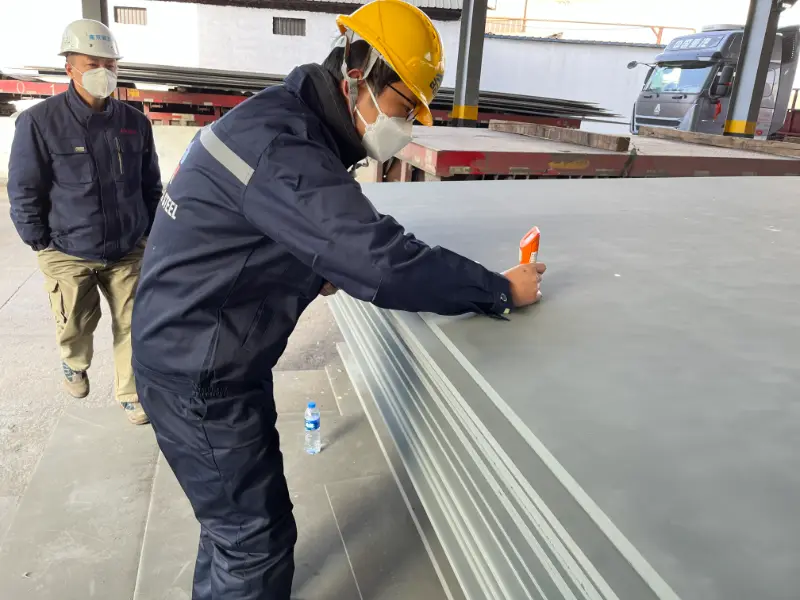
ASTM A533 Grade A Class 3 Pressure Vessel Steel Plate
ASTM A533 Grade A Class 3: High-Strength Quenched & Tempered Mn-Mo Steel for Pressure Vessels
In-depth material data for ASTM A533 Grade A Class 3, a manganese-molybdenum alloy steel plate for welded pressure vessels and boilers. Includes chemical composition, mechanical properties, and thermal/physical data.
Hot rolling + Quenching and Tempering (Q&T), welding (with appropriate preheat and PWHT), machining, cold forming (limited)
- Phone : +8618037372205
- Email : [email protected]
- WhatsApp: Contact via Whtsapp
- WeChat: +8618037372205
ASTM A533 Grade A Class 3 Pressure Vessel Steel Plate Introduction
ASTM A533 Grade A Class 3 is a quenched and tempered manganese-molybdenum alloy steel plate primarily used in the fabrication of welded pressure vessels and boilers. It belongs to the group of low-alloy steels that offer an excellent combination of high strength, good toughness, and weldability. Key attributes:
- Class 3 denotes the highest strength level within Grade A, with minimum yield strength of 415 MPa (60 ksi).
- The material responds well to heat treatment, achieving uniform mechanical properties in thick sections.
- It is designed for moderate-temperature service, typically not exceeding 370°C (700°F).
- Supplied in the quenched and tempered condition, ensuring consistent hardness and strength across the plate.
Typical applications include reactor shells, steam drums, and heat exchanger components in the petrochemical, power generation, and process industries.
ASTM A533 Grade A Class 3 Pressure Vessel Steel Plate Chemical Composition
Chemical requirements as per ASTM A533/A533M for Grade A Class 3. The steel is a manganese-molybdenum type with controlled carbon equivalent to ensure weldability. Heat analysis values apply; product analysis may have slight deviations as per the standard. All elements in weight percent.
| Chemical Element | Standard Value (Heat Analysis) | Remarks |
|---|---|---|
| Carbon (C) | ≤ 0.25 | Maximum limit |
| Manganese (Mn) | 1.15 - 1.50 | Range for base composition |
| Phosphorus (P) | ≤ 0.025 | Maximum limit |
| Sulfur (S) | ≤ 0.025 | Maximum limit |
| Silicon (Si) | 0.15 - 0.40 | Range |
| Molybdenum (Mo) | 0.45 - 0.60 | Range, key alloying element |
| Nickel (Ni) | ≤ 0.40 (residual) | Not intentionally added |
| Chromium (Cr) | ≤ 0.25 (residual) | Not intentionally added |
| Copper (Cu) | ≤ 0.35 (residual) | Trace element |
| Vanadium (V) | ≤ 0.03 (residual) | Trace element |
| Boron (B) | ≤ 0.001 | Not permitted |
ASTM A533 Grade A Class 3 Pressure Vessel Steel Plate Thermal and Electrical Physical Properties
Typical physical properties for ASTM A533 Grade A Class 3 steel. These values are not mandatory but are useful for design calculations. They are based on low-alloy steel data and may vary slightly with heat treatment and test direction.
| Property | Typical Value | Unit | Test Condition / Remarks |
|---|---|---|---|
| Density (ρ) | 7.85 | g/cm³ | Room temperature |
| Modulus of Elasticity (E) | 200 - 210 | GPa | Room temperature, dynamic method |
| Shear Modulus (G) | 80 | GPa | Calculated from E and ν |
| Poisson's Ratio (ν) | 0.27 - 0.30 | — | Elastic range |
| Thermal Expansion Coefficient (α) | 11.7 (20-100°C) | 10⁻⁶/K | 20-100°C |
| Thermal Expansion Coefficient (α) | 12.2 (20-200°C) | 10⁻⁶/K | 20-200°C |
| Thermal Expansion Coefficient (α) | 12.8 (20-300°C) | 10⁻⁶/K | 20-300°C |
| Thermal Conductivity (λ) | 42 | W/(m·K) | At 20°C |
| Thermal Conductivity (λ) | 40 | W/(m·K) | At 200°C |
| Thermal Conductivity (λ) | 37 | W/(m·K) | At 400°C |
| Specific Heat Capacity (cp) | 460 | J/(kg·K) | At 20°C |
| Specific Heat Capacity (cp) | 500 | J/(kg·K) | At 200°C |
| Specific Heat Capacity (cp) | 540 | J/(kg·K) | At 400°C |
| Electrical Resistivity (ρ_e) | 0.25 - 0.30 | μΩ·m | At 20°C |
ASTM A533 Grade A Class 3 Pressure Vessel Steel Plate Mechanical Properties
Minimum mechanical properties for plates in the quenched and tempered condition, as per ASTM A533/A533M for Grade A Class 3. Values depend on plate thickness. Tensile testing at room temperature; impact testing when specified by the purchaser (commonly Charpy V-notch at -40°C or other temperatures for pressure vessel service).
| Property | Standard Requirement | Unit | Test Condition / Thickness Range |
|---|---|---|---|
| Yield Strength (ReH) | ≥ 415 | MPa | Room temperature, t ≤ 50 mm |
| Yield Strength (ReH) | ≥ 380 | MPa | Room temperature, 50 mm < t ≤ 100 mm |
| Yield Strength (ReH) | ≥ 345 | MPa | Room temperature, 100 mm < t ≤ 150 mm |
| Tensile Strength (Rm) | 550 - 690 | MPa | Room temperature |
| Elongation (A) in 200 mm (8 in.) | ≥ 22 | % | t ≤ 50 mm, transverse specimen |
| Elongation (A) in 50 mm (2 in.) | ≥ 18 | % | t ≤ 50 mm, transverse specimen |
| Elongation (A) in 200 mm | ≥ 20 | % | 50 mm < t ≤ 100 mm |
| Elongation (A) in 50 mm | ≥ 16 | % | 50 mm < t ≤ 100 mm |
| Elongation (A) in 200 mm | ≥ 18 | % | 100 mm < t ≤ 150 mm |
| Elongation (A) in 50 mm | ≥ 14 | % | 100 mm < t ≤ 150 mm |
| Bend Test (180°) | No cracks | — | Bend diameter = 3T (T = plate thickness) for t ≤ 50 mm; 4T for thicker |
| Charpy V-Notch Impact (KV) | ≥ 27 (avg), ≥ 20 (single) | J | At -40°C or as agreed, transverse specimen |
ASTM A533 Grade A Class 3 Pressure Vessel Steel Plate Directly Equivalent Standards and Replaceable Grades
| Country/Region | Standard | Grade/Designation | Remarks |
|---|---|---|---|
| USA | ASME SA533 | Grade A Class 3 | Identical to ASTM A533 Gr A Cl3; accepted by ASME Boiler and Pressure Vessel Code |
| USA | ASTM A533 | Grade A Class 3 | The base specification itself |
| USA | ASTM A20/A20M | — | General requirements for pressure vessel plates; supplementary conditions apply |
ASTM A533 Grade A Class 3 Pressure Vessel Steel Plate Application Introduction
ASTM A533 Grade A Class 3 is optimized for heavy-walled pressure vessels operating at ambient to moderate temperatures (up to about 370°C). It provides a balance of strength and toughness, with good weldability using low-hydrogen procedures. Post-weld heat treatment is typically required depending on thickness and service environment.
- Excellent hardenability from Mo addition ensures through-thickness properties.
- Often used in hydrogen service with careful control of impurities and heat treatment.
- Charpy impact requirements guarantee resistance to brittle fracture.
Product Applications: Steam drums for utility and industrial boilers, High-pressure separators in natural gas processing, Hydrocracking and hydrotreating reactor shells, Ammonia converter shells, Methanol synthesis reactor shells, Large heat exchanger shells and channels
Processed into products: Vessel shell courses and heads (dished, elliptical), Nozzle reinforcement pads, Flanges (with proper welding overlay for corrosion), Tube sheets (if clad with corrosion-resistant alloy), Boiler drum end plates, Support skirts and structural rings attached to pressure boundary
Application industries: Oil & Gas (refining, gas processing), Petrochemical (ethylene, ammonia plants), Power Generation (boiler drums, steam-water separators), Chemical Processing (reactors, high-pressure vessels), Nuclear (some components not requiring nuclear-grade SA533 B)
ASTM A533 Grade A Class 3 Pressure Vessel Steel Plate Similar or Near-Equivalent Material Recommendations
| Country/Region | Standard | Grade/Designation | Remarks |
|---|---|---|---|
| European Union | EN 10028-2 | 13CrMo4-5 (1.7335) | Lower tensile strength (440-590 MPa), higher Cr; suitable for similar service up to 570°C but different strength class; cannot directly substitute without redesign |
| China | GB 713 | 15MnMoV | Similar Mn-Mo(-V) type, yield ~390 MPa, requires comparison of thickness and heat treatment |
| Japan | JIS G3119 | SBV2 | Quenched & tempered Mn-Mo-Ni plate with similar strength (SBV2 tensile 570-720 MPa), but contains Ni; may be substituted with engineering approval |
| Germany | DIN 17155 | 15Mo3 (deprecated) | Earlier Mo steel with lower strength; only similar for mild applications, not a direct replacement |
Notes:
- Plates are usually ultrasonic tested per ASTM A435 or A578 for internal soundness.
- For service at low temperatures, supplementary impact testing per SA-20 is mandatory; typical test temperature is -40°C (or lower by agreement).
- Welding requires low-hydrogen electrodes/processes and strict preheat/interpass control; PWHT at 620-680°C is common.
- When specifying to ASME SA533 Gr A Cl3, the material meets the requirements of ASME Section II Part A, and the same composition/mechanical limits apply.
- Share



