
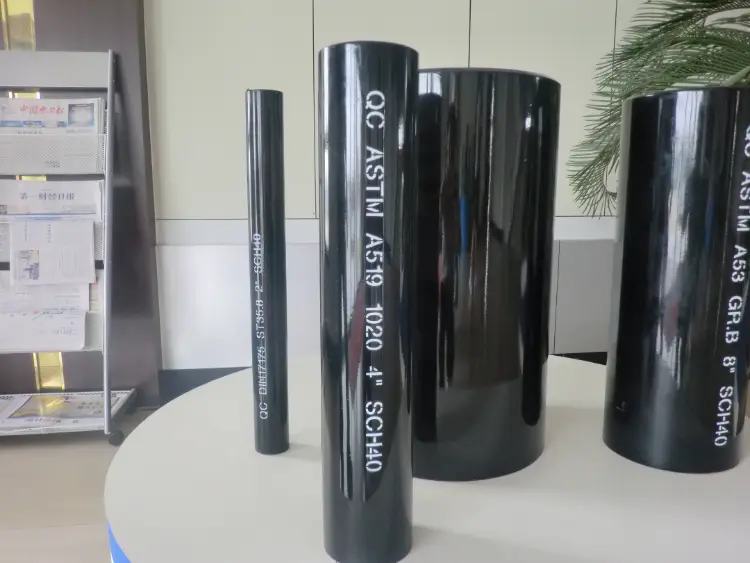
ASTM A519 Grade 4150 Seamless Alloy Steel Tubing
ASTM A519 4150 Seamless Mechanical Tubing: High-Strength Cr-Mo Alloy for Automotive & Structural Parts
Detailed profile of ASTM A519 grade 4150 seamless carbon and alloy steel mechanical tubing, including composition, mechanical properties, physical data, and global equivalents.
Cold drawing, hot rolling, turning, boring, heat treatment (quenching & tempering, annealing, normalizing), machining, welding
- Phone : +8618037372205
- Email : [email protected]
- WhatsApp: Contact via Whtsapp
- WeChat: +8618037372205
ASTM A519 Grade 4150 Seamless Alloy Steel Tubing Introduction
ASTM A519 4150 is a cold-finished or hot-finished seamless mechanical tubing grade specified under ASTM A519. It is a medium-carbon chromium-molybdenum alloy steel that offers an excellent combination of high strength, good toughness, and wear resistance after heat treatment. Typical applications include highly stressed automotive and structural components such as shafts, gears, and hydraulic cylinder barrels. The grade is characterized by:
- Carbon content 0.48–0.53% for deep hardenability
- Chromium (0.80–1.10%) and molybdenum (0.15–0.25%) additions for improved hardenability and high-temperature strength
- Good machinability in the normalized or annealed condition
- Weldable with proper procedures, often requiring preheat and post-weld heat treatment
ASTM A519 Grade 4150 Seamless Alloy Steel Tubing Chemical Composition
The chemical requirements for grade 4150 under ASTM A519 are derived from the standard's general alloy steel requirements. Values represent the heat analysis limits; product analysis may show slight variations as permitted by the specification. Phosphorus and sulfur maxima are typically restricted for better toughness and cleanliness.
| Element | Composition (wt%) | Remarks |
|---|---|---|
| Carbon (C) | 0.48 – 0.53 | |
| Manganese (Mn) | 0.75 – 1.00 | |
| Phosphorus (P) | ≤ 0.035 | Maximum |
| Sulfur (S) | ≤ 0.040 | Maximum (may be ≤ 0.050 for some product forms) |
| Silicon (Si) | 0.15 – 0.35 | Required for killed fine grain practice |
| Chromium (Cr) | 0.80 – 1.10 | |
| Molybdenum (Mo) | 0.15 – 0.25 | |
| Iron (Fe) | Balance | Approximately 96.8 – 97.7% |
ASTM A519 Grade 4150 Seamless Alloy Steel Tubing Physical Properties
The values provided are typical for AISI 4150 steel in the as-rolled or normalized condition. Thermal properties are influenced by heat treatment and microstructure. These data are useful for design calculations involving thermal expansion, heat transfer, and elastic deformation.
| Property | Typical Value | Unit | Test Condition / Remarks |
|---|---|---|---|
| Density (ρ) | 7.85 | g/cm³ | 20 °C |
| Elastic Modulus (E) | 205 | GPa | Tension, room temperature |
| Shear Modulus (G) | 80 | GPa | Calculated from E and ν |
| Poisson's Ratio (ν) | 0.29 | – | In elastic range |
| Thermal Expansion Coefficient (α) | 12.1 | 10⁻⁶/°C | 20–100 °C |
| Thermal Expansion Coefficient (α) | 13.0 | 10⁻⁶/°C | 20–200 °C |
| Thermal Expansion Coefficient (α) | 13.8 | 10⁻⁶/°C | 20–400 °C |
| Thermal Conductivity (λ) | 42.6 | W/(m·K) | At 100 °C |
| Thermal Conductivity (λ) | 38.5 | W/(m·K) | At 200 °C |
| Thermal Conductivity (λ) | 33.5 | W/(m·K) | At 400 °C |
| Specific Heat Capacity (cp) | 477 | J/(kg·K) | At 20 °C (approx.) |
| Electrical Resistivity (ρe) | 0.22 | µΩ·m | At 20 °C |
ASTM A519 Grade 4150 Seamless Alloy Steel Tubing Typical Mechanical Properties
ASTM A519 does not prescribe mandatory mechanical properties; they are subject to agreement between supplier and purchaser. The following values are typical reference data for grade 4150 in various heat-treated conditions, based on industry sources for AISI/SAE 4150 bar products of equivalent chemistry. Actual properties depend on tube size, wall thickness, and exact heat treatment.
| Property | Typical Value | Unit | Condition |
|---|---|---|---|
| Tensile Strength (Rm) | ≥ 965 | MPa | Quenched & tempered (540°C min temper) |
| Yield Strength (ReH 0.2% offset) | ≥ 830 | MPa | Quenched & tempered (540°C min temper) |
| Elongation (A, 2 inch or 50 mm) | ≥ 12 | % | Quenched & tempered (540°C min temper) |
| Reduction of Area (Z) | ≥ 40 | % | Quenched & tempered (540°C min temper) |
| Hardness | 285 – 341 | HBW | Quenched & tempered (typical range) |
| Tensile Strength (Rm) | ≥ 760 | MPa | Normalized and tempered |
| Yield Strength (ReH) | ≥ 520 | MPa | Normalized and tempered |
| Elongation (A) | ≥ 18 | % | Normalized and tempered |
| Hardness | 220 – 270 | HBW | Normalized and tempered |
| Tensile Strength (Rm) | ≥ 620 | MPa | Annealed |
| Yield Strength (ReH) | ≥ 380 | MPa | Annealed |
| Elongation (A) | ≥ 22 | % | Annealed |
| Hardness | ≤ 217 | HBW | Annealed (max) |
| Charpy Impact (KV, room temp.) | ≥ 40 | J | Quenched & tempered (typical) |
ASTM A519 Grade 4150 Seamless Alloy Steel Tubing Directly Equivalent Standards / Substitute Grades
There are very few exact matches for ASTM A519 4150 because of its specific carbon range. The most common direct cross-reference is the UNS designation G41500. In other international standards, the grade exists mainly within the SAE/AISI system. European and Japanese standards offer grades with similar alloy concept but slightly different carbon contents.
| Country / Region | Standard / Specification | Grade Designation | Remarks |
|---|---|---|---|
| USA | ASTM A519 / SAE J404 | 4150 / UNS G41500 | The identical grade in seamless mechanical tubing and bar standards. |
| International | ISO 683-2 | 42CrMo4 (1.7225) | Carbon range 0.38–0.45%, slightly lower; often accepted as nearest equivalent for heat treatable alloy tubing. |
| Japan | JIS G4105 | SCM445 | Carbon 0.43–0.48%, Mo up to 0.30%; close but not identical. |
ASTM A519 Grade 4150 Seamless Alloy Steel Tubing Application Introduction
ASTM A519 4150 tubes are chosen for applications requiring high tensile and torsional strength, good fatigue resistance, and the ability to withstand high contact stresses after induction hardening or through hardening. Typical uses are:
- Power transmission components
- Hydraulic and pneumatic cylinders operating under high pressure
- Structural members in heavy-duty machinery and transportation
The grade is readily machinable in the annealed condition and can be selectively hardened.
Product Applications: Hydraulic cylinder barrels and rods, Drive shafts, Axle tubes, Gear blanks and gear components, Steering knuckles and tie rods, High-stress structural frames
Processed into products: Induction-hardened shaft journals, Spline shafts, Pinion shafts, Cylinder liners for high-pressure pumps, Torsion bars, Roll cages and impact structures
Application industries: Automotive, Agricultural machinery, Construction and earthmoving equipment, Oil & gas, Hydraulic cylinder manufacturing, General mechanical engineering
ASTM A519 Grade 4150 Seamless Alloy Steel Tubing Similar / Alternative Materials with Comparable Performance
| Country / Region | Standard | Grade | Remarks |
|---|---|---|---|
| USA | ASTM A519 / SAE | 4140 | Lower carbon (0.38–0.43%); reduced hardenability and lower maximum hardness, but higher toughness. Commonly used when 4150 hardness is not required. |
| Europe | EN 10297-1 | 42CrMo4 | Widely used alloy mechanical tube grade; carbon 0.38–0.45%, but otherwise similar Cr-Mo content. Suitable where core strength requirements are slightly lower. |
| Japan | JIS G3441 / JIS G4105 | SCM440 | Carbon 0.38–0.43%; similar application profile, often used for quenched and tempered automotive tubing. |
| China | GB/T 8162 | 42CrMo (A30422) | Chinese equivalent to 4140/42CrMo4; can be considered if design allows slightly lower carbon. |
| USA | ASTM A519 | 5150 | Carbon 0.48–0.53% with chromium 0.70–0.90% but no molybdenum. Lower hardenability than 4150; suitable for less severe sections. |
Notes:
Heat treatment: Typical quenching temperature is 830–860°C in oil or water, then temper at 540–680°C depending on required strength. Soak time varies with wall thickness.
Welding: Preheat to 200–300°C is recommended; post-weld stress relief at 600–650°C to avoid cracking. Welding in the quenched and tempered condition may reduce strength in the heat-affected zone.
Non-destructive testing: ASTM A519 permits supplementary requirements for eddy current, ultrasonic, or magnetic particle inspection when specified in the order.
- Share



