
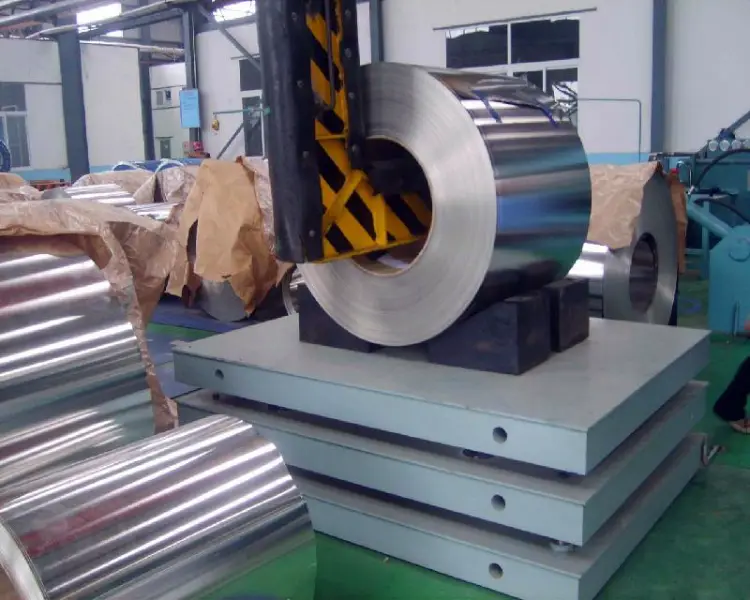
ASTM A514 Grade T High-Strength Quenched & Tempered Steel Coil
ASTM A514 Grade T High-Strength Quenched & Tempered Steel Coil - 690 MPa Alloy Steel for Demanding Structures
Complete material profile for ASTM A514 Grade T carbon and low-alloy high-strength steel coil: chemical composition, mechanical and physical properties, international equivalents, and application guidance.
Hot rolling, controlled rolling, quenching and tempering (Q&T). Fabrication: welding (low-hydrogen process), cold/hot forming, machining.
- Phone : +8618037372205
- Email : [email protected]
- WhatsApp: Contact via Whtsapp
- WeChat: +8618037372205
ASTM A514 Grade T High-Strength Quenched & Tempered Steel Coil Introduction
ASTM A514 Grade T is a quenched and tempered (Q&T) carbon and low-alloy high-strength steel with a minimum yield strength of 690 MPa (100 ksi). It is designed for applications where weight reduction is critical, combining excellent strength, good weldability, and notch toughness. Key features include:
- Ultra-high yield and tensile strength through a balanced chemistry of Ni, Cr, Mo, and microalloying elements like V, Nb, Ti, and B.
- Excellent hardenability enabling full through-thickness properties in plates up to 2 in. (50.8 mm).
- Good low-temperature toughness, often specified with supplementary Charpy requirements.
- Available in coil form for efficient processing into cut-to-length plates or formed components.
It is widely used in heavy mobile equipment, cranes, offshore structures, and bridges.
ASTM A514 Grade T High-Strength Quenched & Tempered Steel Coil Chemical Composition
The chemical composition of ASTM A514 Grade T steel is tightly controlled to achieve deep hardenability and a fine-grained tempered martensitic structure. All values are from the ASTM A514/A514M specification (ladle analysis). Microalloying additions of V, Nb, Ti, and B play a critical role in grain refinement and precipitation strengthening, ensuring high strength without compromising weldability.
| Element | Standard Value | Remarks |
|---|---|---|
| Carbon (C) | 0.10 – 0.20 | Ladle analysis; product analysis may vary slightly |
| Manganese (Mn) | 1.10 – 1.50 | Includes additions for hardenability |
| Phosphorus (P) | ≤ 0.035 | Maximum limit for steel cleanliness |
| Sulfur (S) | ≤ 0.040 | Lower levels often specified for superior toughness |
| Silicon (Si) | 0.15 – 0.35 | Primarily for deoxidation |
| Nickel (Ni) | 1.55 – 2.00 | Enhances toughness and hardenability |
| Chromium (Cr) | 0.45 – 0.75 | Increases hardenability and oxidation resistance |
| Molybdenum (Mo) | 0.45 – 0.60 | Improves hardenability and elevated temperature strength |
| Vanadium (V) | 0.03 – 0.08 | Grain refinement and dispersion strengthening |
| Copper (Cu) | 0.20 – 0.40 | Optional but typical; improves atmospheric corrosion resistance |
| Boron (B) | 0.001 – 0.005 | Significantly boosts hardenability |
| Columbium (Nb/Cb) | 0.05 – 0.10 | Grain refinement and precipitation hardening |
| Titanium (Ti) | 0.01 – 0.06 | Grain refinement and nitrogen fixation to protect boron |
ASTM A514 Grade T High-Strength Quenched & Tempered Steel Coil Thermal and Electrical Physical Properties
These physical properties represent typical values for quenched and tempered A514 Grade T steel. Actual values may vary slightly with tempering temperature and specific heat treatment. Thermal conductivity and expansion are in the range of low-alloy engineering steels, ensuring compatibility with conventional fabrication processes.
| Property | Typical Value | Unit | Condition |
|---|---|---|---|
| Density (ρ) | 7850 | kg/m³ | Room temperature |
| Elastic Modulus (E) | 200 | GPa | Tension, room temperature |
| Shear Modulus (G) | 80 | GPa | Calculated from E and ν |
| Poisson's Ratio (ν) | 0.3 | — | Elastic range |
| Thermal Expansion Coefficient (α) | 11.7 | 10⁻⁶/K | 20–100 °C |
| Thermal Conductivity (λ) | 42 | W/(m·K) | At 100 °C |
| Specific Heat Capacity (c) | 450 | J/(kg·K) | Room temperature |
| Electrical Resistivity (ρₑ) | 0.20 | μΩ·m | Room temperature |
ASTM A514 Grade T High-Strength Quenched & Tempered Steel Coil Mechanical Properties
Mechanical properties are determined on transverse test specimens from quenched and tempered material as per ASTM A514/A514M. Minimum values are mandatory for thicknesses up to 2 in. (50.8 mm). Charpy impact testing is a supplementary requirement and must be specified in the purchase order. The high yield-to-tensile ratio provides excellent structural performance.
| Property | Standard Requirement | Unit | Test Condition |
|---|---|---|---|
| Yield Strength (ReH) | ≥ 690 (100 ksi) | MPa (ksi) | 0.2% offset, room temperature; for all thicknesses |
| Tensile Strength (Rm) | 760 – 895 (110 – 130 ksi) | MPa (ksi) | Room temperature |
| Elongation (A50) | ≥ 18% | % | Gauge length 2 in. (50 mm), transverse; thickness ≤ 3/4 in. |
| Elongation (A50) | ≥ 17% | % | Gauge length 2 in. (50 mm), transverse; thickness > 3/4 in. to 2 in. |
| Bend Test | Bend radius 2t (t ≤ 3/4 in.); 2.5t (t > 3/4 in. to 2 in.) | — | 180° cold bend, supplementary requirement S4 (if specified) |
| Charpy V-Notch Impact | Typically 27 J at -20 °C (standard agreement) | J ( °C) | Supplementary requirement S2; not mandatory unless specified |
ASTM A514 Grade T High-Strength Quenched & Tempered Steel Coil Completely Equivalent Material Standards and Replaceable Grade Recommendations
| Country/Region | Standard | Grade | Remarks |
|---|---|---|---|
| USA | ASTM A517/A517M | Grade T | Identical chemical composition and mechanical properties; intended for pressure vessel plates, but fully interchangeable for structural applications when certified to A517. |
ASTM A514 Grade T High-Strength Quenched & Tempered Steel Coil Application Introduction
ASTM A514 Grade T combines high strength with good formability and weldability, making it a top choice for weight-critical structures subjected to high static and dynamic loads. Its availability in coil form facilitates cost-efficient fabrication of long members and complex shapes. Common application areas include:
Product Applications: Mobile cranes and telescopic booms, Excavator arms, buckets, and mining shovels, Jack-up rig legs and offshore platform braces, Heavy-duty truck chassis frames, Welded bridge girders and trusses, High-strength hollow structural sections, Pressure vessels and storage tanks
Processed into products: Crane main chords and lacings, Excavator boom and stick assemblies, Loader lift arms and linkage, Offshore structural node cans, Bridge splice plates and diaphragms, Mining dump truck bodies and wear liners, Telescopic handler booms, Wind turbine tower flanges and transition pieces
Application industries: Heavy Equipment Manufacturing, Offshore and Marine Engineering, Bridge Construction, Pressure Vessel Fabrication (via A517 equivalent), Mining and Earthmoving Machinery, Crane and Lifting Equipment, Transport and Trailer Engineering
ASTM A514 Grade T High-Strength Quenched & Tempered Steel Coil Similar/Alternative Material Recommendations
| Country/Region | Standard | Grade | Remarks |
|---|---|---|---|
| Europe | EN 10025-6 | S690Q | Quenched and tempered high yield strength structural steel; yield ≥690 MPa, chemistry differs, requires review of weldability and toughness. |
| Japan | JIS G3128 | SHY685 | High-strength steel for welded structures; similar tensile properties, but different alloy design. |
| International | ISO 4950-2 | E690DD | High yield strength structural steel, Q&T; similar performance class, chemical equivalence not guaranteed. |
| USA | ASTM A514/A514M | Grade F | Same specification, 100 ksi yield strength, but different chemical composition; may be considered if toughness and weldability match. |
| China | GB/T 16270 | Q690D | Quenched and tempered high strength structural steel plate; similar strength level, verify specific grade for low-temperature properties. |
Notes:
Welding: Low-hydrogen processes (SMAW, GMAW, FCAW, SAW) are mandatory. Preheating (100–200°C) and controlled interpass temperature are essential due to high hardenability. Post-weld heat treatment is generally unnecessary for thicknesses below 1.5 in., but may be applied for stress relief. Forming: Cold forming should be followed by stress relieving at 550–600°C if deformation exceeds 5%. Hot forming requires subsequent re-quenching and tempering to restore mechanical properties. Availability: Coils are supplied in thicknesses up to 2 in. (50.8 mm) and widths up to 120 in. (3050 mm), with cut-to-length options. Custom testing (Charpy, UT, through-thickness tensile) can be arranged as per ASTM A514/A514M supplementary requirements.
- Share



