
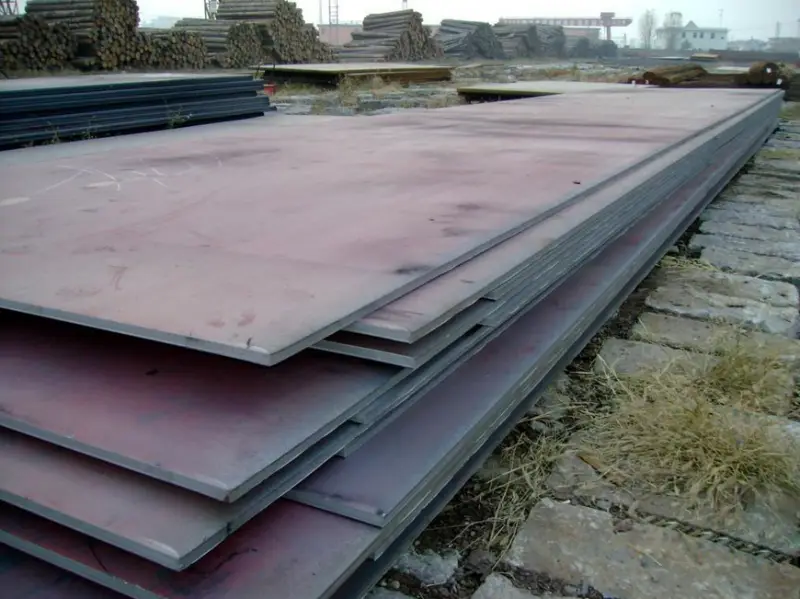
ASTM A514 Grade S Steel
ASTM A514 Grade S Quenched & Tempered High-Strength Steel Coil: Properties & Equivalents
Detailed technical data for ASTM A514/A514M Grade S carbon and low-alloy high-strength steel coil, including chemical composition, mechanical properties, thermal and electrical physical properties, equivalent standards, and application guidance.
Cutting, bending, forming, welding, machining, drilling
- Phone : +8618037372205
- Email : [email protected]
- WhatsApp: Contact via Whtsapp
- WeChat: +8618037372205
ASTM A514 Grade S Steel Introduction
ASTM A514 Grade S is a carbon and low-alloy steel supplied in the quenched and tempered condition, delivering a minimum yield strength of 620 MPa (90 ksi) with excellent weldability and low-temperature toughness. It is designed for weight-critical structural applications that require high strength and good formability. Thanks to its fine grain structure and controlled alloy additions, Grade S offers consistent mechanical performance across a wide thickness range.
- Yield strength up to 690 MPa (100 ksi) for thin plates
- Tensile strength 690–895 MPa (100–130 ksi)
- Charpy impact energy ≥27 J at -45°C
- Available as coil and plate for demanding welded fabrications
ASTM A514 Grade S Steel Chemical Composition
The chemical composition of ASTM A514 Grade S is carefully balanced to achieve high strength and good toughness after quenching and tempering. Carbon is kept in a moderate range to ensure weldability, while micro-alloying elements such as vanadium and boron contribute to hardenability and grain refinement. Maximum limits on phosphorus and sulfur ensure cleanliness and low-temperature ductility.
| Chemical Element | Nominal Value (wt. %) | Remarks |
|---|---|---|
| Carbon, C | 0.10 – 0.20 | Per ASTM A514/A514M |
| Manganese, Mn | 0.60 – 1.00 | Per ASTM A514/A514M |
| Phosphorus, P | ≤ 0.035 | Max |
| Sulfur, S | ≤ 0.040 | Max |
| Silicon, Si | 0.15 – 0.35 | Per ASTM A514/A514M |
| Nickel, Ni | ≤ 0.25 | Max |
| Chromium, Cr | ≤ 0.25 | Max |
| Molybdenum, Mo | ≤ 0.10 | Max |
| Copper, Cu | ≤ 0.35 | Max |
| Vanadium, V | ≤ 0.08 | Max |
| Boron, B | ≤ 0.0005 | Max |
ASTM A514 Grade S Steel Thermal and Electrical Physical Properties
Physical properties of ASTM A514 Grade S are similar to those of common low-alloy quenched and tempered steels. Values provided are typical for engineering calculations at room temperature or as indicated. They can vary slightly depending on exact composition and heat treatment condition.
| Property | Typical Value | Unit | Test Condition / Remarks |
|---|---|---|---|
| Density (ρ) | 7.85 | g/cm³ | At 20°C |
| Elastic Modulus (E) | 205 | GPa | At 20°C |
| Shear Modulus (G) | 80 | GPa | At 20°C |
| Poisson's Ratio (ν) | 0.30 | – | At 20°C |
| Thermal Expansion Coefficient (α) | 12.0 | 10⁻⁶ /°C | 20–100°C range |
| Thermal Conductivity (λ) | 42 | W/(m·K) | At 100°C |
| Specific Heat Capacity | 0.486 | J/(g·°C) | At 100°C |
| Electrical Resistivity (ρ_e) | 0.22 | µΩ·m | At 20°C |
ASTM A514 Grade S Steel Mechanical Properties
Mechanical properties depend on plate thickness. Yield strength and tensile strength are specified for two thickness ranges. Elongation values are determined using 50 mm (2 in.) or 200 mm (8 in.) gauge lengths. The Charpy impact test is performed at -45°C (-50°F) in the longitudinal direction to guarantee brittle fracture resistance. Bend test requirements demonstrate good cold formability.
| Property | Standard Requirement | Unit | Test Condition / Remarks |
|---|---|---|---|
| Yield Strength (ReH) | ≥ 690 (100 ksi) | MPa | Thickness ≤ 12.5 mm (0.5 in.) |
| Yield Strength (ReH) | ≥ 620 (90 ksi) | MPa | Thickness > 12.5 mm to 63.5 mm (0.5–2.5 in.) |
| Tensile Strength (Rm) | 760 – 895 (110–130 ksi) | MPa | Thickness ≤ 12.5 mm (0.5 in.) |
| Tensile Strength (Rm) | 690 – 895 (100–130 ksi) | MPa | Thickness > 12.5 mm to 63.5 mm (0.5–2.5 in.) |
| Elongation (A) | ≥ 21 | % | Gauge length 50 mm (2 in.) |
| Elongation (A) | ≥ 18 | % | Gauge length 200 mm (8 in.) |
| Bend Test | 180° bend, d = 2t | – | Thickness ≤ 12.5 mm |
| Bend Test | 180° bend, d = 3t | – | 12.5 mm < thickness ≤ 38 mm |
| Charpy Impact Energy (KV) | ≥ 27 (20 ft·lb) | J | Longitudinal, -45°C (-50°F), V-notch |
ASTM A514 Grade S Steel Direct Equivalent Standards and Substitute Grades
| Country/Region | Standard | Grade | Remarks |
|---|---|---|---|
| United States | ASTM A514/A514M | Grade S | Original specification |
| Europe | EN 10025-6 | S690Q (1.8931) | Close match in strength and toughness; slight chemistry variation |
| Japan | JIS G 3128 | SHY 685 | Comparable yield and tensile strength, similar weldability |
| China | GB/T 16270 | Q690D | Similar mechanical properties; check impact test temperature |
ASTM A514 Grade S Steel Application Introduction
ASTM A514 Grade S is widely used in heavy-duty welded structures that require high strength and reduced weight. Its combination of high yield strength, good low-temperature toughness, and reliable weldability makes it suitable for mobile equipment and critical infrastructure. Typical applications include:
- Mobile crane booms and lattice structures
- Off-highway truck frames and bodies
- Excavator and shovel components
- Bridge girders and orthotropic deck plates
- Offshore platform members and jack-up legs
- Pressure vessel shells requiring quenched and tempered steel
Product Applications: Mobile cranes, Mining dump trucks, Heavy trailers, Bridges and flyovers, Offshore lifting platforms, Large pressure vessels
Processed into products: Crane boom sections and chords, Truck frame rails, Structural beams and box sections, Welded I-girders, Lifting arms and undercarriage parts, Excavator buckets and attachments
Application industries: Construction & Infrastructure, Mining & Quarrying, Crane & Heavy Lift Equipment, Shipbuilding & Offshore, Transport & Trailers, Pressure Equipment Manufacturing
ASTM A514 Grade S Steel Similar or Approximate Substitute Materials
| Country/Region | Standard | Grade | Remarks |
|---|---|---|---|
| United States | ASTM A514/A514M | Grade B | Higher chromium and molybdenum, similar strength but different hardenability |
| United States | ASTM A514/A514M | Grade H | Optimized for thicker sections; may be substituted with adjusted welding procedures |
| Europe | EN 10025-6 | S690QL (1.8928) | Lower carbon equivalent; improved toughness at low temperatures |
| Europe | EN 10149-2 | S700MC | Thermomechanical rolled; similar strength but thinner gauge capability |
Notes:
Welding considerations: Preheat to 150–200°C (300–400°F) is recommended to prevent hydrogen-induced cold cracking. Use low-hydrogen welding processes and consumables. Post-weld heat treatment: Stress relieving at a temperature no higher than the original tempering temperature (typically ≤540°C) may be applied. Forming: Cold and limited warm forming are possible; hot forming above 600°C may reduce mechanical properties and should be followed by re-heat treatment. Availability: Supplied as quenched and tempered coil, plate, or cut pieces according to ASTM A514/A514M. Mill test reports include chemical analysis and mechanical test results per heat and plate.
- Share



