
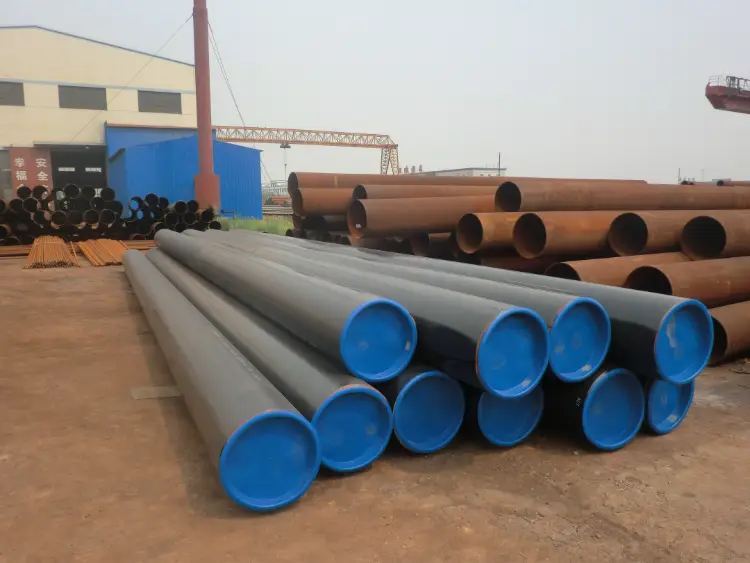
ASTM A36 ERW Pipe
ASTM A36 ERW Pipe: Carbon Structural Steel Tubes
Full material data for ASTM A36 electric resistance welded pipe covering chemical, mechanical and thermal properties with international substitutes and typical applications.
Welding, cutting, bending, punching, drilling, forming
- Phone : +8618037372205
- Email : [email protected]
- WhatsApp: Contact via Whtsapp
- WeChat: +8618037372205
ASTM A36 ERW Pipe Introduction
ASTM A36 is a widely used carbon structural steel specified by ASTM A36/A36M. When produced as electric resistance welded (ERW) pipes, it delivers an excellent balance of strength, weldability and formability. The material is predominantly ferritic, featuring a maximum carbon content of 0.26% and controlled amounts of manganese, phosphorus and sulfur. ERW pipes made from A36 steel find extensive use in structural frames, general piping, and frameworks due to easy fabrication and consistent properties. Standard delivery condition is as‑welded, often requiring no post‑weld heat treatment for many applications.
ASTM A36 ERW Pipe Chemical Composition
The following chemical requirements apply to heat analysis of ASTM A36 steel used for ERW pipe production. Manganese is not explicitly limited by the standard; typical ranges depend on product thickness. Copper may be specified as a minimum when the steel is ordered as copper‑containing.
| Element | Standard Value | Remarks |
|---|---|---|
| Carbon (C) | 0.26 max | Heat analysis |
| Manganese (Mn) | 0.80–1.20 (typical) | No specified limit; value depends on thickness |
| Phosphorus (P) | 0.04 max | |
| Sulfur (S) | 0.05 max | |
| Silicon (Si) | 0.40 max | 0.15–0.40 for plates >1.5 in. thick |
| Copper (Cu) | 0.20 min (if specified) | Only when copper steel is required |
ASTM A36 ERW Pipe Thermal and Electrical Physical Properties
These physical properties are representative of carbon steel similar to ASTM A36 at room temperature and ambient pressure. Values may vary slightly with temperature and exact composition. They are useful for thermal and structural design calculations.
| Property | Value | Unit | Test Condition |
|---|---|---|---|
| Density (ρ) | 7850 | kg/m³ | 20 °C |
| Elastic Modulus (E) | 200 | GPa | Room temperature |
| Shear Modulus (G) | 80 | GPa | Calculated |
| Poisson's Ratio (ν) | 0.26 | – | Room temperature |
| Thermal Expansion (α) | 12.0 | 10⁻⁶/K | 20–100 °C |
| Thermal Conductivity (λ) | 52 | W/(m·K) | 0–100 °C |
| Specific Heat Capacity (c) | 486 | J/(kg·K) | 0–100 °C |
| Electrical Resistivity (ρ_e) | 0.15 | µΩ·m | 20 °C |
ASTM A36 ERW Pipe Mechanical Properties – Typical Reference Values for A36 Steel
The mechanical characteristics shown below are typical for ASTM A36 steel plates and shapes. For ERW pipes, the actual pipe specification (e.g. ASTM A53 Grade B) may impose slightly different values. Yield strength, tensile strength and elongation are determined on a 200 mm (8 in.) gauge length specimen. Bending test requirements are per ASTM A6/A6M.
| Property | Value | Unit | Test Condition |
|---|---|---|---|
| Yield Strength (ReH) | ≥ 250 | MPa | For thickness ≤ 200 mm; 36 ksi min |
| Tensile Strength (Rm) | 400 – 550 | MPa | 58 – 80 ksi |
| Elongation (A) | ≥ 20 | % | 200 mm gauge length |
| Elongation (A) | ≥ 23 | % | 50 mm gauge length (alternative) |
| Bend Test | 180°, mandrel diameter 1.5t (t ≤ 20 mm) | – | No cracks outside the bend; per ASTM A6 |
ASTM A36 ERW Pipe Complete Equivalent Standards and Substitute Grades
| Country/Region | Standard | Grade | Remarks |
|---|---|---|---|
| International (ISO) | ISO 630-2 | Fe 510B | Comparable strength |
| European Union | EN 10025-2 | S275JR | Minimum yield 275 MPa |
| Japan | JIS G3101 | SS400 | General structural steel |
| China | GB/T 700 | Q235B | Yield 235 MPa min |
| USA | ASTM A36/A36M | A36 | Base material |
ASTM A36 ERW Pipe Application Introduction
ASTM A36 ERW pipe is versatile and cost‑effective. Its mechanical properties suit a wide spectrum of structural and light‑duty fluid transmission uses. Typical industries and components include:
Product Applications: Structural steel tubes and hollow sections, Scaffolding tubes and props, Fencing posts and gates, Low‑pressure water and gas pipes, Sign and lighting poles, Conveyor rollers and frames
Processed into products: Beams, columns and braces for light‑duty steel structures, Pipe piles (small diameter), Handrail balusters and rails, Bike racks and park furniture, Fence panels and trellis frames, Greenhouse arches and support beams, Machine frames and guards
Application industries: Construction (building frames, columns, trusses), Transportation (sign posts, guardrails, bicycle racks), Water & gas distribution (low‑pressure lines), Agriculture (irrigation pipes, fences, greenhouse frames), HVAC (duct supports, piping), General fabrication (handrails, furniture, storage racks)
ASTM A36 ERW Pipe Similar or Substitutable Materials
| Country/Region | Standard | Grade | Remarks |
|---|---|---|---|
| USA | ASTM A53/A53M | Grade B (ERW pipe) | Pipe standard; min yield 240 MPa |
| USA | ASTM A283/A283M | Grade C | Slightly lower tensile range |
| European Union | EN 10025-2 | S235JR | Lower yield and tensile |
| Japan | JIS G3101 | SS330 | Lower minimum strength |
| China | GB/T 700 | Q195 | Lower carbon, lower strength |
Notes:
ERW pipes manufactured from ASTM A36 steel are commonly certified to pipe specifications such as ASTM A53 Grade B or API 5L when intended for pressure applications. In these cases, the mechanical and chemical requirements of the pipe standard take precedence. The listed physical properties are typical for carbon steel and can be used for design calculations; however, for precision work, refer to certified mill test reports. When welding, low‑hydrogen procedures are recommended for thicknesses above 25 mm to avoid hydrogen‑induced cracking.
- Share



