
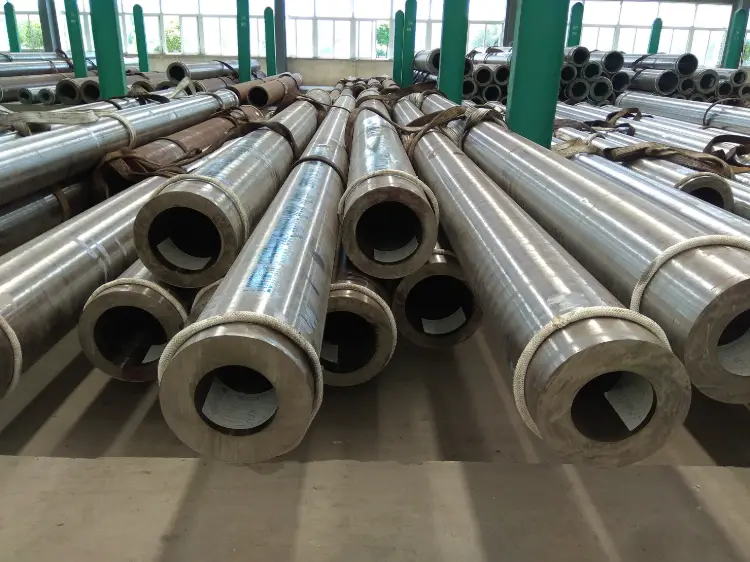
ASTM A283 Grade C Carbon Steel LSAW Pipe
ASTM A283 Grade C Carbon Steel LSAW Pipe - Composition, Properties & Equivalents
Complete material data for ASTM A283 Grade C carbon steel used in LSAW pipes, including chemical composition, mechanical and thermal properties, international equivalents and application examples.
Hot rolling, controlled rolling, normalizing, welding (LSAW), cutting, forming, machining
- Phone : +8618037372205
- Email : [email protected]
- WhatsApp: Contact via Whtsapp
- WeChat: +8618037372205
ASTM A283 Grade C Carbon Steel LSAW Pipe Introduction
ASTM A283 Grade C is a low-to-intermediate strength carbon steel specified in ASTM A283/A283M for structural applications. It is commonly supplied as plates, sheets, and strips, and is widely used to fabricate LSAW (Longitudinal Submerged Arc Welded) pipes for moderate-service conditions. The steel offers good weldability, adequate ductility, and reliable mechanical properties at a cost-effective price point. Typical yield strength is 205 MPa (30 ksi), with tensile strength between 380 and 515 MPa (55–75 ksi). Its chemical composition is uncomplicated, making it suitable for general fabrication, storage tanks, building frameworks, and low-pressure piping systems.
ASTM A283 Grade C Carbon Steel LSAW Pipe Chemical Composition
The chemical requirements for ASTM A283 Grade C according to ASTM A283/A283M. Heat analysis limits are shown. Copper is an optional element when specified. Micro-alloying or residual elements are not intentionally added and are typically limited to standard residual levels.
| Element | Standard Value (max or range) | Notes |
|---|---|---|
| Carbon (C) | 0.24 (t ≤ 40 mm) / 0.27 (t > 40 mm) | max % |
| Manganese (Mn) | 0.90 | max % |
| Phosphorus (P) | 0.030 | max % |
| Sulfur (S) | 0.030 | max % |
| Silicon (Si) | 0.40 (t ≤ 40 mm) / 0.15–0.40 (t > 40 mm) | max % for thin plate; range for thicker |
| Copper (Cu)* | 0.20 min | only when copper is specified |
| Iron (Fe) | Remainder | approximately 97-99% |
ASTM A283 Grade C Carbon Steel LSAW Pipe Thermal and Electrical Physical Properties
Typical physical properties for carbon steel (0.2% C, low alloy) at room temperature unless otherwise noted. Values are representative for ASTM A283 Grade C and similar mild steels. They are not mandatory in the material standard but are widely used in engineering calculations.
| Property | Typical Value | Unit | Test Condition / Temperature |
|---|---|---|---|
| Density (ρ) | 7850 | kg/m³ | 20 °C |
| Elastic Modulus (E) | 205 × 10³ | MPa (GPa) | Ambient |
| Shear Modulus (G) | 80 × 10³ | MPa (GPa) | Ambient, calculated |
| Poisson's Ratio (ν) | 0.29–0.30 | — | Ambient |
| Thermal Expansion Coefficient (α) | 11.7 × 10⁻⁶ | /K | 20–100 °C |
| Thermal Conductivity (λ) | 52 | W/(m·K) | 20 °C |
| Specific Heat Capacity (cp) | 486 | J/(kg·K) | 20–100 °C |
| Electrical Resistivity (ρe) | 0.142 × 10⁻⁶ | Ω·m | 20 °C |
ASTM A283 Grade C Carbon Steel LSAW Pipe Mechanical Properties
Mechanical properties for ASTM A283 Grade C plates and sheet products (inclusive of properties applicable to LSAW pipe base metal). Tensile testing is performed in accordance with ASTM A370. Elongation values depend on specimen geometry and gauge length. The bend test is a cold-bend through 180° without cracking.
| Property | Required Value | Unit | Test Condition |
|---|---|---|---|
| Yield Strength (ReH) | 205 min | MPa | Upper yield or 0.2% offset, depending on product form |
| Tensile Strength (Rm) | 380–515 | MPa | — |
| Elongation (A) - 200 mm gauge | 23 min | % | For sheet/gauge length 200 mm (8 in.) |
| Elongation (A) - 50 mm gauge | 27 min | % | For plate/gauge length 50 mm (2 in.) |
| Bend Test (cold) | 180°, no cracks | — | Bend diameter = 2t for t ≤ 19 mm; 2.5t for t > 19 mm up to 25 mm; 3t for t > 25 mm (typical for structural grade) |
| Impact Toughness (KV) | Not normally required | — | Impact test is not a mandatory requirement of A283. May be specified by supplementary requirements or purchaser. |
ASTM A283 Grade C Carbon Steel LSAW Pipe Completely Equivalent Material Standards and Substitutable Grades
| Country/Region | Standard | Grade | Remarks |
|---|---|---|---|
| International (ISO) | ISO 630-2:2011 | — | No direct equivalent. Fe 360B (ISO 630:1995) is obsolete and not an exact match. |
| EU | EN 10025-2 | S235JR (1.0038) | Closest European grade; minimum yield 235 MPa, higher than A283 Gr.C. Often used interchangeably for mild structural work with adjustments. |
| Japan | JIS G3101 | SS400 | Common commercial structural steel; min. yield 245 MPa (t≤16mm). Slightly stronger than Gr.C. Substitution requires design review. |
| China | GB/T 700 | Q235B | Yield ≥ 235 MPa, tensile 370–500 MPa. Higher yield; may replace Gr.C in thickness ≥ 16 mm where strength is acceptable. |
ASTM A283 Grade C Carbon Steel LSAW Pipe Application Introduction
ASTM A283 Grade C is a versatile carbon steel suitable for general structural and light-to-medium pressure applications. Its good weldability and moderate strength make it an economical choice for LSAW pipes and fabricated components. Typical uses span construction, infrastructure, and industrial sectors.
Product Applications: LSAW pipes for structural and conveyance applications, Structural beams, columns, and angle sections, Storage tanks and pressure vessels (low pressure, ambient temperature), Bridges and highway components, Industrial platforms and handrails
Processed into products: Flanges and pipe fittings (welded), Connectors and adapters for piping systems, Base plates, gussets, and stiffeners, Casing and tubular piling, Machine frames and supports
Application industries: Construction and civil engineering, Petroleum and petrochemical (low-pressure lines), Water and wastewater transport, Storage tank manufacturing, Shipbuilding and marine structures (secondary members), Machinery and equipment fabrication
ASTM A283 Grade C Carbon Steel LSAW Pipe Similar / Alternative Materials Recommendation
| Country/Region | Standard | Grade | Remarks |
|---|---|---|---|
| USA | ASTM A36/A36M | A36 | Higher yield (250 MPa) carbon structural steel, commonly used for plates and shapes. Can substitute Gr.C with strength advantage. |
| USA | API 5L | Grade B (PSL1) | Pipe steel with yield 241 MPa and tensile 414 MPa typical; possible alternative for LSAW pipe in non-sour service. |
| USA | ASTM A572/A572M | Grade 42 or 50 | HSLA steels with higher strength; may be used when greater load capacity is required. |
| EU | EN 10210-1 | S235JRH | Hot finished structural hollow sections; similar strength level (235 MPa) for welded tubes. |
Notes:
Welding of LSAW pipe: A283 Grade C exhibits good weldability by common arc processes (SAW, SMAW, GMAW). Preheating is generally not required for thicknesses below 25 mm, but a preheat of 50–100 °C may be applied when ambient temperatures are low. Post-weld stress relief is not mandatory unless specified for certain service conditions.
Supplementary requirements: Charpy impact tests, ultrasonic examination, and tighter chemistry can be ordered per ASTM A283/A283M Supplementary Requirements.
- Share



