
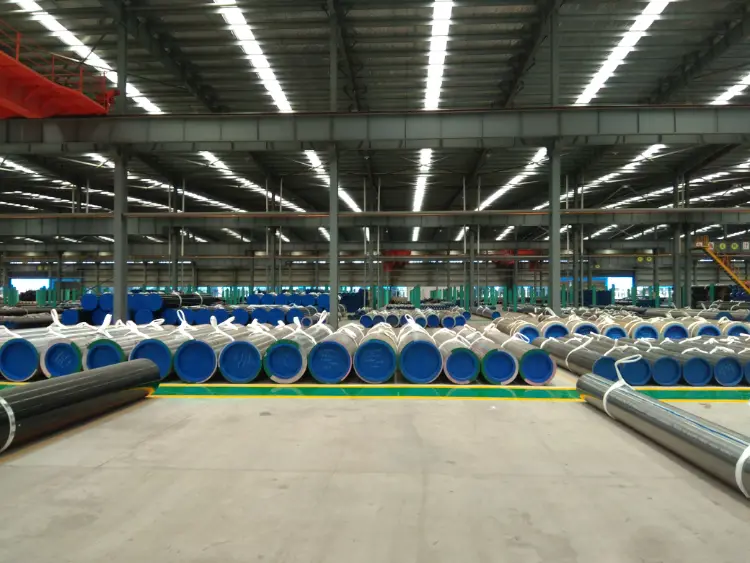
ASTM A36 Structural Steel for LSAW Pipe
ASTM A36 Structural Steel for LSAW Pipe: Properties, Equivalents & Applications
Comprehensive technical data for ASTM A36 carbon structural steel used in longitudinal submerged arc welded (LSAW) pipes, including chemical composition, mechanical and physical properties, international equivalents, and application guidance.
Hot rolling, welding, cutting, machining, forming, galvanizing
- Phone : +8618037372205
- Email : [email protected]
- WhatsApp: Contact via Whtsapp
- WeChat: +8618037372205
ASTM A36 Structural Steel for LSAW Pipe Introduction
ASTM A36 is a widely used hot-rolled carbon structural steel grade defined by ASTM A36/A36M. It is characterized by a minimum yield strength of 250 MPa (36 ksi) and good weldability, making it versatile for general construction and structural applications. When manufactured into LSAW (Longitudinal Submerged Arc Welded) pipes, A36 steel offers excellent formability and moderate strength, suitable for structural tubing, piling, and fluid transmission under low to medium pressure. The material is ductile, easily machinable, and can be galvanized or coated for corrosion protection. Its balanced composition ensures reliable performance in welded structures without requiring pre- or post-weld heat treatment for typical thicknesses. Referenced by multiple international standards, A36 serves as a benchmark for carbon structural steels.
ASTM A36 Structural Steel for LSAW Pipe Chemical Composition
Chemical requirements as per ASTM A36/A36M for plates, shapes, and bars. Values are maximum unless ranges are specified. Copper is optional and specified only when required for atmospheric corrosion resistance. The composition ensures good weldability and consistent mechanical properties.
| Chemical Element | Standard Value | Remarks |
|---|---|---|
| Carbon (C) | 0.25 max (plates ≤20 mm) | Increase allowed for thicker plates: 0.26% for 20–40 mm, 0.27% for 40–65 mm, 0.29% for 65–100 mm, consult standard for >100 mm |
| Manganese (Mn) | 0.60–1.20 (plates); 0.80–1.20 (shapes) | Exact range dependent on thickness and product form |
| Phosphorus (P) | 0.04 max | |
| Sulfur (S) | 0.05 max | |
| Silicon (Si) | 0.40 max (plates); 0.15–0.40 (shapes) | Not always specified; optional for killed steel |
| Copper (Cu) | 0.20 min (when specified) | Optional for enhanced atmospheric corrosion resistance |
ASTM A36 Structural Steel for LSAW Pipe Thermal and Electrical Physical Properties
The values below represent approximate data for carbon steel in the as-rolled condition. They are not part of ASTM A36 mandatory requirements but are commonly used for engineering calculations. Slight variations may occur with composition and processing.
| Property | Typical Value | Unit | Test Condition |
|---|---|---|---|
| Density (ρ) | 7.85 | g/cm³ | Room temperature |
| Modulus of Elasticity (E) | 200 | GPa | Room temperature |
| Shear Modulus (G) | 80 | GPa | Estimated from E and ν |
| Poisson's Ratio (ν) | 0.26–0.30 (typical 0.29) | Room temperature | |
| Coefficient of Thermal Expansion (α) | 11.7 | 10&supmin;&sup6;/°C | 20–100 °C range |
| Thermal Conductivity (λ) | 51.9 | W/(m·K) | At 20 °C |
| Specific Heat Capacity | 486 | J/(kg·K) | At 20 °C |
| Electrical Resistivity (ρe) | 0.159 | µΩ·m | At 20 °C |
ASTM A36 Structural Steel for LSAW Pipe Mechanical Properties
Tensile testing per ASTM A6/A6M methodology. Yield strength and tensile strength shall meet the specified minimums; elongation varies with specimen gauge length and plate thickness. A simple bend test demonstrates ductility and soundness. Impact toughness is not a standard requirement unless supplementary provisions (e.g., Charpy V-notch) are specified in the purchase order.
| Property | Standard Requirement | Unit | Test Condition |
|---|---|---|---|
| Yield Strength (ReH) | 250 min | MPa | 0.2% offset; applies to plates, shapes & bars |
| Tensile Strength (Rm) | 400–550 | MPa | Room temperature |
| Elongation (A) in 200 mm (8 in.) gauge | 20 min | % | Thickness ≤ 20 mm plates; see note for thicker sections |
| Elongation (A) in 50 mm (2 in.) gauge | 23 min | % | Thickness ≤ 20 mm plates; see note for thicker sections |
| Bend Test | No cracks on outside of bent portion | 180° bend, bend diameter = specimen thickness (t ≤ 20 mm); larger diameter for thicker plates |
ASTM A36 Structural Steel for LSAW Pipe Full Equivalent Material Standards and Substitutable Grades
| Country/Region | Standard | Grade | Remarks |
|---|---|---|---|
| International | ISO 630-2:2011 | Fe 430B | Microalloyed optional; direct equivalent |
| Europe | EN 10025-2:2004 | S275JR | Matching strength, similar weldability |
| Japan | JIS G 3101:2015 | SS400 | Tensile 400–510 MPa, yield ≥245 MPa; widely interchangeable |
| China | GB/T 700-2006 | Q235B | Yield ≥235 MPa; often used interchangeably for structural work |
| Russia | GOST 380-2005 | St3sp | Comparable carbon structural steel |
| India | IS 2062:2011 | E250 (Fe 410W A) | Similar strength but different test requirements |
ASTM A36 Structural Steel for LSAW Pipe Application Introduction
ASTM A36 LSAW pipe combines the renowned weldability and strength of A36 steel with the cost-effectiveness of longitudinal submerged arc welding. It is ideal for structural and moderate-pressure applications where high toughness at low temperatures is not critical. The pipe can be coated or lined for corrosion protection and is easily cut, drilled, and welded on-site.
Product Applications: Structural columns and beams, Bridge trusses and girders, Storage tank shells and roofs, Pipe piles and casing, Conveyor tubes, Handrail and guardrail posts, Equipment frames and supports
Processed into products: Welded pipe fittings (elbows, tees, reducers), Flanges and backing rings for piping, Base plates and gussets, Brackets and mounting pads, Connecting rods and tension members, Anchor bolts and U-bolts (when cold formed), Spacer rings and stiffeners in structural assemblies
Application industries: Construction and civil engineering, Oil & gas (low-pressure pipelines, structural supports), Water transmission and distribution, Piling and foundation engineering, Mechanical and machinery manufacturing, Ship and barge building (secondary structures), Renewable energy (wind turbine towers internal platforms)
ASTM A36 Structural Steel for LSAW Pipe Closely Related or Similar Alternative Materials
| Country/Region | Standard | Grade | Remarks |
|---|---|---|---|
| USA | ASTM A283/A283M | Grade D | Lower yield (230 MPa), slightly softer; used for less demanding structures |
| USA | ASTM A572/A572M | Grade 50 (Type 1) | Higher strength (345 MPa yield); used when weight reduction needed |
| USA | ASTM A529/A529M | Grade 50 | Yield 345 MPa, similar carbon level; used in building frames |
| International | EN 10025-2:2004 | S235JR | Lower strength grade, often replaced by A36 |
| International | JIS G 3101:2015 | SS330 | Lower tensile strength; lighter applications |
Notes:
Weldability: ASTM A36 is readily weldable by all common arc welding processes (SMAW, GMAW, SAW). Preheating may be required for thick sections and low ambient temperatures to prevent hydrogen-induced cracking. Post-weld heat treatment is generally not needed for thicknesses below 40 mm unless specified. The steel is not recommended for low-temperature service where impact toughness is mandatory unless Charpy-tested material is ordered. Surface protection by painting or hot-dip galvanizing greatly extends service life in atmospheric exposure. For LSAW pipes, the weld seam shall be free of cracks and full penetration; hydrostatic testing is often applied to verify pipe integrity per relevant pipe standard (e.g., ASTM A53 or proprietary specifications).
- Share



