
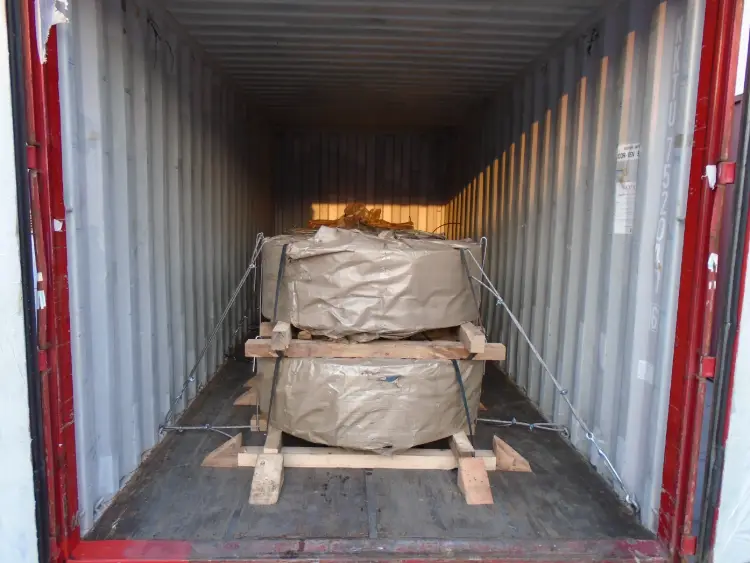
API 5L PSL2 Grade BN (L245N) Pipeline Steel Coil
API 5L PSL2 Grade BN (L245N) Pipeline Steel Coil - Properties, Equivalents & Applications
Explore the detailed chemical, mechanical, thermal, and electrical properties of API 5L PSL2 Grade BN (L245N) pipeline steel coil. Find complete international equivalents, similar materials, and application guidelines for oil & gas transmission piping.
Hot rolling, normalized rolling, cold forming (for pipe manufacturing), welding (ERW, SAW), bending, beveling
- Phone : +8618037372205
- Email : [email protected]
- WhatsApp: Contact via Whtsapp
- WeChat: +8618037372205
API 5L PSL2 Grade BN Pipeline Steel Coil Introduction
API 5L PSL2 Grade BN (L245N) is a microalloyed pipeline steel grade supplied as hot-rolled coil. It is designated under API Specification 5L, 46th Edition, for line pipe applications with additional requirements for sour service and low-temperature toughness. The "BN" suffix indicates normalized or normalized-rolled delivery condition, ensuring refined grain structure and improved notch toughness. With a minimum yield strength of 245 MPa (35,500 psi) and a specific carbon equivalent limit (CEIIW ≤ 0.43%), this steel is suitable for transporting gas, water, and oil in onshore and offshore environments. The PSL2 classification imposes tighter chemical composition, mandatory impact testing at 0°C (27 J minimum), and non-destructive inspection protocols, making it a reliable choice for demanding pipeline projects.
API 5L PSL2 Grade BN Pipeline Steel Coil Chemical Composition
The chemical composition limits comply with API 5L PSL2 for Grade B (L245), suitable for pipe manufacturing. Values represent maximum permitted unless a range is indicated. The carbon equivalent CEIIW is calculated according to API 5L formula and must be ≤ 0.43% for this grade. All alloying and residual elements are controlled to ensure good weldability and toughness.
| Chemical Element | Standard Value (max, wt%) | Remarks |
|---|---|---|
| Carbon (C) | 0.22 | For pipe wall thickness ≤ 25 mm (0.984 in) |
| Manganese (Mn) | 1.20 | |
| Silicon (Si) | 0.45 | |
| Phosphorus (P) | 0.025 | PSL2 limit tighter than PSL1 |
| Sulfur (S) | 0.015 | PSL2 limit for improved toughness |
| Vanadium (V) | 0.05 | |
| Niobium (Nb) | 0.05 | |
| Titanium (Ti) | 0.04 | |
| Copper (Cu) | 0.50 | Residual element |
| Nickel (Ni) | 0.50 | Residual element |
| Chromium (Cr) | 0.50 | Residual element |
| Molybdenum (Mo) | 0.15 | Residual element |
| Nitrogen (N) | 0.012 | Applicable when Al is not added |
| Carbon Equivalent CEIIW | 0.43 | Based on product analysis (max) |
API 5L PSL2 Grade BN Pipeline Steel Coil Thermal and Electrical Physical Properties
These physical properties are typical for normalized C-Mn pipeline steel with a density close to that of pure iron. Actual values may vary slightly depending on the exact chemical composition and manufacturing route. They are provided as reference data for design calculations (thermal expansion, heat transfer, electrical resistance). All values apply at room temperature unless specified otherwise.
| Property | Typical Value | Unit | Test Condition / Remarks |
|---|---|---|---|
| Density (ρ) | 7.85 | g/cm³ | Room temperature |
| Modulus of Elasticity (E) | 205 | GPa | Room temperature static |
| Shear Modulus (G) | 79.3 | GPa | Estimated from E and ν = 0.3 |
| Poisson's Ratio (ν) | 0.30 | – | Elastic range |
| Thermal Expansion Coefficient (α) | 11.7 (20–100°C), 12.2 (20–200°C), 12.7 (20–300°C) | 10⁻⁶/°C | Mean coefficient of linear thermal expansion |
| Thermal Conductivity (λ) | 50.7 | W/(m·K) | At 100°C |
| Specific Heat Capacity (cp) | 486 | J/(kg·K) | At 100°C |
| Electrical Resistivity (ρe) | 0.17 – 0.22 | μΩ·m | At 20°C, depending on precise composition |
API 5L PSL2 Grade BN Pipeline Steel Coil Mechanical Properties
The following properties are the minimum and/or maximum required values for pipe made from PSL2 Grade BN coil, as per API 5L. Testing is performed on transverse specimens (strip tensile) unless otherwise noted. Impact test temperature is 0°C for PSL2 grade B, with full-size Charpy V-notch (CVN) absorbed energy minimum at 27 J individually. For thinner wall materials, sub-size specimens may apply with proportional energy requirements. Elongation is measured on round bar or strip specimens according to API 5L table 7.
| Property | Standard Requirement | Unit | Test Condition / Remarks |
|---|---|---|---|
| Yield Strength (Rt0.5) | 245 – 450 | MPa | Transverse direction; 0.5% total extension under load method or 0.2% offset |
| Tensile Strength (Rm) | 415 – 760 | MPa | Transverse direction |
| Yield-to-Tensile Ratio (Rt0.5/Rm) | ≤ 0.93 | – | Required for certain sour service or by agreement |
| Elongation after fracture (A) | ≥ 22 (approx.) | % | For strip specimen L0=2 in (50.8 mm); minimum values based on formula e = 1940·A0.2/U0.9 |
| Charpy V-notch impact energy (KV) | ≥ 27 (individual), ≥ 36 (average of 3) | J | At 0°C, full-size transverse specimens (10 × 10 mm) |
| Bend test (guided bend) | No cracks or ruptures | – | Bend diameter according to API 5L table 23, normally 180° around a pin of diameter 3t (t = specimen thickness) |
API 5L PSL2 Grade BN Pipeline Steel Coil Fully Equivalent Material Standards and Replaceable Grade Designations
| Country / Region | Standard | Grade / Designation | Remarks |
|---|---|---|---|
| International (ISO) | ISO 3183:2019 | L245N (PSL2 equivalent) | Identical strength and chemistry; letter R for rolled, N for normalized |
| Europe | EN 10208-2:2009 | L245NB | B denotes PSL2 type requirements; NB for normalized |
| China | GB/T 9711-2017 | L245N (PSL2) | Chinese standard aligns with ISO 3183; N indicates normalized condition |
| USA / API | API 5L 46th Ed. | BN (PSL2) | The original designation, often written as API 5L B PSL2 N or simply BN |
API 5L PSL2 Grade BN Pipeline Steel Coil Application Introduction
API 5L PSL2 Grade BN (L245N) coil is primarily used to manufacture longitudinal or spiral welded pipes for the oil and gas industry. The material exhibits good formability for cold expansion and bending, reliable weldability with standard procedures, and consistent low-temperature toughness. Its normalized microstructure ensures resistance to brittle fracture and stable properties along the coil length. Typical applications include flowlines, gathering lines, long-distance transmission pipelines, and water injection pipelines. The steel is also suitable for structural pipe piles, slurry transport, and low-pressure well tubing.
Product Applications: Longitudinal Submerged Arc Welded (LSAW) pipes, Helical Submerged Arc Welded (HSAW) pipes, Electric Resistance Welded (ERW) pipes, Spiral welded pipes, Line pipe for sour service (with additional HIC/SSC tests)
Processed into products: Pipe spools and fittings (bends, tees, reducers), Flanges (Weld Neck, Slip-on), Piping manifolds, Casing and tubing for low-pressure oil/gas wells, Structural pipe piles and piling connectors, Flowline pup pieces and risers (after suitable qualification)
Application industries: Oil & Gas (Upstream, Midstream, Downstream), Water Treatment & Transmission, Mining (Slurry and Tailings Transport), Civil Engineering & Construction, Energy (Geothermal, Steam Piping)
API 5L PSL2 Grade BN Pipeline Steel Coil Similar or Near-Equivalent Substitute Material Recommendations
The materials listed below offer comparable or slightly higher strength and are often considered for pipeline applications where L245N is specified. They may require additional evaluations for weldability, toughness, or manufacturing route.
| Country / Region | Standard | Grade / Designation | Remarks |
|---|---|---|---|
| International / USA | API 5L PSL2 | X42N (L290N) | Higher yield (290 MPa) but similar composition envelope; often used as upgrade |
| Europe | EN 10208-2 | L290NB | Equivalent to API X42; provides greater strength margin |
| Russia | ГОСТ 10705-80 (GOST) | К52 | Yield strength ~350 MPa; can be considered a heavier-duty linepipe steel |
| China | GB/T 9711 | L290N | Direct strength upgrade to 290 MPa minimum yield |
Notes:
Additional Information: API 5L PSL2 Grade B coils are normally supplied with a mill test certificate (EN 10204 type 3.1 or 3.2) showing actual chemical analysis, tensile and impact results. Weldability: The carbon equivalent limit (CEIIW ≤ 0.43) ensures good field weldability using cellulosic (E6010) or low-hydrogen (E7018) electrodes. Preheating may be required for thicknesses above 20 mm in cold climates. Corrosion resistance: Standard pipeline steel has no inherent corrosion resistance above common steel; external coatings (3LPE, FBE) and cathodic protection are mandatory for buried or submerged service. For sour environments, supplementary testing per NACE MR0175/ISO 15156 may be specified.
- Share



