
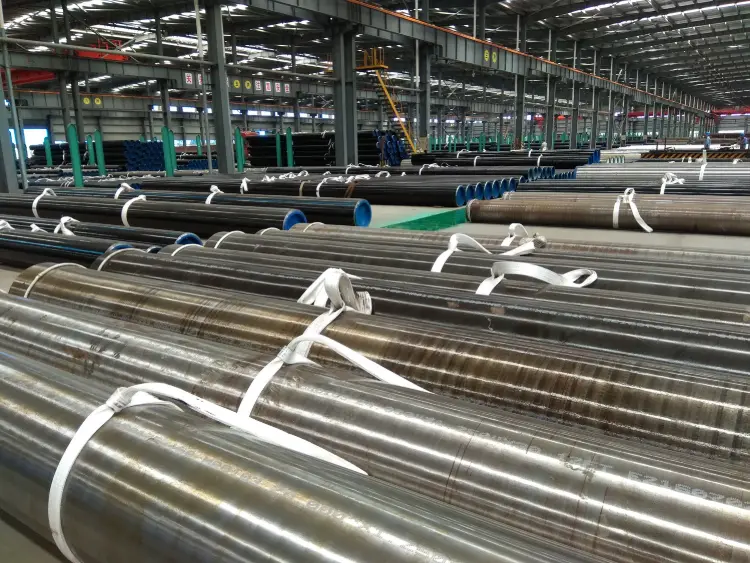
ASTM A572 Grade 42 Steel for LSAW Pipes
ASTM A572 Grade 42 Steel for LSAW Pipes: High-Strength Low-Alloy Structural Solution
Explore ASTM A572 Gr.42 LSAW pipe: chemistry, mechanical properties, thermal & electrical data, equivalent grades, and typical applications in construction, offshore, and machinery.
Hot rolling, normalizing (optional), cold forming, welding (SAW, ERW, GMAW), LSAW pipe manufacturing
- Phone : +8618037372205
- Email : [email protected]
- WhatsApp: Contact via Whtsapp
- WeChat: +8618037372205
ASTM A572 Grade 42 Steel for LSAW Pipes Introduction
ASTM A572 Grade 42 is a high-strength low-alloy (HSLA) niobium-vanadium structural steel widely used for welded pipes, especially LSAW (Longitudinal Submerged Arc Welded) pipes. With a minimum yield strength of 42 ksi (290 MPa), it offers improved strength-to-weight ratio compared to plain carbon steel. Key features:
- Excellent weldability and formability for large-diameter pipes
- Enhanced atmospheric corrosion resistance relative to A36
- Controlled chemical composition ensuring consistent mechanical properties
- Available in various plate thicknesses suitable for pipe fabrication
This grade is frequently specified for structural applications such as bridges, buildings, and offshore platforms, where LSAW pipes serve as columns, piles, and pressure conduits.
ASTM A572 Grade 42 Steel for LSAW Pipes Chemical Composition
Heat analysis limits per ASTM A572 Grade 42 requirements. Elements not listed shall not be intentionally added. Niobium, vanadium, or combinations may be used to achieve the strength level. Notes:
- Silicon (Si) content may be specified in the range 0.15–0.40% for killed steels.
- Each reduction of 0.01% C below the max may be compensated by an increase of 0.06% Mn above the minimum, up to a maximum of 1.35%.
- Optional alloying elements like Nb, V, Ti may be present.
| Element | Standard Value (max unless range given) | Remarks |
|---|---|---|
| Carbon (C) | 0.21% | Maximum; for plates ≤ 1 in. (25 mm) thick |
| Manganese (Mn) | 1.35% | Maximum; varies with thickness (0.60–1.35%) |
| Phosphorus (P) | 0.04% | Maximum |
| Sulfur (S) | 0.05% | Maximum |
| Silicon (Si) | 0.40% | Maximum; for killed steel 0.15–0.40% |
| Niobium (Nb) | 0.005–0.05% | Optional; minimum when used |
| Vanadium (V) | 0.01–0.15% | Optional; minimum when used |
| Titanium (Ti) | Up to 0.05% | Optional; not always required |
| Nitrogen (N) | 0.015% | Maximum if microalloyed |
| Copper (Cu) | 0.20% (minimum when specified) | For improved corrosion resistance (optional) |
ASTM A572 Grade 42 Steel for LSAW Pipes Thermal and Electrical Physical Properties
Typical physical properties for ASTM A572 Grade 42 carbon-manganese steel at ambient temperature. These values are not mandatory in the standard but are representative of HSLA steels for general design and processing. Variations may occur depending on exact composition and heat treatment. Values provided as a general guide for LSAW pipe engineering.
| Property | Typical Value | Unit | Test Condition / Remarks |
|---|---|---|---|
| Density (ρ) | 7.85 | g/cm³ | At 20°C |
| Elastic Modulus (E) | 200 | GPa | Ambient; tensile modulus |
| Shear Modulus (G) | 77 | GPa | Ambient; calculated from E and Poisson ratio |
| Poisson's Ratio (ν) | 0.29 | — | At 20°C (typical for carbon steel) |
| Thermal Expansion (α) | 11.7 × 10⁻⁶ | /°C | 20–100°C; average linear coefficient |
| Thermal Expansion (α) | 12.4 × 10⁻⁶ | /°C | 20–200°C |
| Thermal Expansion (α) | 13.2 × 10⁻⁶ | /°C | 20–400°C |
| Thermal Conductivity (λ) | 52 | W/(m·K) | At 20°C; typical for low-alloy steel |
| Thermal Conductivity (λ) | 48 | W/(m·K) | At 100°C |
| Thermal Conductivity (λ) | 40 | W/(m·K) | At 300°C |
| Specific Heat Capacity | 470 | J/(kg·K) | At 20°C |
| Electrical Resistivity (ρ_e) | 0.16 | μΩ·m | At 20°C; approximate |
ASTM A572 Grade 42 Steel for LSAW Pipes Mechanical Properties
Mechanical properties for ASTM A572 Grade 42 structural steel plates used for LSAW pipe manufacturing. Values apply to transverse specimens unless otherwise noted. Notes:
- Elongation in 200 mm (8 in.) for plate thickness ≤ 3/4 in.; in 50 mm (2 in.) for thicker sections.
- Charpy V-notch impact requirements may be specified for certain structural applications (e.g., at -20°C, 27 J).
- Bend test not mandatory for plates over 1 in. thick but typical values for pipe certification may be provided by agreement.
| Property | Value | Unit | Test Condition |
|---|---|---|---|
| Yield Strength (ReH) | ≥ 290 (42) | MPa (ksi) | Transverse, 0.2% offset; for all thicknesses |
| Tensile Strength (Rm) | ≥ 415 (60) | MPa (ksi) | Transverse, for plates ≤ 100 mm |
| Elongation (A) | ≥ 20 | % | In 200 mm (8 in.); for plates ≤ 19 mm |
| Elongation (A) | ≥ 18 | % | In 50 mm (2 in.); for plates > 19 mm |
| Charpy Impact (KV) | ≥ 27 @ 21°C | J | Transverse, full-size specimen (optional requirement) |
| Bend Test (Dia. = 2T) | 180° no cracks | — | For plates ≤ 1 in.; mandrel diameter = 2× thickness |
ASTM A572 Grade 42 Steel for LSAW Pipes Completely Equivalent Material Standards and Substitutable Grades
| Country/Region | Standard | Grade | Remarks |
|---|---|---|---|
| International | ISO 4950-2 | S290 | HSLA structural steel, yield 290 MPa; similar chemistry |
| European Union | EN 10025-2 | S275J0 (1.0143) / S275J2 (1.0144) | Yield 275 MPa, similar weldability; slight strength difference |
| Japan | JIS G 3106 | SM400A / SM400B | Yield 245 MPa; often used as equivalent for structural pipe |
| China | GB/T 1591 | Q345B (Q345C) | Higher strength (345 MPa), but similar low-alloy concept; often substituted where higher strength is acceptable |
| India | IS 2062 | E250 (Fe 410W) | Yield 250 MPa; closest available standard grade, may be upgraded to Fe 410 with microalloys |
| Germany (historical) | DIN 17100 | St44-3 (S275JR) | Older designation; S275JR is comparable |
ASTM A572 Grade 42 Steel for LSAW Pipes Application Introduction
ASTM A572 Grade 42 LSAW pipes are deployed where high strength, good weldability, and moderate corrosion resistance are needed. The LSAW manufacturing process uses rolled plates formed into a pipe shape and welded longitudinally, providing consistent wall thickness and mechanical properties. Industries that benefit from this material include:
- Building and infrastructure (columns, bracing, trusses)
- Offshore and marine structures (jacket legs, caissons, piles)
- Bridge construction (box girders, arch ribs)
- Mechanical and equipment manufacturing (crane booms, hydraulic cylinders)
- Water and sewage systems (large‑diameter penstocks, pressure pipes)
- Renewable energy (wind turbine towers, foundation pipes)
Product Applications: LSAW structural pipes and hollow sections, Spiral welded pipes (when plate is formed spirally), Steel piles (open‑end and closed‑end), Bridge girders and box sections, Offshore substructures (jacket legs, braces), Tower sections for wind turbines, Penstocks and large‑diameter water pipelines
Processed into products: Longitudinal seam pipe up to 120-inch OD, Tubular columns and beams in high‑rise buildings, Heavy‑duty crane booms and lifting frames, Piling sleeves and caissons, Manifolds and header pipes in oil & gas, Flanges and connectors (weld‑neck, slip‑on), Structural nodes for truss and frame connections
Application industries: Civil Engineering and Construction, Offshore Oil & Gas Platforms, Marine and Shipbuilding, Bridge Engineering, Water Transmission and Penstock Systems, Renewable Energy (Wind, Solar Structures), Heavy Machinery and Equipment
ASTM A572 Grade 42 Steel for LSAW Pipes Similar or Alternative Material Recommendations
| Country/Region | Standard | Grade | Remarks |
|---|---|---|---|
| USA | ASTM A36/A36M | A36 | Carbon structural steel, yield 250 MPa; commonly used for pipe, lower strength, higher ductility |
| USA | ASTM A572/A572M | Grade 50 [345] | Higher HSLA grade, yield 345 MPa; may be overqualified but readily available for LSAW pipe |
| USA | API Spec 5L | X42 (L290) | Line pipe steel with yield 290 MPa; similar strength, often used for LSAW line pipes for oil/gas |
| Europe | EN 10219 | S275J0H / S275J2H | Cold-formed welded structural hollow section, comparable strength |
| Japan | JIS G 3444 | STK400 | Structural tube steel, yield 235 MPa; often used for general structures, slightly lower strength |
| China | GB/T 9711 | L290 (X42) | Petroleum and natural gas line pipe, identical strength level, popular for LSAW |
Notes:
Additional information:
- LSAW pipes made from A572 Grade 42 are usually supplied with a mill test certificate (EN 10204 3.1 or equivalent) showing chemical analysis and mechanical test results.
- For low‑temperature service, supplementary impact testing at –20°C or –40°C can be performed; the steel exhibits a ductile‑to‑brittle transition temperature typical of fine‑grained HSLA steels.
- Welding consumables should match the strength level (e.g., AWS A5.1 E7018 for SMAW, ER70S‑6 for GMAW). Preheating is generally not required for thicknesses below 25 mm.
- The material is not intended for prolonged use above 400°C, as creep properties are not guaranteed.
- When compared to API 5L X42, the chemistry and mechanical properties are very similar, but API grades have tighter controls on sulfur, phosphorus, and carbon equivalent for line pipe applications.
- Share



