
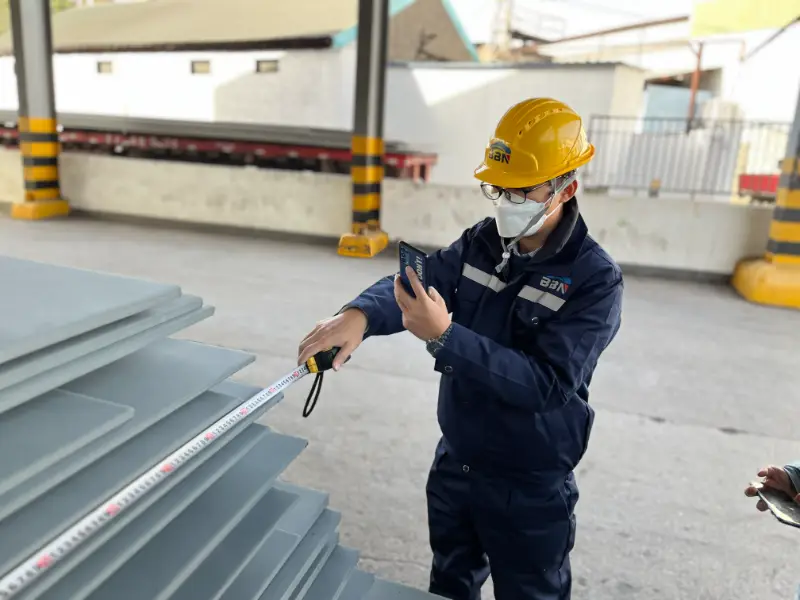
ASTM A240 321 (S32100) Stainless Steel
ASTM A240 321 (S32100) Stainless Steel: Titanium-Stabilized Austenitic Grade for High-Temperature Service
Explore the properties, composition, and applications of ASTM A240 321 (UNS S32100) stainless steel, a titanium-stabilized austenitic grade for high-temperature and corrosion resistance.
Hot rolling, cold rolling, welding, forming, forging, machining
- Phone : +8618037372205
- Email : [email protected]
- WhatsApp: Contact via Whtsapp
- WeChat: +8618037372205
ASTM A240 321 Stainless Steel Introduction
ASTM A240 321 (UNS S32100) is a titanium-stabilized austenitic chromium-nickel stainless steel designed to prevent intergranular corrosion after exposure to temperatures in the chromium carbide precipitation range (approximately 425–850°C). The addition of titanium, at a minimum of five times the carbon plus nitrogen content, ties up carbon and nitrogen, preserving intergranular corrosion resistance even after welding or long-term high-temperature service. It offers excellent oxidation resistance up to 816°C and good creep strength, making it suitable for continuous service in the 800–900°C range. Typical delivery condition is solution annealed at 1040°C minimum followed by water quenching. While ASTM A240 primarily covers plate, sheet, strip, and coil, the grade is also widely used in tubular products under ASTM A312 TP321. 321 stainless steel is non-hardenable by heat treatment, exhibits good weldability, and is commonly formed by hot or cold working. It finds extensive application in aircraft exhaust systems, furnace parts, chemical processing equipment, and boiler shells.
ASTM A240 321 Stainless Steel Chemical Composition
The chemical composition of ASTM A240 Grade 321 (S32100) stainless steel is controlled to ensure adequate titanium stabilization and optimal corrosion resistance. Titanium acts as a strong carbide former, preventing chromium depletion at grain boundaries and thereby providing immunity to intergranular attack after heating in the critical range. Nitrogen is limited to avoid excessive titanium consumption, while carbon is kept low to maintain ductility and weldability.
| Element | Standard Value (wt%) | Remarks |
|---|---|---|
| Carbon (C) | ≤0.08 | Max limit to preserve corrosion resistance |
| Manganese (Mn) | ≤2.00 | Austenite stabilizer |
| Phosphorus (P) | ≤0.045 | Impurity, controlled for ductility |
| Sulfur (S) | ≤0.030 | Impurity, improves machinability if higher |
| Silicon (Si) | ≤0.75 | Deoxidizer, improves oxidation resistance |
| Chromium (Cr) | 17.0–19.0 | Primary element for corrosion and oxidation resistance |
| Nickel (Ni) | 9.0–12.0 | Austenite former, enhances ductility |
| Titanium (Ti) | 5×(C+N) min, 0.70 max | Stabilizer, prevents chromium carbide formation |
| Nitrogen (N) | ≤0.10 | Limited to reduce Ti consumption |
ASTM A240 321 Stainless Steel Thermal and Electrical Physical Properties
The following physical properties are typical for annealed 321 (S32100) stainless steel and are provided for design and engineering reference. Values represent the moderate-temperature service capability of this titanium-stabilized grade. Thermal conductivity and expansion data are particularly relevant for applications involving thermal cycling, such as exhaust systems and heat exchangers.
| Property | Typical Value | Unit | Test Condition |
|---|---|---|---|
| Density (ρ) | 8.0 | g/cm³ | Room Temperature |
| Modulus of Elasticity (E) | 193 | GPa | Room Temperature |
| Shear Modulus (G) | 77 | GPa | Room Temperature (calculated) |
| Poisson's Ratio (ν) | 0.30 | — | Room Temperature |
| Thermal Expansion Coefficient (α) | 16.6 | µm/m·K | 0–100°C |
| Thermal Expansion Coefficient (α) | 17.3 | µm/m·K | 0–315°C |
| Thermal Expansion Coefficient (α) | 18.0 | µm/m·K | 0–500°C |
| Thermal Expansion Coefficient (α) | 18.6 | µm/m·K | 0–650°C |
| Thermal Conductivity (λ) | 16.2 | W/m·K | 100°C |
| Thermal Conductivity (λ) | 19.0 | W/m·K | 300°C |
| Thermal Conductivity (λ) | 21.5 | W/m·K | 500°C |
| Specific Heat Capacity | 500 | J/kg·K | 0–100°C |
| Electrical Resistivity (ρe) | 0.72 | µΩ·m | 20°C |
ASTM A240 321 Stainless Steel Mechanical Properties
Room temperature tensile properties per ASTM A240 for annealed plate, sheet, and strip. The values are minimum requirements unless otherwise noted. Elongation is measured in a standard 50 mm (2 in.) gauge length for thicknesses under 5/16 in. Hardness values are maximum limits. These properties ensure the material's suitability for structural and pressure-containing applications in corrosive and high-temperature environments.
| Property | Standard Requirement | Unit | Test Condition |
|---|---|---|---|
| Tensile Strength (Rm) | ≥515 | MPa | Room Temperature |
| Tensile Strength (Rm) | ≥75 | ksi | Room Temperature |
| Yield Strength (ReH, 0.2% offset) | ≥205 | MPa | Room Temperature |
| Yield Strength (ReH, 0.2% offset) | ≥30 | ksi | Room Temperature |
| Elongation (A) | ≥40 | % | 50 mm gauge length, thickness ≤12.7 mm |
| Brinell Hardness (HBW) | ≤201 | HB | As annealed |
| Rockwell B Hardness (HRBW) | ≤92 | HRB | As annealed |
ASTM A240 321 Stainless Steel Fully Equivalent Material Standards and Replaceable Grades
| Country/Region | Standard | Grade | Remarks |
|---|---|---|---|
| USA | ASTM A240 | 321 (S32100) | Plate, sheet, strip — base specification |
| USA | ASTM A276 | 321 (S32100) | Stainless steel bars and shapes |
| USA | ASTM A312 | TP321 (S32100) | Seamless and welded pipe |
| USA | ASTM A358 | 321 (S32100) | Electric-fusion-welded pipe for high-temperature service |
| USA | ASME SA240 | 321 (S32100) | Boiler and pressure vessel code |
| Europe | EN 10088-2 | X6CrNiTi18-10 (1.4541) | Plate, sheet, strip |
| Europe | EN 10088-3 | 1.4541 | Bars, wire, sections |
| Europe | EN 10216-5 | 1.4541 | Seamless tubes for pressure purposes |
| Japan | JIS G4304 | SUS321 | Hot-rolled stainless steel plate, sheet and strip |
| Japan | JIS G4303 | SUS321 | Stainless steel bars |
| China | GB/T 3280 | 06Cr18Ni11Ti | Cold-rolled stainless steel plate, sheet and strip |
| China | GB/T 1220 | 06Cr18Ni11Ti | Stainless steel bars |
| International | ISO 15510 | X6CrNiTi18-10 | Heat-resisting steel |
ASTM A240 321 Stainless Steel Application Introduction
321 stainless steel is the material of choice for many elevated-temperature and mildly corrosive environments. Its titanium stabilization ensures long-term resistance to intergranular attack, making it especially suitable for welded constructions that operate in the sensitization range. The following lists highlight typical industries, product forms, and specific components that benefit from this grade.
Product Applications: Aircraft exhaust systems and afterburner rings, Boiler shells and firebox sheets, Furnace muffles and radiant tubes, Expansion joints and bellows, Welded pressure vessels, Manifolds for chemical reactors
Processed into products: Exhaust manifold flanges and elbows, Welded tube assemblies for heat recovery, Forged nozzles and fittings, Corrugated hoses and flexible risers, Rivets and fasteners for high-temperature joints, Thermocouple protection tubes
Application industries: Aerospace, Chemical Processing, Power Generation (including nuclear), Oil & Gas, Heat Exchanger Manufacturing, Automotive (exhaust systems)
ASTM A240 321 Stainless Steel Similar / Alternative Materials Recommendation
| Country/Region | Standard | Grade | Remarks |
|---|---|---|---|
| USA | ASTM A240 | 321H (S32109) | Higher carbon (0.04–0.10%) for improved creep strength; similar corrosion resistance |
| USA | ASTM A240 | 347 (S34700) | Niobium-stabilized; equivalent intergranular corrosion resistance; better for heavy-section welding |
| USA | ASTM A240 | 304L (S30403) | Low-carbon alternative; good weldability without sensitization; lower temperature limit |
| Europe | EN 10088-2 | 1.4878 (X10CrNiTi18-10) | Higher Ti content for increased scaling resistance; also heat-resistant |
| Germany | DIN EN 10088-2 | 1.4571 (X6CrNiMoTi17-12-2) | Molybdenum-alloyed variant (316Ti); better pitting resistance, slightly lower strength |
| Japan | JIS G4304 | SUS347 | Niobium-stabilized; equivalent heat resistance and good formability |
| China | GB/T 3280 | 06Cr19Ni10 (S30403) | Low-carbon 304; no stabilization; requires careful selection for welded high-temp service |
Notes:
- While ASTM A240 covers flat products (plate, sheet, strip), the same alloy is frequently used for piping under ASTM A312 TP321. Users should select the appropriate product standard for the intended form.
- Post-weld heat treatment is generally not required to restore corrosion resistance because of titanium stabilization; however, for heavy sections or stress corrosion cracking concerns, stress relief may be advisable.
- The alloy exhibits excellent oxidation resistance in intermittent service up to 870°C and continuous service to 925°C, but scaling resistance diminishes above 816°C in sulfur-bearing environments.
- For applications requiring improved low-temperature toughness or lower hardness, consider the titanium-stabilized low-carbon variant or consult the supplier.
- All data conform to ASTM A240/A240M and typical published values; verify against the latest standard revision for design-critical applications.
- Share



