
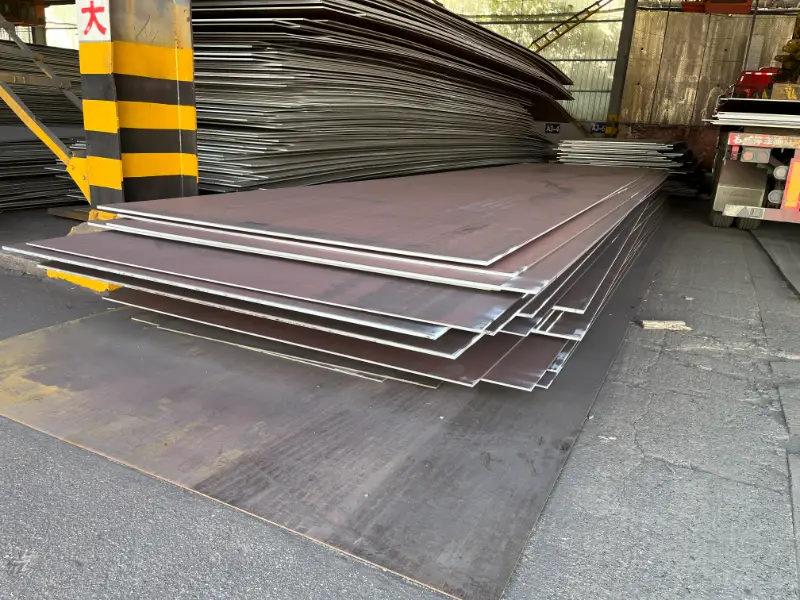
ASTM A240 317L (S31703) Stainless Steel
ASTM A240 317L (S31703) Stainless Steel - Advanced Corrosion Resistance for Pipe Systems
Discover the properties and industrial uses of ASTM A240 317L (UNS S31703) stainless steel, a low-carbon austenitic grade for welded pipe components.
Hot rolling, cold rolling, forming, welding, machining, solution annealing, pickling
- Phone : +8618037372205
- Email : [email protected]
- WhatsApp: Contact via Whtsapp
- WeChat: +8618037372205
ASTM A240 317L Stainless Steel Introduction
ASTM A240 317L, designated as UNS S31703, is a molybdenum-bearing austenitic stainless steel with a low carbon content (max 0.03%). This grade offers significantly enhanced general corrosion resistance compared to conventional 304L and 316L, particularly in acidic chloride environments such as those containing sulfuric, phosphoric, and acetic acids. The low carbon level minimizes carbide precipitation during welding, making it suitable for as-welded pipe applications in aggressive chemical and petrochemical processes. Although ASTM A240 primarily covers flat-rolled products (plate, sheet, strip), the 317L alloy is also widely manufactured into seamless and welded pipes under specifications like ASTM A312 TP317L, with the chemical requirements directly derived from A240. The alloy exhibits excellent toughness, high creep strength, and good formability, positioning it as a reliable choice for critical piping systems where resistance to pitting and crevice corrosion is paramount. Typical delivery for A240 material is in the solution-annealed condition to achieve optimum ductility and corrosion resistance.
ASTM A240 317L Stainless Steel Chemical Composition
The chemical requirements for 317L (S31703) per ASTM A240 are strictly defined to ensure optimal corrosion resistance and weldability.
- Low Carbon (C ≤ 0.03%): Prevents intergranular corrosion after welding by suppressing chromium carbide precipitation.
- Molybdenum (Mo 3.0–4.0%): Enhances pitting and crevice corrosion resistance in chloride-containing media, and improves resistance to reducing acids like sulfuric acid.
- Nickel (Ni 11.0–15.0%): Stabilizes the austenitic structure and contributes to ductility and toughness.
- Chromium (Cr 18.0–20.0%): Provides basic oxidation and corrosion resistance.
- Residual elements are tightly controlled to maintain material integrity.
| Element | Specification Value (%) | Remarks |
|---|---|---|
| Carbon (C) | ≤ 0.030 | Low carbon for improved welding characteristics |
| Manganese (Mn) | ≤ 2.00 | Austenite stabilizer; controlled for hot workability |
| Phosphorus (P) | ≤ 0.045 | Impurity; limited to avoid embrittlement |
| Sulfur (S) | ≤ 0.030 | Impurity; for general pipe, not strictly low-S, but can be specified lower for enhanced weldability |
| Silicon (Si) | ≤ 0.75 | Deoxidizer; kept low to maintain ductility |
| Chromium (Cr) | 18.0 – 20.0 | Primary corrosion resistance element |
| Nickel (Ni) | 11.0 – 15.0 | Austenite former; critical for toughness |
| Molybdenum (Mo) | 3.0 – 4.0 | Key for chloride pitting and acid resistance |
| Nitrogen (N) | ≤ 0.10 | Residual; can increase strength but controlled to maintain corrosion resistance |
ASTM A240 317L Stainless Steel Thermal and Electrical Physical Properties
Physical properties are measured on annealed, wrought 317L material in the temperature range 20–100°C unless otherwise noted. Density (approx. 8.0 g/cm³) is slightly higher than 304L due to increased molybdenum and nickel content. Thermal conductivity is relatively low (typical of austenitic stainless steels), which influences heat transfer calculations in heat exchanger pipes. The coefficient of thermal expansion must be accounted for in piping system design to accommodate thermal cycling. Electrical resistivity is moderate, making the material suitable for applications requiring low magnetic permeability but not high electrical conductivity.
| Property | Typical Value | Unit | Test Condition |
|---|---|---|---|
| Density (ρ) | 8.0 | g/cm³ | At 20°C |
| Elastic Modulus (E) | 200 | GPa | At 20°C, tension |
| Shear Modulus (G) | 77 | GPa | Calculated from E and Poisson's ratio, at 20°C |
| Poisson's Ratio (ν) | 0.27 – 0.30 | - | At 20°C, elastic range |
| Thermal Expansion Coefficient (α) | 16.5 | 10⁻⁶/K | Between 20°C and 100°C |
| Thermal Expansion Coefficient (α) | 17.5 | 10⁻⁶/K | Between 20°C and 500°C |
| Thermal Conductivity (λ) | 14.0 | W/m·K | At 100°C |
| Thermal Conductivity (λ) | 18.5 | W/m·K | At 500°C |
| Specific Heat Capacity (cp) | 500 | J/kg·K | At 20°C |
| Electrical Resistivity (ρe) | 0.75 | μΩ·m | At 20°C, annealed |
ASTM A240 317L Stainless Steel Mechanical Properties
The mechanical properties below reflect ASTM A240 requirements for plate, sheet, and strip in the solution-annealed condition; these values also serve as a reference baseline for pipes manufactured to ASTM A312 TP317L (which may have slight variations depending on product form and wall thickness). High elongation (≥ 35% in 2 inches) ensures excellent formability for cold bending and flaring. Strength levels are moderate but sufficient for pressure-containing components. The alloy remains non-magnetic (relative permeability < 1.02) after annealing. Hardness limits guarantee good machinability and structural stability.
| Property | Specification Requirement | Unit | Test Condition |
|---|---|---|---|
| Tensile Strength (Rm) | ≥ 515 (75) | MPa (ksi) | Room temperature, transverse specimen |
| Yield Strength (0.2% offset, ReH) | ≥ 205 (30) | MPa (ksi) | Room temperature, transverse specimen |
| Elongation (A) | ≥ 35 | % | In 2 in. (50.8 mm) gauge length for thickness ≥ 0.0625 in.; for thinner gauges, values may differ per standard |
| Hardness | ≤ 217 HBW / ≤ 95 HRB | - | Brinell or Rockwell B as applicable, no specific gauge restriction |
| Bend Test | No cracks allowed; bend angle 180° | - | Bend diameter = specimen thickness × factor (commonly 1T for austenitic grades), tested at room temperature |
ASTM A240 317L Stainless Steel Exact Equivalent Material Standards and Replaceable Grades
| Country/Region | Standard | Designation/Grade | Remarks |
|---|---|---|---|
| USA | ASTM A312 | TP317L | Seamless and welded pipe; chemical composition follows A240 S31703 |
| USA | ASTM A240 | 317L (S31703) | Plate, sheet, strip – base material for pipe fabrication |
| Europe | EN 10028-7 / EN 10088-2 | 1.4438 (X2CrNiMo18-15-4) | Equivalent for flat products and pressure vessels; slight composition tolerances may differ but considered interchangeable in most applications |
| Japan | JIS G4304/G4305 | SUS317L | Hot/cold rolled stainless steel plate and sheet; equivalent to 317L |
| China | GB/T 3280 | 022Cr19Ni13Mo3 (S31703) | Identical to A240 317L in composition and properties |
| International | ISO 15510 | X2CrNiMo18-15-4 | General international designation; comparable to 1.4438 and S31703 |
ASTM A240 317L Stainless Steel Application Introduction
ASTM A240 317L stainless steel pipe and components are primarily specified where superior corrosion resistance is required beyond that of 316L. Its resistance to sulfuric, phosphoric, and organic acids, along with excellent chloride pitting and crevice corrosion resistance, makes it a preferred material in the chemical process industry and pollution control systems. Typical usage includes seamless and welded pipe systems, fittings, and flanges operating at temperatures up to approximately 450°C in continuous service. The alloy is also approved for pressure vessel construction under ASME Boiler and Pressure Vessel Code (Section VIII, Div.1).
Product Applications: Seamless stainless steel pipes (ASTM A312 TP317L), Welded stainless steel tubes and pipes (ASTM A358, A778, A312), Pipe fittings (ASTM A403 WP317L), Flanges (ASTM A182 F317L), Plate heat exchangers, Pressure vessels and columns, Storage tank shells and bottoms
Processed into products: Chemical reactor linings and internal coils, Scrubber spray headers and mist eliminator support grids, Heat exchanger tube bundles for corrosive media, Pulp bleaching tower piping and nozzles, Condenser plates and tubing in desalination plants, Rotary kiln seals and expansion joints in cement plants, Surgical and dental instruments (bars forged from 317L)
Application industries: Chemical and petrochemical processing (reactors, storage tanks, piping), Flue gas desulfurization (FGD) scrubbers in coal-fired power plants, Pulp and paper industry (digesters, bleach plants, liquor heaters), Pharmaceutical and food processing (clean-in-place systems, heat exchangers), Offshore oil and gas (seawater cooling systems, firewater piping), Textile and dyeing equipment, Nuclear (low-level waste handling)
ASTM A240 317L Stainless Steel Similar / Alternative Stainless Steel Grades
| Country/Region | Standard | Designation/Grade | Remarks |
|---|---|---|---|
| USA | ASTM A240 | 317 (S31700) | Higher carbon version (max 0.08%); slightly higher strength but susceptible to sensitization in welding; used in non-welded or post-weld heat-treated components |
| USA | ASTM A240 | 316L (S31603) | Lower molybdenum (2.0–3.0%); reduced pitting resistance equivalent (PREN typically ~26 vs. ~34 for 317L); suitable for less aggressive chloride environments; often used as a cost-effective alternative when full 317L corrosion resistance is not required |
| Europe | EN 10088-2 | 1.4404 (X2CrNiMo17-12-2) | 316L equivalent; good alternative for many chemical applications but not for harsh acidic/chloride services |
| Europe | EN 10088-2 | 1.4539 (X1NiCrMoCu25-20-5) | Super-austenitic grade with higher nickel and molybdenum; significantly better corrosion resistance but higher cost; used in extreme environments replacing 317L |
| China | GB/T 3280 | 06Cr17Ni12Mo2 (S31608) | 316 equivalent with higher carbon; might replace 317L in non-welded, mild environments |
Notes:
- Welding Considerations: 317L is readily weldable by common processes (GTAW, GMAW, SMAW) using matching filler metals (e.g., ER317L, E317L-15/16). Low carbon content eliminates the need for post-weld annealing in most service conditions, although solution annealing may be applied for maximum corrosion resistance in extremely aggressive environments.
- Heat Treatment: Solution annealing is performed at 1040–1120°C (1900–2050°F) followed by rapid water quenching or air cooling. This treatment dissolves any precipitated carbides and restores the fully austenitic structure.
- Corrosion Properties: The Pitting Resistance Equivalent Number (PREN) using the formula %Cr + 3.3×%Mo + 16×%N is typically around 32–35, which outperforms 316L (PREN ~26). This makes 317L suitable for service where chloride pitting or crevice corrosion is a concern, such as in brackish water or mild seawater applications.
- Product Forms: While ASTM A240 defines flat products, pipes produced to ASTM A312 TP317L are the direct tubular equivalents with identical chemical composition requirements. The mechanical property limits in A312 are substantially the same as those in A240 for comparable product thicknesses.
- Share



