
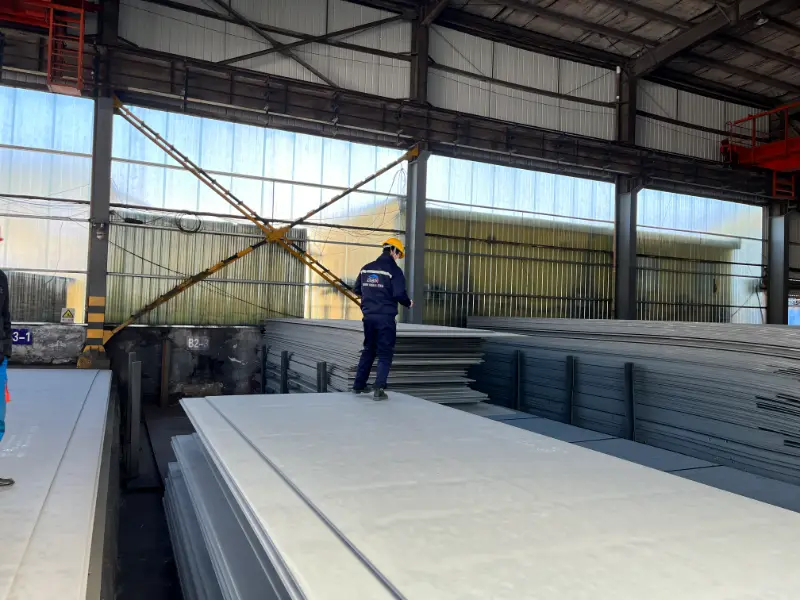
ASTM A240 317 (S31700) Stainless Steel
ASTM A240 317 (S31700) Stainless Steel - Properties, Composition & Equivalents
Comprehensive material data for ASTM A240 317 (UNS S31700) stainless steel pipe, including chemical composition, mechanical and physical properties, equivalent international grades, and application guidelines.
Hot rolling, cold rolling, welding, forming, machining, solution annealing
- Phone : +8618037372205
- Email : [email protected]
- WhatsApp: Contact via Whtsapp
- WeChat: +8618037372205
ASTM A240 317 Stainless Steel Introduction
ASTM A240 317 (UNS S31700) is a molybdenum-bearing austenitic stainless steel with higher corrosion resistance than the standard 304/304L and 316/316L grades. Its increased molybdenum content (3-4%) provides enhanced resistance to pitting and crevice corrosion in chloride environments, as well as improved strength at elevated temperatures. The alloy is non-magnetic in the annealed condition and retains good toughness even at cryogenic temperatures. It is commonly supplied as plate, sheet, strip, and pipe (e.g., per ASTM A312). The material is typically delivered in the solution-annealed condition to maximize ductility and corrosion performance. Key features include:
- Excellent resistance to a wide range of chemicals, especially acidic chloride solutions
- Superior stress-corrosion cracking resistance compared to standard austenitic grades
- Good weldability and formability
ASTM A240 317 Stainless Steel Chemical Composition
The chemical requirements for UNS S31700 according to ASTM A240. All values are in weight percent. The composition is balanced to provide improved corrosion resistance through the addition of molybdenum.
| Element | Content (%) | Remarks |
|---|---|---|
| Carbon (C) | ≤ 0.08 | |
| Manganese (Mn) | ≤ 2.00 | |
| Silicon (Si) | ≤ 1.00 | |
| Phosphorus (P) | ≤ 0.045 | |
| Sulfur (S) | ≤ 0.030 | |
| Chromium (Cr) | 18.0 – 20.0 | |
| Nickel (Ni) | 11.0 – 15.0 | |
| Molybdenum (Mo) | 3.0 – 4.0 | Key element for pitting resistance |
| Nitrogen (N) | Not specified | Typically ≤ 0.10 in practice |
ASTM A240 317 Stainless Steel Physical Properties
Typical thermal and electrical properties of UNS S31700 stainless steel at room temperature unless otherwise noted. These values are representative for the annealed condition and may vary slightly with processing.
| Property | Value | Unit | Test Condition |
|---|---|---|---|
| Density (ρ) | 8.0 | g/cm³ | At 20°C |
| Modulus of Elasticity (E) | 193 | GPa | At 20°C |
| Shear Modulus (G) | 77 | GPa | Calculated from E and Poisson's ratio |
| Poisson's Ratio (ν) | 0.30 | – | At 20°C |
| Thermal Expansion Coefficient (α) | 16.0 | 10⁻⁶/K | 20–100°C |
| Thermal Expansion Coefficient (α) | 17.0 | 10⁻⁶/K | 20–500°C |
| Thermal Conductivity (λ) | 14.6 | W/m·K | At 100°C |
| Specific Heat Capacity (c) | 500 | J/kg·K | At 20°C |
| Electrical Resistivity (ρe) | 0.74 | µΩ·m | At 20°C |
ASTM A240 317 Stainless Steel Mechanical Properties
Minimum mechanical properties at room temperature for 317 plate, sheet, and strip per ASTM A240. These values ensure adequate strength and ductility for forming and service. Higher strength may be achieved through cold working.
| Property | Value | Unit | Condition |
|---|---|---|---|
| Tensile Strength (Rm) | ≥ 515 | MPa | Annealed, room temperature |
| Yield Strength (ReH, 0.2% offset) | ≥ 205 | MPa | Annealed, room temperature |
| Elongation (A) in 50 mm | ≥ 40 | % | Annealed, room temperature |
| Brinell Hardness | ≤ 217 | HBW | Converted or direct |
| Rockwell B Hardness | ≤ 95 | HRB |
ASTM A240 317 Stainless Steel Completely Equivalent Material Standards and Designations
International standards that provide identical or very closely matching chemical and mechanical requirements for 317 (S31700) stainless steel.
| Country/Region | Standard | Grade | Remarks |
|---|---|---|---|
| USA | ASTM A240, A312 | 317 (S31700) | Original specification; also used for pipe (A312 TP317) |
| Japan | JIS G4304 / G4305 | SUS 317 | Chemical composition and mechanical properties match ASTM 317 |
| China | GB/T 3280, GB/T 14976 | 06Cr19Ni13Mo3 | New designation; old designation 0Cr19Ni13Mo3 also found |
ASTM A240 317 Stainless Steel Application Introduction
Due to its enhanced pitting and crevice corrosion resistance, ASTM A240 317 stainless steel is widely used in aggressive environments. The material is easily formed and welded using common stainless steel practices. Post-weld annealing is not required for most applications, though low-carbon 317L is often preferred for welded structures. Typical application areas include:
Product Applications: Seamless and welded pipe for corrosive fluid transport, Heat exchanger tubes and plates, Pressure vessels and storage tanks, Sheet metal components for chemical equipment, Kitchen equipment and architectural panels in marine environments
Processed into products: Flanges, fittings, and valves, Pump impellers and casings, Distillation column internals, Fasteners (bolts, nuts) for sour service, Spray nozzles and educator systems
Application industries: Chemical processing (reactors, storage tanks, piping for organic and inorganic chemicals), Pulp and paper (bleaching equipment, digesters, liquor heaters), Food and beverage (processing equipment, evaporators, storage vessels), Oil and gas (offshore platforms, heat exchangers, seawater handling), Power generation (flue gas desulfurization scrubbers, condenser tubing)
ASTM A240 317 Stainless Steel Similar / Alternative Material Recommendations
Materials with comparable corrosion resistance or intended for similar service environments. Substitution should be confirmed by the design engineer considering specific media, temperature, and pressure conditions.
| Country/Region | Standard | Grade | Remarks |
|---|---|---|---|
| USA | ASTM A240 | 317L (S31703) | Low-carbon version for improved weldability and intergranular corrosion resistance |
| USA | ASTM A240 | 316 (S31600) | Lower molybdenum (2-3%); less pitting resistance but more economical |
| USA | ASTM B625 | UNS N08904 (904L) | Higher alloy content (Ni, Cr, Mo, Cu) for severe acidic and chloride environments |
| Europe | EN 10088-2 | 1.4438 (X2CrNiMo18-15-4) | Low-carbon austenitic grade with similar Mo range; close to 317L |
Notes:
Welding: All common fusion methods are suitable. Use filler metal AWS ER317 or ER317L for thinner sections. Post-weld heat treatment is generally not required for thicknesses below 20 mm, but may be necessary for stress relief in heavy sections. Machining: 317 work hardens; use sharp tools, rigid setups, and adequate lubrication. Forming: Excellent formability in the annealed condition. Springback is higher than carbon steel. Corrosion: While 317 offers good resistance to sulfuric and phosphoric acids, service limits must be verified with corrosion data for specific concentrations and temperatures.
- Share



