
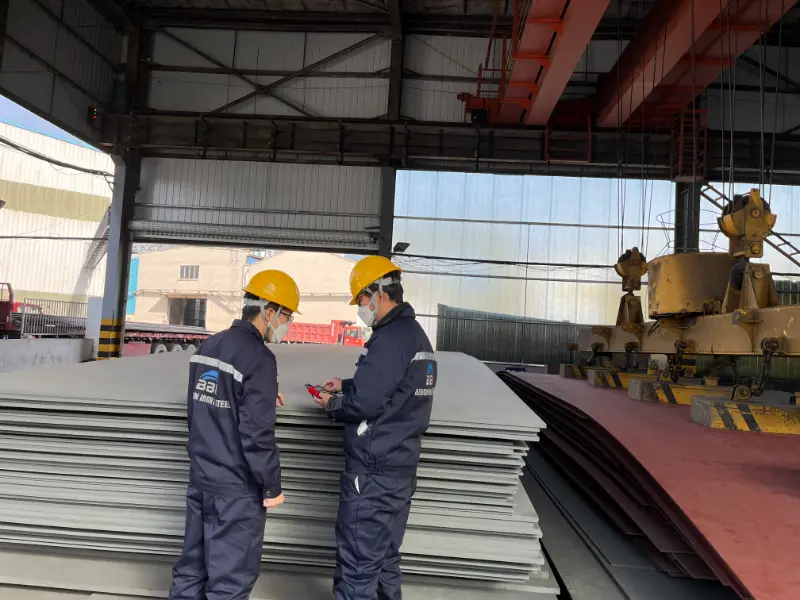
ASTM A240 316L (S31603) Stainless Steel
ASTM A240 316L (S31603) Stainless Steel – Low Carbon Austenitic Grade for Superior Corrosion Resistance
Complete material data for 316L (UNS S31603) according to ASTM A240/A240M, including chemical composition, mechanical properties, physical properties, international equivalents, and application guidance for plate, sheet, strip, and pipe forms.
Hot rolling, cold rolling, forming, bending, welding, machining, solution annealing, pickling
- Phone : +8618037372205
- Email : [email protected]
- WhatsApp: Contact via Whtsapp
- WeChat: +8618037372205
ASTM A240 316L Stainless Steel Introduction
ASTM A240 316L (UNS S31603) is a molybdenum-bearing, low-carbon austenitic stainless steel designed to provide enhanced resistance to pitting and crevice corrosion in chloride environments compared to the standard 304/304L grades. The low carbon content minimizes carbide precipitation during welding, enabling its use in the as-welded condition without intergranular corrosion in many applications. It exhibits excellent formability, weldability, and toughness at cryogenic temperatures. Typical delivery condition is solution annealed and, if required, lightly cold worked. It is widely used in chemical processing, marine equipment, pharmaceutical production, food processing, and heat exchangers. The material conforms to ASTM A240/A240M for flat-rolled products but is also commonly specified for pipe and tube under standards such as ASTM A312/A312M.
ASTM A240 316L Stainless Steel Chemical Composition per ASTM A240/A240M for 316L
The chemical composition of 316L is characterized by low carbon (max. 0.030%) and the addition of 2.00–3.00% molybdenum, which significantly improves resistance to chlorides. Nickel content is increased to stabilize the austenitic structure. All values are maximum unless a range is given.
- Iron is the balance.
- Nitrogen is controlled to maintain strength and weldability.
| Element | Standard Value (wt. %) | Remarks |
|---|---|---|
| Carbon (C) | ≤ 0.030 | Low carbon for improved intergranular corrosion resistance |
| Manganese (Mn) | ≤ 2.00 | Deoxidizer and strength contributor |
| Phosphorus (P) | ≤ 0.045 | Residual element |
| Sulfur (S) | ≤ 0.030 | Residual element; lower sulfur reduces hot workability |
| Silicon (Si) | ≤ 0.75 | Improves oxidation resistance |
| Chromium (Cr) | 16.0 – 18.0 | Primary element for passivity and corrosion resistance |
| Nickel (Ni) | 10.0 – 14.0 | Austenite stabilizer; enhances ductility and formability |
| Molybdenum (Mo) | 2.00 – 3.00 | Improves resistance to pitting and crevice corrosion in chloride environments |
| Nitrogen (N) | ≤ 0.10 | Residual; acts as an austenite stabilizer and strengthens solid solution |
| Iron (Fe) | Balance | Remainder |
ASTM A240 316L Stainless Steel Physical Properties
The physical properties of 316L are typical for molybdenum-bearing austenitic stainless steels. They are influenced by heat treatment and cold work but remain relatively stable over a wide temperature range. These data are based on published literature for solution-annealed material and are not mandatory specifications under ASTM A240.
- Density is approximately 8.00 g/cm³.
- Thermal conductivity is lower than carbon steels, requiring careful heat management during welding.
| Property | Typical Value | Unit | Test Condition / Temperature |
|---|---|---|---|
| Density (ρ) | 8.00 | g/cm³ | Room temperature |
| Modulus of Elasticity (E) | 193 | GPa | Tension, room temperature |
| Shear Modulus (G) | 77 | GPa | Torsion, room temperature |
| Poisson's Ratio (ν) | 0.30 | – | Elastic range |
| Coefficient of Thermal Expansion (α) | 16.0 | 10−⁶ /K | 0–100 °C (32–212 °F) |
| Coefficient of Thermal Expansion (α) | 16.2 | 10−⁶ /K | 0–315 °C (32–600 °F) |
| Coefficient of Thermal Expansion (α) | 17.5 | 10−⁶ /K | 0–538 °C (32–1000 °F) |
| Thermal Conductivity (λ) | 14.0 | W/(m·K) | At 100 °C (212 °F) |
| Thermal Conductivity (λ) | 15.1 | W/(m·K) | At 500 °C (932 °F) |
| Specific Heat Capacity (c) | 500 | J/(kg·K) | Room temperature |
| Electrical Resistivity (ρe) | 0.74 | 10−⁶ Ω·m | Room temperature |
ASTM A240 316L Stainless Steel Mechanical Properties
The mechanical properties are determined on test specimens taken transverse to the rolling direction unless longitudinal testing is specified. For material thickness up to 25.4 mm (1 in.), the following minimum values apply in the annealed condition. Hardness values are maximum allowed. The bend test is required for all plate, sheet, and strip supplied under ASTM A240.
- Yield strength is the 0.2% offset value.
- Elongation is measured in 50 mm (2 in.) gauge length for sheets; for plates, 50 mm or 200 mm gauge length is used per product standard. The 40% minimum applies to standard gauge length 50 mm.
| Property | Standard Requirement (min. or max.) | Unit | Test Condition |
|---|---|---|---|
| Tensile Strength (Rm) | ≥ 485 (70 ksi) | MPa | Room temperature, transverse specimen |
| Yield Strength (Rp0.2) | ≥ 170 (25 ksi) | MPa | Room temperature, 0.2% offset method |
| Elongation (A) | ≥ 40 | % | Gauge length 50 mm (2 in.) |
| Hardness, Rockwell B | ≤ 95 | HRB | Solution annealed, typical hardness 79 HRB |
| Hardness, Brinell | ≤ 217 | HBW | Alternative measurement |
| Bend Test | 180° bend, no cracks | – | Mandrel diameter = specimen thickness (t) for t ≤ 19 mm (0.75 in.) |
ASTM A240 316L Stainless Steel Complete Equivalent Standards and Substitute Grades
| Country/Region | Standard/Specification | Designation/Grade | Remarks |
|---|---|---|---|
| Europe / EU | EN 10088-2:2014 | X2CrNiMo17-12-2 (1.4404) | Chemically identical; covers flat products for general purposes |
| International | ISO 15510:2014 | X2CrNiMo17-12-2 | Chemical and mechanical requirements aligned with 1.4404 and 316L |
| Japan | JIS G4304:2015 | SUS316L | Equivalent hot-rolled stainless steel plate, sheet and strip |
| China | GB/T 3280-2015 | 022Cr17Ni12Mo2 (formerly 00Cr17Ni14Mo2) | Mechanical properties and chemical limits comparable to 316L |
| USA (pipe) | ASTM A312/A312M | TP316L | Seamless and welded pipe; chemistry same as A240; tensile ≥485 MPa, yield ≥170 MPa |
| USA (tube) | ASTM A213/A213M | TP316L | Ferritic/austenitic tube for boiler, superheater, and heat-exchanger applications |
ASTM A240 316L Stainless Steel Application Introduction
316L stainless steel is a workhorse material in industries where corrosion resistance, cleanliness, and fabrication ease are critical. Its low carbon content makes it the preferred choice for welded structures that cannot be post-weld annealed. Typical industries and applications include:
Product Applications: Storage tanks and process vessels, Piping systems, flanges, and fittings (ASTM A312 TP316L), Heat exchanger tubes and plates, Brewing and dairy equipment (kettles, tanks), Stainless steel fasteners (bolts, nuts, washers), Kitchen sinks and countertops, Surgical implants and medical tubing, Desalination plant components, Exhaust manifolds and catalytic converter shells
Processed into products: Welded pressure vessel shells and heads, made from 316L plates, Seamless and welded pipes for corrosive fluid transport, manufactured by cold pilgering or hot extrusion, Stamped and deep-drawn parts: sink bowls, housings, using annealed sheets, Precision machined valve bodies and pump impellers from bar stock or forgings, Laser-cut flanges and gaskets from plate, Formed and welded structural channels and angles for marine construction, CNC-bent tubing for architectural railings or heat exchanger coils, Investment cast brackets and clamps requiring corrosion resistance
Application industries: Chemical and petrochemical processing, Oil and gas (piping, valves, pressure vessels), Marine engineering and offshore platforms, Food and beverage processing equipment, Pharmaceutical and biotechnology manufacturing, Pulp and paper industry (digesters, bleaching equipment), Heat exchangers and condensers, Architectural and construction (cladding, handrails), Cryogenic equipment, Medical devices and surgical instruments
ASTM A240 316L Stainless Steel Similar / Alternative Stainless Steel Grades for Consideration
| Country/Region | Standard/Specification | Designation/Grade | Remarks |
|---|---|---|---|
| USA | ASTM A240/A240M | 316 (UNS S31600) | Higher carbon (max 0.08%), otherwise similar composition; better strength but less weldability without post-weld annealing in corrosive environments |
| Europe | EN 10088-2 | X5CrNiMo17-12-2 (1.4401) | Equivalent to 316; higher carbon variant; may require post-weld heat treatment to avoid sensitization |
| Global | Common designation | 1.4435 / 316L (enhanced Mo) | Higher molybdenum (2.5–3.5%) for even better chloride resistance; used in marine and chemical environments |
| USA | ASTM A240/A240M | 304L (UNS S30403) | Lower cost, no molybdenum; moderate corrosion resistance; suitable for less aggressive environments |
| Europe / USA | EN 10088-2 / ASTM A240 | 1.4539 / N08904 | High-alloy austenitic with ~4.2% Mo and 24% Ni; superior pitting resistance, used in severely corrosive conditions |
Notes:
Welding: 316L can be joined by all common fusion and resistance welding techniques. Use filler metals such as ER316L (AWS A5.9) or E316L (AWS A5.4) to match composition. No post-weld annealing is typically required for most service environments, though full solution annealing may be applied for maximum corrosion resistance. Heat Treatment: Annealing should be performed at 1040–1120 °C followed by rapid cooling (water quench or fast air cool). Cold Working: The grade work hardens significantly; intermediate annealing may be necessary for severe cold forming. Corrosion: Excellent resistance in a wide range of atmospheric and organic environments; however, it can suffer stress corrosion cracking in hot chloride solutions above 60 °C. Descaling: Pickling with nitric-hydrofluoric acid solution is standard; passivation in nitric acid enhances critical pitting temperature.
- Share



