
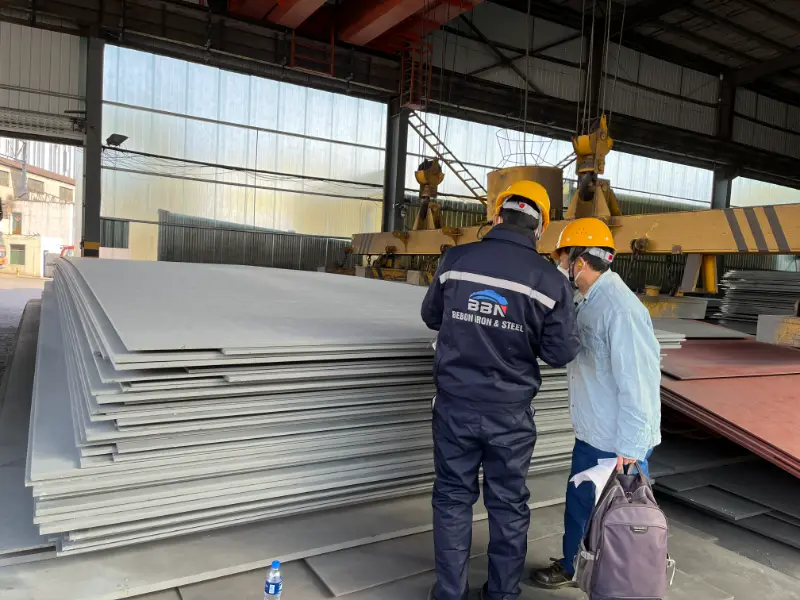
ASTM A240 347 (S34700) Stainless Steel
ASTM A240 347 (S34700) Stainless Steel: Austenitic Chromium-Nickel Alloy with Niobium Stabilization
Comprehensive data sheet for ASTM A240 Grade 347 (UNS S34700) stainless steel, including chemical composition, mechanical and physical properties, international equivalents, and application guidance for pressure vessel plates, sheets, strips, and pipes.
Welding, forming, cold working, hot working, machining (requires high work hardening management)
- Phone : +8618037372205
- Email : [email protected]
- WhatsApp: Contact via Whtsapp
- WeChat: +8618037372205
ASTM A240 347 Stainless Steel Introduction
ASTM A240 347 (UNS S34700) is an austenitic chromium-nickel stainless steel stabilized by additions of niobium (columbium) and tantalum. The stabilization minimizes carbide precipitation at grain boundaries during welding or exposure to elevated temperatures (800–1500 °F / 427–816 °C), drastically reducing susceptibility to intergranular corrosion. This grade offers excellent oxidation resistance up to approximately 1500 °F (816 °C) and good creep strength. It is non-magnetic in the annealed condition, can be hardened only by cold working, and exhibits superior toughness at cryogenic temperatures. The alloy is widely used for high-temperature service in chemical, petrochemical, aerospace, and power generation industries. The standard form covers plates, sheets, and strips, but the same chemistry is applied to seamless and welded pipes under specifications such as ASTM A312 TP347. The material is typically supplied in solution-annealed condition to restore optimal ductility and corrosion resistance.
ASTM A240 347 Stainless Steel Chemical Composition
The chemical composition complies with ASTM A240 limits for Grade 347. The defining stabilization element is niobium plus tantalum, which must be at least ten times the carbon content to effectively suppress sensitization. All values are maximum unless a range is indicated.
| Element | Standard Value | Remarks |
|---|---|---|
| Carbon (C) | 0.08 max | Key for stabilization ratio |
| Manganese (Mn) | 2.00 max | Deoxidizer |
| Phosphorus (P) | 0.045 max | Impurity |
| Sulfur (S) | 0.030 max | Impurity |
| Silicon (Si) | 1.00 max | Deoxidizer |
| Chromium (Cr) | 17.0 – 19.0 | Primary corrosion resistance element |
| Nickel (Ni) | 9.0 – 13.0 | Austenite stabilizer |
| Niobium (Nb) + Tantalum (Ta) | 10×C min, 1.00 max | Stabilization against intergranular attack |
| Nitrogen (N) | 0.10 max (not always specified, but typical) | Residual element |
ASTM A240 347 Stainless Steel Thermal and Electrical Physical Properties
Physical properties are typical for annealed 347 stainless steel. Values may vary slightly depending on exact composition and processing. Thermal conductivity decreases with increasing temperature; expansion coefficient and specific heat increase.
| Property | Typical Value | Unit | Test Condition |
|---|---|---|---|
| Density (ρ) | 8.0 | g/cm³ | 20 °C (68 °F) |
| Elastic Modulus (E) | 193 (28.0×10³) | GPa (ksi) | Tension, 20 °C |
| Shear Modulus (G) | 77 (11.2×10³) | GPa (ksi) | Calculated from E and Poisson's ratio |
| Poisson's Ratio (ν) | 0.3 | - | Elastic range, room temperature |
| Mean Coefficient of Thermal Expansion (α) | 16.6 (9.2) | μm/m/°C (μin./in./°F) | 20–100 °C (68–212 °F) |
| Mean Coefficient of Thermal Expansion (α) | 18.2 (10.1) | μm/m/°C (μin./in./°F) | 20–500 °C (68–932 °F) |
| Mean Coefficient of Thermal Expansion (α) | 18.8 (10.4) | μm/m/°C (μin./in./°F) | 20–800 °C (68–1472 °F) |
| Thermal Conductivity (λ) | 16.3 (113) | W/m·K (Btu·in./hr·ft²·°F) | 100 °C (212 °F) |
| Thermal Conductivity (λ) | 19.0 (132) | W/m·K (Btu·in./hr·ft²·°F) | 300 °C (572 °F) |
| Thermal Conductivity (λ) | 22.6 (157) | W/m·K (Btu·in./hr·ft²·°F) | 500 °C (932 °F) |
| Specific Heat Capacity (cp) | 500 (0.12) | J/kg·K (Btu/lb·°F) | 20–100 °C |
| Electrical Resistivity (ρe) | 0.73 (28.7) | μΩ·m (μΩ·in.) | 20 °C |
ASTM A240 347 Stainless Steel Mechanical Properties at Room Temperature
Tensile properties apply to plates, sheets, and strips in solution-annealed condition, thickness ≤ 1.50 in. (38 mm), per ASTM A240/A240M. Hardness values are given as maxima. For thicker sections, slightly lower strength values may apply.
| Property | Standard Requirement | Unit | Test Condition |
|---|---|---|---|
| Yield Strength (ReH, 0.2% offset) | ≥ 205 (30) | MPa (ksi) | Room temperature, longitudinal |
| Tensile Strength (Rm) | ≥ 515 (75) | MPa (ksi) | Room temperature, longitudinal |
| Elongation (A, 50 mm or 4D) | ≥ 40 | % | Gauge length 50 mm (2 in.) |
| Brinell Hardness (HBW) | ≤ 201 | - | Converted from Rockwell or measured directly |
| Rockwell Hardness (HRB) | ≤ 92 | - | Thick sections may require Rockwell C (HRC) conversion, but HRB typical |
| Bend Test | No cracking or flaws | - | 180° bend, diameter = specimen thickness (t) for thickness ≤ 1.00 in. (25.4 mm); for >1.00 in., bend guided by ASTM A370 |
ASTM A240 347 Stainless Steel Full Equivalent Material Standards and Replacement Grades
| Country/Region | Standard | Grade Designation | Remarks |
|---|---|---|---|
| United States | ASTM A240/A240M | 347 (S34700) | Plate, sheet, strip – base specification |
| United States | ASTM A312/A312M | TP347 (S34700) | Seamless and welded pipe – identical chemistry |
| United States | ASME SA-240/SA-312 | 347 | Boiler and Pressure Vessel Code adoption of ASTM specs |
| European Union | EN 10088-2/-3 | X6CrNiNb18-10 (1.4550) | Comparable chemical and mechanical properties |
| Japan | JIS G4304/G4305 | SUS347 | Rolled stainless steel plate/sheet/strip |
| China | GB/T 4237 | 06Cr19Ni11Nb (S34778) | Equivalent stainless steel plate/sheet |
| International | ISO 15510 | X6CrNiNb18-10 | Chemical similarity; refer to ISO for exact product forms |
ASTM A240 347 Stainless Steel Application Introduction
ASTM A240 347 (S34700) is the preferred material when service temperatures are within the sensitization range (800–1500 °F) and weldments cannot be post-weld solution annealed. Its superior corrosion resistance and mechanical properties make it suitable for demanding environments. Typical applications include:
Product Applications: Boiler and pressure vessel shells and heads, Heat exchanger tube sheets and baffles, Seamless and welded pipes (per ASTM A312), Expansion bellows and flexible joints, Flue gas desulfurization components, High-temperature fasteners (when martensitic grades are incompatible with corrosion), Fabricated ductwork and stacks
Processed into products: Nozzles and manway reinforcements (plate form), Tube-to-tubesheet welds (plate and pipe), Liners and weld overlay strips, Custom-formed fabrications requiring bending and welding of sheet/plate, Machined parts like flanges, support rings, and gaskets (where corrosion and moderate temperature strength are needed)
Application industries: Chemical processing (reactors, columns, heat exchangers), Petrochemical and petroleum refining (furnace tubes, piping, heater headers), Power generation (steam and gas turbine components, superheater tubing), Aerospace (exhaust collectors, thrust reversers, engine afterburner liners), Food and beverage processing (high-temperature cooking vessels, storage tanks), Pulp and paper (digesters, bleach plant equipment), Pharmaceutical (clean steam piping, reaction vessels)
ASTM A240 347 Stainless Steel Closely Related or Similar Substitute Materials
| Country/Region | Standard | Grade Designation | Remarks |
|---|---|---|---|
| United States | ASTM A240 | 347H (S34709) | Higher carbon (0.04–0.10) for improved high-temperature strength; still stabilized |
| United States | ASTM A240 | 321 (S32100) | Titanium-stabilized austenitic stainless steel; similar corrosion resistance but uses Ti for stabilization |
| United States | ASTM A240 | 304L (S30403) | Unstabilized low carbon for improved weldability, but not recommended for continuous high-temperature service above 800°F |
| United States | ASTM A240 | 316L (S31603) | Molybdenum-bearing low carbon grade for enhanced pitting resistance; not stabilized |
Notes:
Welding Considerations: Grade 347 can be welded with matching filler metal (e.g., AWS E347/ER347). Preheating is generally not required. Post-weld heat treatment is usually unnecessary but may be performed to relieve stress if the stabilization ratio is marginal. Heat Treatment: Solution annealing must be followed by rapid cooling to avoid precipitation of chromium carbides. Pickling/Passivation: After forming or welding, the surface must be chemically cleaned to restore full corrosion resistance. Magnetic Properties: Slightly magnetic after cold working; permeability remains low in annealed condition. For pipe applications, always refer to ASTM A312 TP347 or the appropriate pipe specification, though chemistry and mechanical properties are essentially equivalent to A240 347 plate.
- Share



