
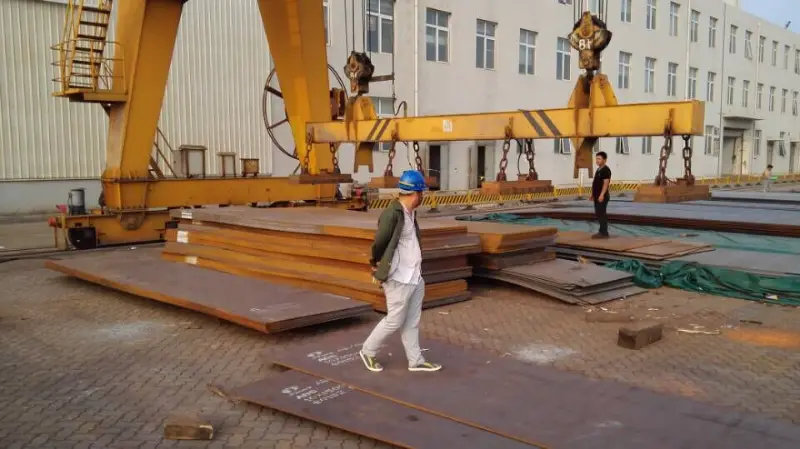
ASME SA633/SA633M Grade E Carbon
ASME SA633/SA633M Grade E Carbon and Low-alloy High-strength Steel Coil Datasheet
Complete material specifications for ASME SA633/SA633M Grade E low-carbon microalloyed high-strength steel coil, including chemical composition, mechanical properties, physical properties, and international equivalents.
Hot rolling, normalizing, welding, cold forming, cutting, machining
- Phone : +8618037372205
- Email : [email protected]
- WhatsApp: Contact via Whtsapp
- WeChat: +8618037372205
ASME SA633/SA633M Grade E Carbon Introduction
ASME SA633/SA633M Grade E is a low-carbon, vanadium-niobium microalloyed high-strength low-alloy (HSLA) steel intended for welded construction. It combines a minimum yield strength of 415 MPa with good notch toughness and excellent weldability. The steel is typically supplied in the normalized condition to refine the grain structure and ensure uniform mechanical properties across thicknesses up to 100 mm. Its balanced composition provides resistance to brittle fracture and allows reliable performance in both ambient and low-temperature environments. Grade E is widely specified for heavy structural members, pressure vessels, offshore platforms, and bridges where high strength and fabrication economy are required.
ASME SA633/SA633M Grade E Carbon Chemical Composition
The chemical composition of Grade E is designed to provide high strength through microalloying with vanadium and optional niobium, while maintaining low carbon for weldability. Maximum limits on phosphorus and sulfur ensure good toughness and internal soundness. Copper may be specified for improved atmospheric corrosion resistance.
| Chemical Element | Standard Value (wt%) | Remarks |
|---|---|---|
| Carbon (C) | ≤0.22 | |
| Manganese (Mn) | 1.15 – 1.50 | |
| Phosphorus (P) | ≤0.04 | |
| Sulfur (S) | ≤0.05 | |
| Silicon (Si) | 0.15 – 0.30 | |
| Copper (Cu) | ≥0.20 | When copper is specified |
| Nickel (Ni) | ≤0.45 | |
| Chromium (Cr) | ≤0.25 | |
| Molybdenum (Mo) | ≤0.08 | |
| Vanadium (V) | 0.02 – 0.10 | |
| Niobium (Nb) | 0.005 – 0.05 | Optional; when added |
| Nitrogen (N) | ≤0.015 | Maximum |
ASME SA633/SA633M Grade E Carbon Thermal and Electrical Physical Properties
These physical properties are typical for normalized vanadium-microalloyed HSLA steels and are suitable for engineering calculations. Actual values may vary slightly depending on exact composition and processing conditions.
| Property | Typical Value | Unit | Condition |
|---|---|---|---|
| Density (ρ) | 7.85 | g/cm³ | Ambient temperature |
| Elastic Modulus (E) | 205 | GPa | Ambient temperature |
| Shear Modulus (G) | 80 | GPa | Ambient temperature |
| Poisson's Ratio (ν) | 0.30 | – | Ambient temperature |
| Thermal Expansion Coefficient (α) | 12.0 × 10⁻⁶ | 1/°C | 20–100 °C |
| Thermal Conductivity (λ) | 50 | W/(m·K) | At 20 °C |
| Specific Heat Capacity (cp) | 470 | J/(kg·K) | At 20 °C |
| Electrical Resistivity (ρe) | 0.22 | µΩ·m | At 20 °C |
ASME SA633/SA633M Grade E Carbon Mechanical Properties
Tensile and yield strength requirements apply to plates in the normalized condition for thicknesses up to 100 mm. Elongation is measured on a proportional test piece. Bend test cold bending properties are also specified. The exact required values depend on plate thickness; the most common values are given for thicknesses ≤ 12.7 mm.
| Property | Required Value | Unit | Test Condition |
|---|---|---|---|
| Yield Strength (ReH) | ≥ 415 | MPa | Thickness ≤ 100 mm |
| Tensile Strength (Rm) | 550 – 690 | MPa | Thickness ≤ 100 mm |
| Elongation (A) | ≥ 23 | % | Gauge length 50 mm (2 in), thickness ≤ 19 mm |
| Elongation (A) | ≥ 18 | % | Gauge length 200 mm (8 in), thickness ≤ 19 mm |
| Bend Test | 3t | – | Bend diameter, thickness ≤ 12.7 mm (0.5 in.) |
| Bend Test | 4t | – | Bend diameter, thickness 12.7–40 mm (0.5–1.5 in.) |
| Bend Test | 5t | – | Bend diameter, thickness > 40 mm (1.5 in.) to 100 mm |
ASME SA633/SA633M Grade E Carbon Identical Material Standards and Replaceable Grade Recommendations
| Country/Region | Standard | Grade | Remarks |
|---|---|---|---|
| United States | ASTM A633/A633M | Grade E | Identical to ASME SA633 Grade E (ASME SA633 was adopted from ASTM A633) |
ASME SA633/SA633M Grade E Carbon Application Introduction
ASME SA633 Grade E steel is selected for applications requiring a combination of high strength, good low-temperature toughness, and reliable weldability under shop or field conditions. Its normalized delivery condition ensures uniform properties across the section, making it ideal for safety-critical fabrications.
Product Applications: Welded plate girders and box columns, Pressure vessel shells and heads, Offshore platform modules and legs, Pipes and penstocks for hydroelectric plants, Heavy welded frames and bases
Processed into products: Bridge flange and web plates, Boiler and pressure vessel drums, Lattice boom sections for cranes, Hydro turbine staying rings, Wind tower base sections
Application industries: Civil engineering and infrastructure, Shipbuilding and offshore construction, Pressure vessel and storage tank manufacturing, Heavy machinery and mining equipment, Renewable energy (wind turbine towers, penstocks)
ASME SA633/SA633M Grade E Carbon Similar/Substitute Material Recommendations
| Country/Region | Standard | Grade | Remarks |
|---|---|---|---|
| European Union | EN 10025-3 | S460N / S460NL | Normalized structural steel; similar strength, lower carbon equivalent if needed |
| Japan | JIS G3106 | SM570 | High-strength weldable structural steel; comparable tensile properties, check impact |
| China | GB/T 1591 | Q460E | HSLA steel with V/Nb microalloying; often used as an alternative after design review |
| International | ISO 4950-2 | E460DD | High yield steel for welded structures; close in chemistry and strength |
Notes:
Normalizing heat treatment is recommended for thicknesses above 25 mm to meet toughness uniformity. When specifying supplementary requirements such as Charpy V-notch impact testing (per ASME SA633 S5), typical absorbed energy values for Grade E are ≥ 27 J at -20°C. Preheating for welding is generally not required for thicknesses below 40 mm; for thicker sections a minimum preheat of 50–100°C is advised. Post-weld heat treatment may be applied when stress relief is demanded, keeping temperature below 600°C to preserve strength. All bend test bend angles are 180° unless otherwise agreed.
- Share



