
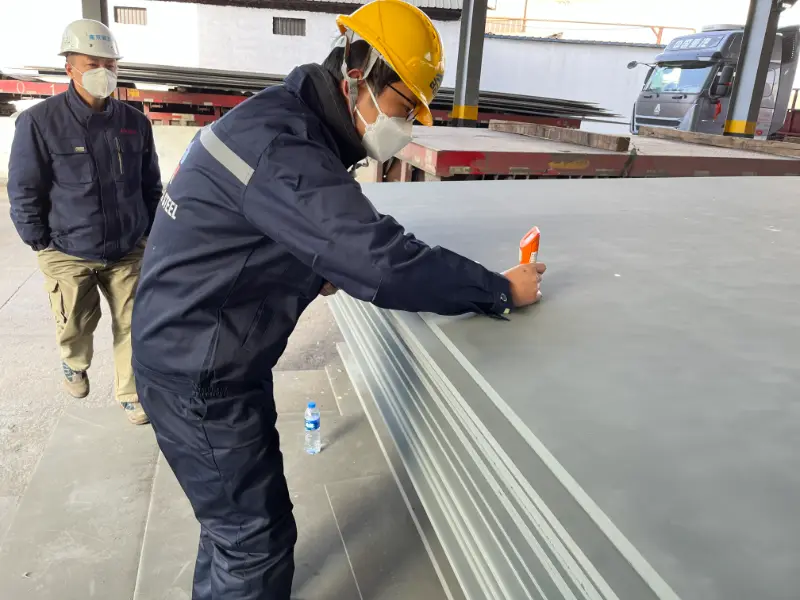
ASME SA633 Grade D
ASME SA633 Grade D: High-Strength Low-Alloy Steel for Structural and Pressure Vessel Use
Detailed material data for ASME SA633/SA633M Grade D carbon and low-alloy high-strength steel coil, including chemical makeup, tensile and impact properties, thermal and electrical characteristics, international equivalents, and application sectors.
Hot rolling, Normalizing, Quenching and Tempering, Welding, Cutting, Forming
- Phone : +8618037372205
- Email : [email protected]
- WhatsApp: Contact via Whtsapp
- WeChat: +8618037372205
ASME SA633 Grade D Introduction
ASME SA633/SA633M Grade D is a high-strength low-alloy (HSLA) structural steel specified for welded construction, bridges, and pressure vessel components. It is supplied primarily as hot-rolled coil, plate, or strip, and can be ordered in the as-rolled, normalized, or quenched-and-tempered condition. The steel achieves its minimum 345 MPa yield strength through a lean chemistry with niobium (columbium) microalloying, which provides grain refinement and enhances both strength and notch toughness. The material exhibits good weldability with standard procedures, provided adequate preheat and interpass controls are observed. Its balanced composition results in relatively low carbon equivalent (typically ≤0.45), minimizing the risk of cold cracking. Typical applications include main load-bearing members in bridges, heavy machinery frames, offshore structures, and bulk transport equipment. When supplementary impact requirements are invoked, Grade D can deliver reliable Charpy V-notch energy absorption at temperatures as low as -20 °C or -40 °C, making it suitable for dynamically loaded and low-temperature service environments.
ASME SA633 Grade D Chemical Composition
The ladle analysis limits for ASME SA633/SA633M Grade D are set to ensure a combination of strength, toughness, and weldability. The intentional addition of niobium refines the ferrite grain, providing precipitation strengthening. Residual elements such as copper, nickel, chromium, and molybdenum may be present from the steelmaking process but are not deliberately added without agreement. The carbon equivalent (CEV) typically falls below 0.45, contributing to good field weldability.
| Element | Required Value (wt.%) | Remarks |
|---|---|---|
| Carbon (C) | ≤0.20 | Maximum |
| Manganese (Mn) | 0.70 – 1.35 | Heat analysis range |
| Phosphorus (P) | ≤0.030 | Maximum |
| Sulfur (S) | ≤0.030 | Maximum |
| Silicon (Si) | 0.15 – 0.50 | Heat analysis range |
| Niobium (Columbium) (Nb) | 0.01 – 0.05 | Grain refinement element |
| Copper (Cu), Nickel (Ni), Chromium (Cr), Molybdenum (Mo), etc. | Residual amounts only | Not intentionally added unless by agreement |
ASME SA633 Grade D Thermal and Electrical Physical Properties
The physical constants listed are representative of carbon and low-alloy steels of this strength class. Slight variations may occur depending on the exact final rolling and heat treatment condition. These values are suitable for engineering calculations such as thermal expansion compensation, heat transfer analysis, and electrical resistivity estimation.
| Property | Typical Value | Unit | Test Condition / Remarks |
|---|---|---|---|
| Density (ρ) | 7.85 | g/cm³ | At 20 °C |
| Modulus of Elasticity (E) | 200 | GPa | At 20 °C |
| Shear Modulus (G) | 80 | GPa | At 20 °C |
| Poisson's Ratio (ν) | 0.30 | – | Elastic region |
| Thermal Expansion Coefficient (α) | 11.7 | 10⁻⁶/K | 20–100 °C |
| Thermal Expansion Coefficient (α) | 12.5 | 10⁻⁶/K | 20–300 °C |
| Thermal Expansion Coefficient (α) | 13.5 | 10⁻⁶/K | 20–500 °C |
| Thermal Conductivity (λ) | ≈52 | W/(m·K) | At 20 °C |
| Specific Heat Capacity (cp) | ≈480 | J/(kg·K) | At 20 °C |
| Electrical Resistivity (ρe) | ≈0.15 | µΩ·m | At 20 °C |
ASME SA633 Grade D Tensile and Bend Properties
The mechanical properties below are taken from the ASME SA633/SA633M specification. Values are for longitudinal test specimens taken from the rolled product. As plate thickness increases, strength values may decrease per the standard's thickness groupings. The work hardening exponent allows the steel to undergo appreciable plastic deformation before fracture. Bend test requirements demonstrate adequate ductility for cold forming. Supplementary impact testing is optional and, when specified, Charpy V-notch values (e.g., 27 J at −20 °C) can be met.
| Property | Required Value | Unit | Test Condition / Remarks |
|---|---|---|---|
| Yield Strength (ReH) | ≥345 | MPa | Thickness ≤ 40 mm |
| Yield Strength (ReH) | ≥345 | MPa | Thickness 40–65 mm |
| Yield Strength (ReH) | ≥315 | MPa | Thickness 65–100 mm |
| Tensile Strength (Rm) | 485–620 | MPa | Thickness ≤ 40 mm |
| Tensile Strength (Rm) | 450–590 | MPa | Thickness 40–65 mm |
| Tensile Strength (Rm) | 450–590 | MPa | Thickness 65–100 mm |
| Elongation (A200) | ≥18 | % | Gauge length 200 mm, all thicknesses |
| Elongation (A50) | ≥23 | % | Gauge length 50 mm, all thicknesses |
| Bend Test (180°) | D=2a (longitudinal) | – | a = specimen thickness; no cracks allowed |
ASME SA633 Grade D Identical Standard Matches and Substitute Designations
| Country / Region | Standard | Designation | Remarks |
|---|---|---|---|
| United States | ASME SA633/SA633M | Grade D | Original specification; identical to ASTM A633 |
| United States | ASTM A633/A633M | Grade D | Identical chemical and mechanical requirements |
ASME SA633 Grade D Application Introduction
ASME SA633 Grade D is engineered for applications where high strength, good weldability, and dependable notch toughness are required. It is particularly suitable for heavy welded fabrications that must perform under static and moderate dynamic loads, often in outdoor or low-temperature service. The steel responds well to flame cutting, cold forming, and all common arc welding processes. Components made from this grade are found in civil engineering, shipbuilding, energy, and transportation projects.
Product Applications: Welded plate girders and box girders, Bridge deck plates and stiffeners, Crane booms and excavator buckets, Offshore platform legs and nodes, Pressure vessel shells and heads (ASME Section VIII, Div. 1 & 2 applications), Bulk transport trailers and dump bodies, Wind turbine tubular towers
Processed into products: Main load-bearing beams and columns, Stiffened panels and bulkheads, Flanges and web plates for built-up sections, Gusset plates and connection nodes, Rolled structural profiles (when processed from coil into angles, channels, etc.), Welded tubular sections for truss work, Support brackets and crane rails
Application industries: Bridge and highway construction, Commercial and industrial building, Pressure vessel and tank fabrication, Offshore and marine structures, Heavy machinery and earthmoving equipment, Railway freight and passenger cars, Wind energy (tower sections)
ASME SA633 Grade D Recommended Similar / Substitutional Materials
| Country / Region | Standard | Designation | Remarks |
|---|---|---|---|
| European Union | EN 10025-3 | S355N / S355NL | Normalized, minimum yield 355 MPa; slightly different CEV limits; N or NL for notch toughness |
| China | GB/T 1591 | Q345D | Yield 345 MPa; comparable strength, but chemistry and delivery condition may differ; good candidate for substitution |
| Japan | JIS G3106 | SM490A / SM490B | 490 MPa tensile class; for welded structures; verify impact temperature per project |
| United States | ASTM A572/A572M | Grade 50 | Yield 345 MPa; widely available structural steel; no intentional niobium addition required |
Notes:
Supplementary Requirements: Impact testing (Charpy V-notch) is not mandatory in the base specification but can be ordered per Supplementary Requirement S5. Typical absorbed energy values of 27 J at −20 °C or 40 J at −40 °C are achievable. Welding: Low-hydrogen practices and suitable preheat (typically 50–150 °C depending on thickness) are recommended. Post-weld heat treatment is generally not required for thicknesses up to 50 mm unless service conditions demand stress relief. Certification: Mill test reports (MTRs) showing heat analysis and mechanical test results are furnished with each shipment when requested.
- Share



