
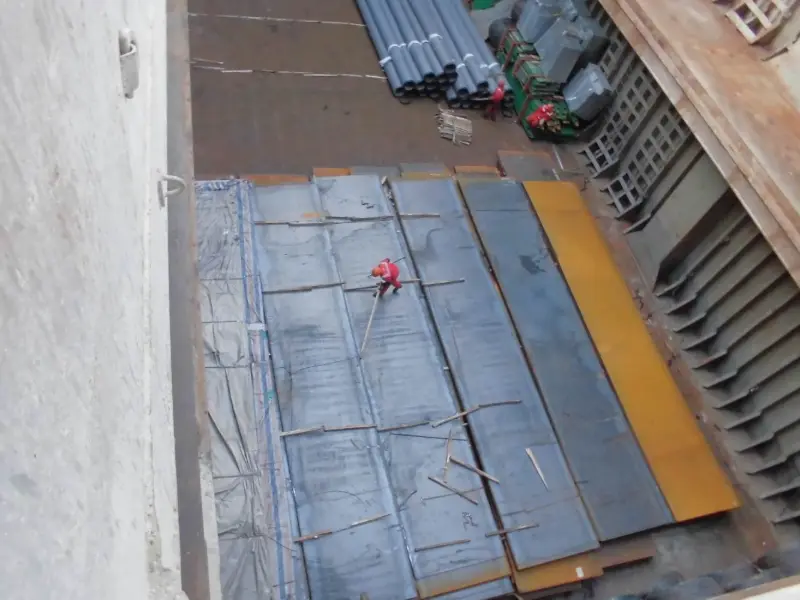
ASME SA588 Grade C (SA588 GR.C) Weathering Steel Plate
ASME SA588 Grade C (SA588 GR.C) Weathering Steel Plate: Complete Material Data
Comprehensive material data sheet for ASME SA588 Grade C (SA588 GR.C) high-strength low-alloy structural steel plate with enhanced atmospheric corrosion resistance, including chemical composition, mechanical, thermal, and electrical properties, international equivalents, and application guide.
Hot rolling, cold forming, welding, machining, drilling, bolting
- Phone : +8618037372205
- Email : [email protected]
- WhatsApp: Contact via Whtsapp
- WeChat: +8618037372205
ASME SA588 Grade C Weathering Steel Plate Introduction
ASME SA588 Grade C is a high-strength low-alloy (HSLA) structural steel defined under ASME SA588/SA588M, equivalent to ASTM A588 Grade C. This weathering steel contains alloying elements such as copper, chromium, nickel, and vanadium, providing superior atmospheric corrosion resistance. When exposed to outdoor environments, it develops a tightly adherent protective oxide layer (patina) that slows further corrosion, often eliminating the need for painting. It combines high strength (minimum yield 345 MPa for most thicknesses) with good weldability and formability, making it ideal for bridges, buildings, and other welded structures. It is typically supplied in the as-rolled condition and can be fabricated using standard structural steel processes.
ASME SA588 Grade C Weathering Steel Plate Chemical Composition
The chemical composition of ASME SA588 Grade C steel is strictly controlled to achieve the required atmospheric corrosion resistance and mechanical properties. Alloying elements such as copper, chromium, nickel, and vanadium are critical for forming a protective patina. Ranges and limits per ASME SA588/SA588M are based on heat analysis. Note that for plate thicknesses over 4 inches (100 mm), the manganese range is adjusted to ensure hardenability.
| Chemical Element | Standard Value (wt%) | Remarks |
|---|---|---|
| Carbon (C) | ≤ 0.15 | |
| Manganese (Mn) | 0.80 – 1.35 | For plates ≤4 in. (100 mm) thick. For plates >4 in. to 5 in. (100–125 mm): 0.80 – 1.10 |
| Phosphorus (P) | ≤ 0.04 | |
| Sulfur (S) | ≤ 0.05 | |
| Silicon (Si) | 0.30 – 0.50 | |
| Nickel (Ni) | 0.25 – 0.50 | |
| Chromium (Cr) | 0.30 – 0.50 | |
| Copper (Cu) | 0.20 – 0.50 | |
| Vanadium (V) | 0.01 – 0.10 |
ASME SA588 Grade C Weathering Steel Plate Thermal and Electrical Physical Properties
The following typical physical properties apply to ASME SA588 Grade C (and similar weathering steels) at room temperature and are not specified in the ASME standard. These values are representative for general engineering calculations. Density, elastic modulus, thermal expansion, and conductivity are comparable to those of ordinary structural steels.
| Property | Standard Value (Typical) | Unit | Test Condition / Remarks |
|---|---|---|---|
| Density (ρ) | 7800 | kg/m³ | At 20 °C |
| Elastic Modulus (E) | 200 | GPa | At 20 °C |
| Shear Modulus (G) | 80 | GPa | Approximate, based on E and ν |
| Poisson's Ratio (ν) | 0.3 | – | Typical for structural steel |
| Thermal Expansion Coefficient (α) | 12.0 | µm/m·°C | Between 20 °C and 100 °C |
| Thermal Conductivity (λ) | 42 | W/m·K | At 20 °C, typical for weathering steel |
| Specific Heat Capacity (cₚ) | 460 | J/kg·K | At 20 °C |
| Electrical Resistivity (ρₑ) | 0.25 | µΩ·m | At 20 °C |
ASME SA588 Grade C Weathering Steel Plate Mechanical Properties
Mechanical properties for ASME SA588 Grade C are defined for various thickness ranges and test specimen orientations (longitudinal). Yield strength (ReH) and tensile strength (Rm) are determined using standard tension tests. Elongation (A) is measured over a 2 inch (50 mm) gauge length. Cold bend tests ensure ductility: the specimen is bent 180° around a specified inside diameter without cracking. Impact toughness is not a standard requirement unless specified on the purchase order; when required, it is typically tested to ASTM A673.
| Property | Standard Required Value | Unit | Test Condition |
|---|---|---|---|
| Yield Strength (ReH) | ≥ 345 | MPa | Plate thickness ≤ 100 mm (4 in.) |
| Yield Strength (ReH) | ≥ 315 | MPa | Plate thickness > 100 mm to 125 mm (4–5 in.) |
| Tensile Strength (Rm) | ≥ 485 | MPa | Plate thickness ≤ 100 mm |
| Tensile Strength (Rm) | ≥ 460 | MPa | Plate thickness > 100 mm to 125 mm |
| Elongation (A) in 50 mm (2 in.) | ≥ 18 | % | Thickness ≤ 20 mm (≤3/4 in.) |
| Elongation (A) in 50 mm (2 in.) | ≥ 21 | % | Thickness > 20 mm to 50 mm (>3/4–2 in.) |
| Elongation (A) in 50 mm (2 in.) | ≥ 18 | % | Thickness > 50 mm to 100 mm (>2–4 in.) |
| Elongation (A) in 50 mm (2 in.) | ≥ 16 | % | Thickness > 100 mm to 125 mm (>4–5 in.) |
| Cold Bend Test | Bend radius = 1t | - | Thickness t ≤ 20 mm, 180° bend, no cracks |
| Cold Bend Test | Bend radius = 1.5t | - | 20 mm < t ≤ 25.4 mm (1 in.) |
| Cold Bend Test | Bend radius = 2t | - | 25.4 mm < t ≤ 50 mm (1–2 in.) |
| Cold Bend Test | Bend radius = 2.5t | - | 50 mm < t ≤ 100 mm (2–4 in.) |
| Cold Bend Test | Bend radius = 3t | - | 100 mm < t ≤ 125 mm (4–5 in.) |
ASME SA588 Grade C Weathering Steel Plate Fully Equivalent Material Standards and Replaceable Grades
| Country / Region | Standard | Grade / Designation | Remarks |
|---|---|---|---|
| USA (International) | ASTM A588/A588M | Grade C | Identical chemical and mechanical requirements; both ASME SA588 Gr. C and ASTM A588 Gr. C are the same material specification. |
ASME SA588 Grade C Weathering Steel Plate Application Introduction
ASME SA588 Grade C is engineered for long-term durability in outdoor, unpainted applications where a stable oxide patina can form. It is widely used in structures that are difficult to access for maintenance painting. Proper design must allow for adequate drainage and avoidance of crevices to ensure uniform patina development. The steel can be welded using common processes (SMAW, GMAW, SAW) with low-hydrogen consumables matching the base metal strength. Preheating may be needed for thick sections (>38 mm). It is readily formed and machined with standard tools.
Product Applications: Steel bridge girders, arches, and decks, Building columns, beams, and trusses, Facades and curtain wall components, Railway car bodies and container frames, Transmission poles and towers, Outdoor storage tanks and silos, Pedestrian bridges and viewing platforms
Processed into products: Riveted or bolted structural connections, Welded built-up sections (H-beams, box columns), Stiffeners and gusset plates, Architectural cladding support brackets, High-strength bolted splices and end plates, Corrosion-resistant shims and base plates, Bending-formed angles and channels
Application industries: Bridge engineering, Commercial and industrial building construction, Railway and rolling stock manufacturing, Power transmission towers and utility structures, Architectural and landscape structures, Marine and coastal environments (with caution regarding continuous immersion), Mining and heavy machinery (non-abrasive environments)
ASME SA588 Grade C Weathering Steel Plate Similar Alternative Material Recommendations
| Country / Region | Standard | Grade / Designation | Remarks |
|---|---|---|---|
| Europe | EN 10025-5 | S355J2W (1.8965) | Comparable weathering steel with minimum yield 355 MPa; composition differs slightly (e.g., Cu & Cr ranges not identical). May replace SA588 Gr. C in many applications with engineering assessment. |
| Europe | EN 10025-5 | S355K2W (1.8967) | Higher toughness version; yield 355 MPa; suitable for thicker sections. Compositionally similar but not exact. |
| Japan | JIS G3125 | SPA-H | High phosphorus weathering steel with yield typically 355–365 MPa; used for atmospheric corrosion resistant applications. Not identical but often used in similar structural roles. |
| China | GB/T 4171 | Q355GNH (09CuPCrNi-A) | Chinese weathering steel with yield 355 MPa; contains Cu, P, Cr, Ni. Substitute with verification of thickness-dependent properties. |
Notes:
Special considerations:
- Surface preparation: For uniform patina formation, mill scale should be removed. Abrasive blasting is often used prior to exposure.
- Welding: Use low-hydrogen electrodes with matching mechanical properties (e.g., E7018 for SMAW). Consult AWS D1.1 Structural Welding Code.
- Fatigue: The weathering patina may slightly reduce fatigue strength of as-welded details; design codes (e.g., AASHTO) provide fatigue categories.
- Thickness limitations: For thicknesses beyond 125 mm (5 in.), other grades or specifications (e.g., ASTM A709) may be more suitable.
- Painting: While not required, painting is possible. If applied after patina forms, proper surface preparation (e.g., blast cleaning) is essential.
- Coating with carbon steel: When in direct contact with non-weathering steel, galvanic corrosion may accelerate; appropriate isolation should be provided.
- Share



