
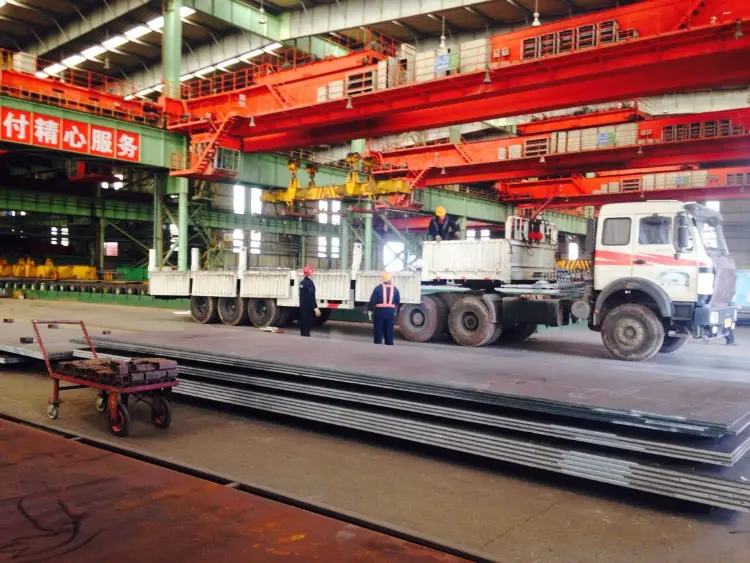
ASME SA573 Grade 65 Structural Carbon Steel
ASME SA573/SA573M Grade 65: Enhanced Toughness Carbon Steel Coil for Structural Applications
In-depth technical data for ASME SA573/SA573M Grade 65 carbon and low-alloy high-strength steel coil, including chemical composition, mechanical properties, thermal and electrical properties, equivalent grades, and application guidance.
Hot rolling, normalizing, welding, forming, machining
- Phone : +8618037372205
- Email : [email protected]
- WhatsApp: Contact via Whtsapp
- WeChat: +8618037372205
ASME SA573 Grade 65 Structural Carbon Steel Introduction
ASME SA573/SA573M Grade 65 is a carbon steel plate/coil specification with improved notch toughness intended for structural applications in bridges, buildings, and general fabrication. It offers a minimum tensile strength of 65 ksi (450 MPa) in the as-rolled or normalized condition. The steel provides a balanced combination of strength, weldability, and ductility, while the enhanced toughness makes it suitable for service at moderately low temperatures. Typical uses include welded bridge components, storage tanks, structural frameworks, and heavy machinery parts. The alloy is characterized by controlled manganese content (0.85–1.20%) and a fine-grain practice that contributes to its impact resistance. Thickness ranges up to 4 in. (100 mm) are covered, with slightly adjusted chemistry and properties for thicker sections. This grade is widely accepted in North American pressure vessel and structural codes and can be substituted for ASTM A573 Grade 65 directly.
ASME SA573 Grade 65 Structural Carbon Steel Chemical Composition
The chemical composition of ASME SA573/SA573M Grade 65 is controlled to ensure improved toughness and weldability. Carbon content is limited to 0.26% for sections up to 1.5 in. (40 mm) and 0.28% for thicker sections up to 4 in. (100 mm). Manganese is held in a narrow range to enhance strength without compromising ductility. Phosphorus and sulfur are each kept ≤0.030% to maintain internal soundness and toughness. Silicon is specified within 0.15–0.40% to aid deoxidation. When copper is specified, it is typically limited to 0.20% minimum if corrosion resistance is required. Grain refinement elements may be added by agreement.
| Element | Content (≤1.5 in. / ≤40 mm) | Content (>1.5–4 in. / >40–100 mm) | Remarks |
|---|---|---|---|
| Carbon (C) | 0.26 max | 0.28 max | Heat analysis |
| Manganese (Mn) | 0.85–1.20 | 0.85–1.20 | Product analysis tolerance applies |
| Phosphorus (P) | 0.030 max | 0.030 max | |
| Sulfur (S) | 0.030 max | 0.030 max | |
| Silicon (Si) | 0.15–0.40 | 0.15–0.40 | For all thicknesses |
| Copper (Cu) | ≥0.20 (if required) | ≥0.20 (if required) | When specified for atmospheric corrosion resistance |
ASME SA573 Grade 65 Structural Carbon Steel Thermal and Electrical Physical Properties
Physical properties are based on typical carbon steel data at room temperature. Density is approximately 7.85 g/cm³. The elastic modulus is around 200 GPa, with a shear modulus near 80 GPa. Thermal expansion between 20°C and 100°C averages 12.0 × 10⁻⁶ /°C. Thermal conductivity is about 51.9 W/(m·°C) at ambient temperature. Specific heat capacity is roughly 486 J/(kg·°C). Electrical resistivity is in the range of 0.2 μΩ·m. These values are suitable for general engineering calculations but may vary with composition and processing.
| Property | Standard Value | Unit | Test Condition |
|---|---|---|---|
| Density (ρ) | 7.85 | g/cm³ | At 20°C |
| Elastic modulus (E) | 200 | GPa | Room temperature |
| Shear modulus (G) | 80 | GPa | Room temperature |
| Poisson's ratio (ν) | 0.3 | — | Room temperature |
| Thermal expansion coefficient (α) | 12.0 | 10⁻⁶/°C | 20–100°C |
| Thermal conductivity (λ) | 51.9 | W/(m·°C) | 20°C |
| Specific heat capacity (cp) | 486 | J/(kg·°C) | 20°C |
| Electrical resistivity (ρe) | 0.2 | μΩ·m | 20°C |
ASME SA573 Grade 65 Structural Carbon Steel Mechanical Properties
Tensile properties are verified in the as-rolled or normalized condition. Yield strength is measured at 0.2% offset. Minimum tensile strength is 65 ksi (450 MPa) and maximum 85 ksi (585 MPa). Elongation requirements depend on thickness and gauge length. The steel exhibits good formability and ductility. Charpy V-notch impact energy is an optional supplementary test; when ordered to S5, typical minimum average values are 20 J (15 ft·lbf) at specified temperatures such as −20°C or 4°C, indicating improved toughness for low-temperature service.
| Property | Required Value | Unit | Test Condition |
|---|---|---|---|
| Yield Strength (ReH) | ≥35 (≤1.5 in.) | ksi | 0.2% offset, transverse sample |
| Yield Strength (ReH) | ≥240 (≤40 mm) | MPa | 0.2% offset, transverse sample |
| Yield Strength (ReH) | ≥32 (>1.5–4 in.) | ksi | 0.2% offset, transverse sample |
| Yield Strength (ReH) | ≥220 (>40–100 mm) | MPa | 0.2% offset, transverse sample |
| Tensile Strength (Rm) | 65–85 (all thicknesses) | ksi | Transverse sample |
| Tensile Strength (Rm) | 450–585 (all thicknesses) | MPa | Transverse sample |
| Elongation (A) in 8 in. (200 mm) | ≥18 (≤1.5 in.) | % | Transverse sample |
| Elongation (A) in 8 in. (200 mm) | ≥17 (>1.5–4 in.) | % | Transverse sample |
| Elongation (A) in 2 in. (50 mm) | ≥23 (≤1.5 in.) | % | Transverse sample |
| Elongation (A) in 2 in. (50 mm) | ≥21 (>1.5–4 in.) | % | Transverse sample |
| Charpy V-notch impact (KV) | ≥20 (typical S5) | J | At −20°C, transverse, average of 3 specimens, if ordered |
ASME SA573 Grade 65 Structural Carbon Steel Fully Equivalent Material Standards and Replaceable Grades
| Country/Region | Standard | Grade | Remarks |
|---|---|---|---|
| USA | ASTM A573/A573M | Grade 65 | Identical technical requirements; ASME SA573 is derived from ASTM A573. |
ASME SA573 Grade 65 Structural Carbon Steel Application Introduction
ASME SA573/SA573M Grade 65 is ideal for welded structural and heavy fabrication applications where reliability and notch toughness are essential. It can be readily formed, welded, and machined using standard practices. Principal application industries and concrete products include:
Product Applications: Welded plate girders and bridge stringers, Storage tank shells and bottoms, Building columns and beams, Rail wagon underframes and bodies, Heavy machinery frames and booms, Tubular poles and towers
Processed into products: Splice plates and connection gussets, Stiffeners and brackets, Flange and web plates for built-up sections, Skid bases and mounting plates, Crane runway beams, Bulkheads and hatch covers
Application industries: Bridge and highway construction, Building and civil infrastructure, Railcar and wagon manufacturing, Heavy machinery and equipment, Storage tanks and pressure vessels (non-ASME Code ambient service), Offshore and marine structural components
ASME SA573 Grade 65 Structural Carbon Steel Closely Related or Similar Substitute Materials
| Country/Region | Standard | Grade | Remarks |
|---|---|---|---|
| European Union | EN 10025-2 | S275J2 (+N) | Comparable minimum yield (275 MPa) but tensile range 410–560 MPa; J2 guarantees 27 J impact at −20°C. Not exact replacement in strength. |
| European Union | EN 10025-3 | S275M/ML | Thermomechanically rolled fine-grain steel with similar toughness; slightly lower tensile upper limit. |
| Japan | JIS G3106 | SM400B/C | General structural steel with impact option; SM400B tensile 400–510 MPa, not directly matching Grade 65 strength. |
| International | ISO 630 | E275C | Fe 430C grade with improved toughness; tensile 410–560 MPa, comparable carbon-manganese levels. |
Notes:
This specification is commonly ordered with supplementary requirement S5 (Charpy V-Notch Test) at a user-specified temperature (e.g., 40°F, −20°C) and minimum energy (typically 15 ft·lbf / 20 J). The steel is typically supplied in the as-rolled condition, but normalizing may be applied to refine grain structure and enhance toughness. Welding should follow standard procedures for carbon-manganese steel (e.g., preheat may be required for thicker sections). For pressure boundary components, ASME BPVC Section VIII, Division 1 applicability should be verified separately. Thicknesses above 4 inches are not covered by this standard.
- Share



