
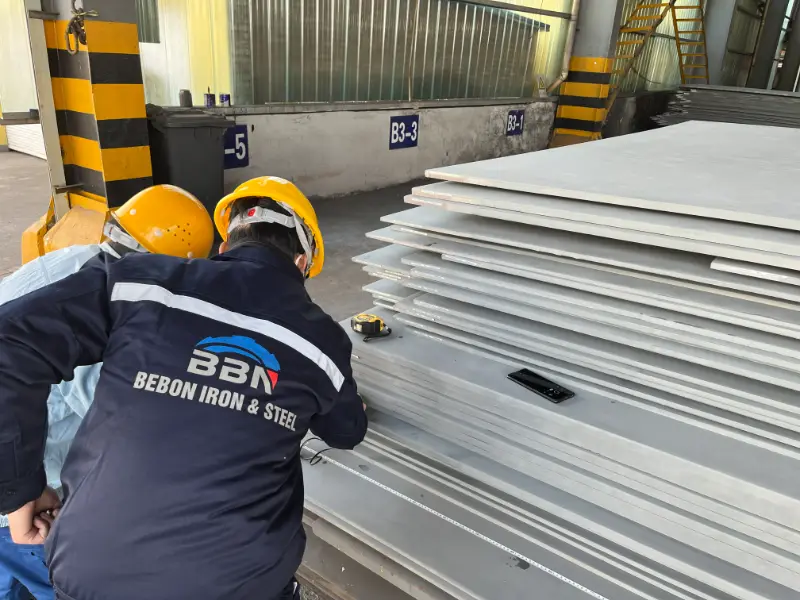
High-Strength Carbon Steel ASME SA573 Grade 70
High-Strength Carbon Steel ASME SA573 Grade 70: Properties, Equivalents & Applications
Comprehensive technical data for ASME SA573/SA573M Grade 70 carbon and low-alloy high-strength steel coil, including chemical composition, mechanical and thermal properties, international equivalents, and application guidance.
Hot rolling, Controlled rolling, Normalizing, Welding, Forming, Machining, Cutting
- Phone : +8618037372205
- Email : [email protected]
- WhatsApp: Contact via Whtsapp
- WeChat: +8618037372205
High-Strength Carbon Steel ASME SA573 Grade 70 Introduction
ASME SA573/SA573M Grade 70 is a carbon-manganese structural steel specifically designed for improved toughness in welded structures. It is primarily supplied as a hot-rolled coil or plate suitable for forming, welding, and moderate fabrication. Grade 70 offers a minimum yield strength of 70 ksi (485 MPa) for thinner sections (≤1.5 in.), providing an excellent balance of strength, ductility, and notch toughness at ambient temperatures. This grade is widely used in bridges, buildings, machinery, and transportation equipment. The steel is produced with controlled manganese and silicon levels to ensure grain refinement and uniform mechanical properties. Compared to ordinary structural carbon steels, SA573 Grade 70 exhibits better resistance to brittle fracture, making it suitable for dynamically loaded components. Its chemistry is strictly controlled to guarantee weldability without excessive preheating in moderate thicknesses. The material can be delivered in the as-rolled, normalized, or controlled-rolled condition depending on the fabricator's requirements.
High-Strength Carbon Steel ASME SA573 Grade 70 Chemical Composition
Chemical requirements are per ASME SA573/SA573M Table 1. The composition is typical of a carbon-manganese steel with no intentional additions of other alloying elements. Manganese content is optimized to achieve the required strength and toughness. Silicon is controlled for deoxidation. Phosphorus and sulfur are kept low to enhance notch toughness. For thicknesses above 40 mm (1.5 in.), slightly relaxed limits may apply.
- Values are for heat (ladle) analysis. Product analysis tolerances are defined in the standard.
- Other elements may be present but are not specified unless agreed between purchaser and producer.
| Element | Standard Value (wt %) | Remarks |
|---|---|---|
| Carbon (C) | ≤ 0.27 | For thickness ≤ 1.5 in. (40 mm) |
| Carbon (C) | ≤ 0.28 | For thickness > 1.5 in. (40 mm) |
| Manganese (Mn) | 0.85 – 1.20 | For all thicknesses (Grade 70) |
| Phosphorus (P) | ≤ 0.035 | Maximum |
| Sulfur (S) | ≤ 0.04 | Maximum |
| Silicon (Si) | 0.15 – 0.40 | Typical for deoxidation |
| Copper (Cu) | ≤ 0.20 (optional) | When specified for improved atmospheric corrosion resistance (by agreement) |
High-Strength Carbon Steel ASME SA573 Grade 70 Thermal and Electrical Physical Properties
The following are reference values for structural carbon steels similar to Grade 70. They are not part of the ASME SA573/SA573M standard but are commonly used for engineering calculations. Slight variations may occur depending on exact composition and heat treatment. The properties are valid at room temperature unless otherwise noted.
| Property | Typical Value | Unit | Remarks / Test Condition |
|---|---|---|---|
| Density (ρ) | 7.85 | g/cm³ | At 20 °C |
| Modulus of Elasticity (E) | 205 | GPa | At 20 °C |
| Shear Modulus (G) | 80 | GPa | Calculated based on E and ν |
| Poisson's Ratio (ν) | 0.30 | - | At 20 °C |
| Coefficient of Thermal Expansion (α) | 11.7 – 13.5 | 10⁻⁶ /K | 20 °C to 300 °C (typical range) |
| Thermal Conductivity (λ) | 52 | W/(m·K) | At 20 °C; decreases with temperature |
| Specific Heat Capacity (cp) | 460 – 490 | J/(kg·K) | At 20 °C; increases with temperature |
| Electrical Resistivity (ρe) | 0.15 – 0.20 | µΩ·m | At 20 °C; depends on carbon content |
High-Strength Carbon Steel ASME SA573 Grade 70 Mechanical Properties
Mechanical properties are specified in ASME SA573/SA573M Table 2. Tests are conducted on transverse specimens. Yield strength (ReH), tensile strength (Rm), and elongation depend on the plate/coil thickness. Impact testing is not mandatory by the standard; however, when required, supplementary requirements (e.g., Charpy V-notch) can be added. Values below represent the minimum requirements as per the standard.
- 1 ksi ≈ 6.895 MPa.
- Full section specimens cannot be used; standard test coupons are taken from the product.
| Property | Required Value | Unit | Test Condition / Thickness Range |
|---|---|---|---|
| Yield Strength (ReH) | ≥ 70 | ksi (MPa) | Thickness ≤ 1.5 in. (40 mm) |
| Yield Strength (ReH) | ≥ 65 | ksi (MPa) | Thickness > 1.5 in. to 3 in. (40–75 mm) |
| Yield Strength (ReH) | ≥ 60 | ksi (MPa) | Thickness > 3 in. (75 mm) |
| Tensile Strength (Rm) | 80 – 100 | ksi (MPa) | Thickness ≤ 1.5 in. (40 mm) |
| Tensile Strength (Rm) | 80 – 100 | ksi (MPa) | Thickness > 1.5 in. to 3 in. (40–75 mm) |
| Tensile Strength (Rm) | 75 – 95 | ksi (MPa) | Thickness > 3 in. (75 mm) |
| Elongation (A) | ≥ 19 | % | in 200 mm (8 in.) gauge length; thickness ≤ 1.5 in. (40 mm) |
| Elongation (A) | ≥ 19 | % | in 200 mm; thickness > 1.5 in. to 3 in. (40–75 mm) |
| Elongation (A) | ≥ 19 | % | in 200 mm; thickness > 3 in. (75 mm) |
| Bend Test (Bend Diameter) | 1.5 × plate thickness | - | 180° bend; no cracking on outside of bent portion |
High-Strength Carbon Steel ASME SA573 Grade 70 Complete Equivalent Material Standards & Replaceable Grades
| Country/Region | Standard | Grade | Remarks |
|---|---|---|---|
| USA | ASTM A573/A573M | Grade 70 | Identical to ASME SA573/SA573M Grade 70 |
| USA | ASME SA573/SA573M | Grade 70 | Current specification; identical to ASTM A573 |
High-Strength Carbon Steel ASME SA573 Grade 70 Application Introduction
ASME SA573 Grade 70 is selected when higher strength with improved toughness is needed over plain structural carbon steel (e.g., ASTM A36/A36M). It is well-suited for welded fabrications in moderate climates. Preheating may be required for thick sections or when ambient temperature is low. The material is not recommended for sour service or elevated-temperature applications without additional testing. Typical industries and products include:
Product Applications: Structural steel frames and columns, Welded bridge girders and trusses, Base plates and gusset plates, Machinery frames and supports, Storage tanks and silos (non-pressure), Piping support structures, Truck trailer chassis and dump bodies, Offshore topsides secondary steel
Processed into products: Welded I‑beams and box columns, Crane runway beams, Bolted and welded connections in structures, Bearing plates and stiffeners, Piling splice plates, Cut and formed brackets, Fabricated crane booms, Mining truck bodies and loader frames, Railcar underframes and bolster plates, Dozer blade structures, Agricultural equipment frames, Excavator boom and arm sections
Application industries: Civil engineering and construction, Bridge building and highway infrastructure, Heavy machinery and equipment manufacturing, Ship and marine structures (secondary members), Transportation (truck frames, railcar components), Tank and pressure vessel (non-code) fabrication, Offshore and platform structures, Mining and material handling equipment
High-Strength Carbon Steel ASME SA573 Grade 70 Similar / Near-Equivalent Material Recommendations
| Country/Region | Standard | Grade | Remarks |
|---|---|---|---|
| Europe | EN 10025-2 | S355J2+N | Comparable yield strength (355 MPa min); slightly different chemistry with higher Mn and micro-alloying; often used as a substitute for structural applications requiring toughness. |
| Japan | JIS G3106 | SM490A / SM490B | Yield strength 325–365 MPa; similar weldable structural steel with good toughness; SM490B adds Charpy requirements. |
| China | GB/T 1591 | Q355D | Yield strength 355 MPa; low-alloy structural steel with impact testing at -20 °C; often used as a substitute. |
| International | ISO 630-2 | S355K2 | Fine grain structural steel with 355 MPa yield; can replace SA573 Gr.70 in many applications, especially where impact toughness at low temperatures is needed. |
| USA | ASTM A516/A516M | Grade 70 | Pressure vessel carbon steel with similar strength; more strict on phosphorus and sulfur but requires different impact testing. Cannot be directly interchanged for structural code use without requalification. |
Notes:
Welding: Low-hydrogen processes are recommended. Preheat and interpass temperature should be selected based on plate thickness and carbon equivalent (typically ≤ 0.45 for SA573 Gr.70). Post-weld heat treatment (PWHT) is generally not required for thicknesses under 1.5 inches but may be applied for thick sections or when stress relief is needed. Forming: The steel can be cold formed to moderate radii. For severe forming, normalization before or after forming may improve ductility. Nondestructive testing: UT or other NDE can be specified as a supplementary requirement in the purchase order. Identification: Products are typically marked with the heat number, grade, and manufacturer's logo. Structural designers should use the design stresses in accordance with applicable building codes (e.g., AISC) using the material's published minimum yield and tensile data.
- Share



