
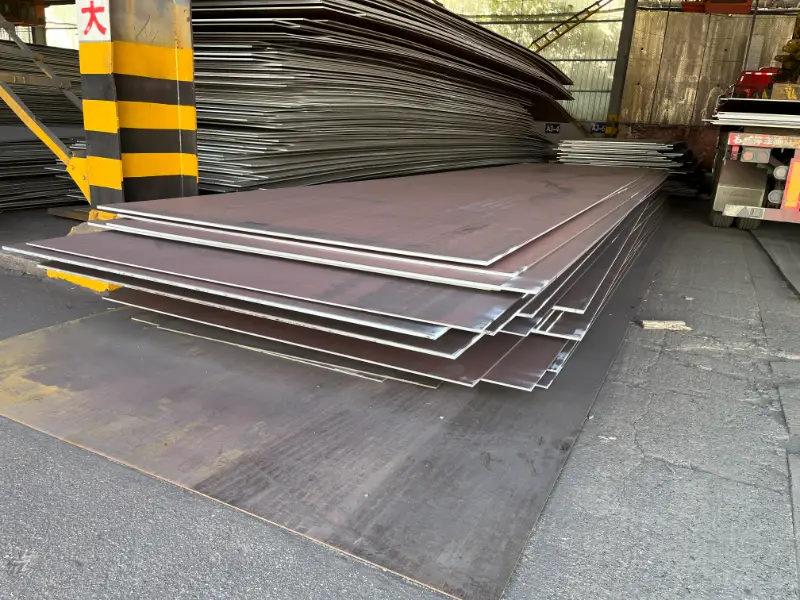
ASME SA514 Grade C Steel
ASME SA514 Grade C Steel: Quenched & Tempered High-Strength Carbon/Low-Alloy Plate for Structural Applications
Detailed material data for ASME SA514/SA514M Grade C steel including chemical composition, mechanical properties under various conditions, thermal and electrical properties, international equivalents, and application guidance for pressure vessel and structural use.
Hot rolling, Quenching, Tempering, Cutting, Welding, Cold forming
- Phone : +8618037372205
- Email : [email protected]
- WhatsApp: Contact via Whtsapp
- WeChat: +8618037372205
ASME SA514 Grade C Steel Introduction
ASME SA514/SA514M Grade C is a quenched and tempered, carbon and low-alloy high-strength steel plate intended for structural applications where weight savings and high strength are critical. With a specified minimum yield strength of 100 ksi (690 MPa) in thicknesses up to 2.5 in. (63.5 mm), this grade offers excellent weldability and good notch toughness at low temperatures. The addition of boron enhances hardenability, allowing full through-thickness hardening. Typical applications include heavy equipment, pressure vessels, offshore structures, and bridges, where its high strength-to-weight ratio enables reduced dead load without compromising safety or durability.
ASME SA514 Grade C Steel Chemical Composition
The chemical composition of ASME SA514/SA514M Grade C is carefully controlled to achieve high strength, good weldability, and adequate toughness after quenching and tempering. Maximum limits for carbon, sulfur, and phosphorus ensure weldability and cleanliness. Boron is intentionally added as a micro-alloying element, significantly enhancing hardenability in thick sections. The alloying with manganese, chromium, and molybdenum provides deep hardening and high-temperature tempering resistance.
| Element | Standard Value (max, unless range specified) | Remarks |
|---|---|---|
| Carbon (C) | 0.10 – 0.20 | Heat analysis |
| Manganese (Mn) | 1.10 – 1.50 | Heat analysis |
| Phosphorus (P) | 0.025 | Maximum |
| Sulfur (S) | 0.025 | Maximum |
| Silicon (Si) | 0.15 – 0.40 | Heat analysis |
| Chromium (Cr) | 0.40 – 0.70 | Heat analysis |
| Molybdenum (Mo) | 0.15 – 0.25 | Heat analysis |
| Boron (B) | 0.0005 – 0.005 | Heat analysis |
ASME SA514 Grade C Steel Thermal and Electrical Physical Properties
The physical properties are typical for quenched and tempered low-alloy steels and are influenced by microstructure and temperature. These values are useful for calculating thermal stresses, deflection under load, and electrical resistivity in specific applications. Data is provided at room temperature unless otherwise noted and is representative of the grade in the Q&T condition.
| Property | Standard Requirement Value | Unit | Test Condition |
|---|---|---|---|
| Density (ρ) | 7.85 | g/cm³ | At 20°C (68°F) |
| Modulus of Elasticity (E) | 205 | GPa | At 20°C (68°F) |
| Shear Modulus (G) | 80 | GPa | At 20°C (68°F) |
| Poisson's Ratio (ν) | 0.28 | – | At 20°C (68°F) |
| Thermal Expansion Coefficient (α) | 11.7 | 10⁻⁶/K | At 20–100°C |
| Thermal Expansion Coefficient (α) | 12.8 | 10⁻⁶/K | At 20–200°C |
| Thermal Expansion Coefficient (α) | 13.7 | 10⁻⁶/K | At 20–400°C |
| Thermal Conductivity (λ) | 42 | W/(m·K) | At 20°C (68°F) |
| Specific Heat Capacity (cp) | 460 | J/(kg·K) | At 20°C (68°F) |
| Electrical Resistivity (ρ_e) | 0.25 | µΩ·m | At 20°C (68°F) |
ASME SA514 Grade C Steel Mechanical Properties
The mechanical properties are highly dependent on plate thickness due to the quench and temper process. The table below shows the specified minimum tensile requirements according to ASME SA514/SA514M. Properties for thicker plates (over ¾ in. to 2.5 in.) are slightly lower than for thinner plates to ensure through-thickness properties. Charpy V-notch impact testing is often specified for low-temperature applications, with typical requirements of 20 ft-lbf (27 J) at -50°F (-46°C).
| Property | Standard Requirement Value | Unit | Test Condition / Plate Thickness |
|---|---|---|---|
| Yield Strength (ReH) | 100 (690) – min | ksi (MPa) | Up to ¾ in. (20 mm) incl. |
| Tensile Strength (Rm) | 110 – 130 (760 – 895) | ksi (MPa) | Up to ¾ in. (20 mm) incl. |
| Elongation (A) in 2 in. (50 mm) | 18 – min | % | Up to ¾ in. (20 mm) incl. |
| Elongation (A) in 8 in. (200 mm) | 14 – min | % | Up to ¾ in. (20 mm) incl. |
| Yield Strength (ReH) | 100 (690) – min | ksi (MPa) | Over ¾ in. to 2.5 in. (20 – 63.5 mm) |
| Tensile Strength (Rm) | 110 – 130 (760 – 895) | ksi (MPa) | Over ¾ in. to 2.5 in. (20 – 63.5 mm) |
| Elongation (A) in 2 in. (50 mm) | 18 – min | % | Over ¾ in. to 2.5 in. (20 – 63.5 mm) |
| Elongation (A) in 8 in. (200 mm) | 14 – min | % | Over ¾ in. to 2.5 in. (20 – 63.5 mm) |
ASME SA514 Grade C Steel Identical Material Standards and Substitutable Grades
| Country/Region | Standard | Grade/Designation | Remarks |
|---|---|---|---|
| USA | ASTM A514/A514M | Grade C | Chemically identical; mandatory for structural service in the USA. |
| USA | ASTM A517/A517M | Grade C | Same chemistry but intended for pressure vessel plates. |
| Europe | EN 10025-6 | S690Q (1.8931) | Similar minimum yield strength (690 MPa), Q&T condition; not necessarily boron-treated. |
ASME SA514 Grade C Steel Application Introduction
ASME SA514/SA514M Grade C is selected for its high strength-to-weight ratio, enabling significant material savings in heavy structures. It is well-suited for cold-bent sections, press brake forming, and welding with low-hydrogen practices. Direct substitution must consider thickness and the intended temperature of service.
Product Applications: Mobile crane telescopic booms and outriggers, Offshore platform topside modules and jack-up rig legs, Welded bridge girders and arch ribs, High-pressure gas storage cylinders, Heavy-duty dump truck bodies and excavator buckets, Industrial lifting and spreader beams
Processed into products: Flanges and webs of welded built-up girders, Shear plates and gusset plates in braced frames, Pin-connected structural linkages, Longitudinal stiffeners in ship hulls, Cold-formed channel and angle sections for trailers, Baseplates for high-stress machinery
Application industries: Heavy Equipment & Machinery, Marine & Offshore Engineering, Bridge & Infrastructure Construction, Pressure Vessel & Boiler Manufacturing, Mining & Earthmoving Equipment
ASME SA514 Grade C Steel Similar/Near-Substitute Materials Recommendation
| Country/Region | Standard | Grade/Designation | Remarks |
|---|---|---|---|
| Europe | EN 10025-6 | S690QL (1.8928) | Offers 690 MPa yield with enhanced low-temperature toughness (L-grade). Widely used equivalent but chemistry differs slightly. |
| Japan | JIS G 3128 | SHY 685 | Similar high-strength Q&T steel for structural use; 685 N/mm² min yield. |
| China | GB/T 16270 | Q690D | Chinese high-strength structural steel with similar strength level; chemistry is adapted for domestic raw materials. |
| International | ISO 4950-2 | E690DD | High yield strength flat steel with a minimum yield of 690 MPa and improved formability. |
Notes:
Welding must follow ASME Boiler and Pressure Vessel Code (BPVC) or relevant design code recommendations. Preheat, interpass temperature control, and post-weld heat treatment (PWHT) are often required and depend on plate thickness and hydrogen control. For coil products, specification for mechanical properties might differ slightly from discrete plates; consult the specific edition of the standard for coil-gauge tolerances and property extent.
- Share



