
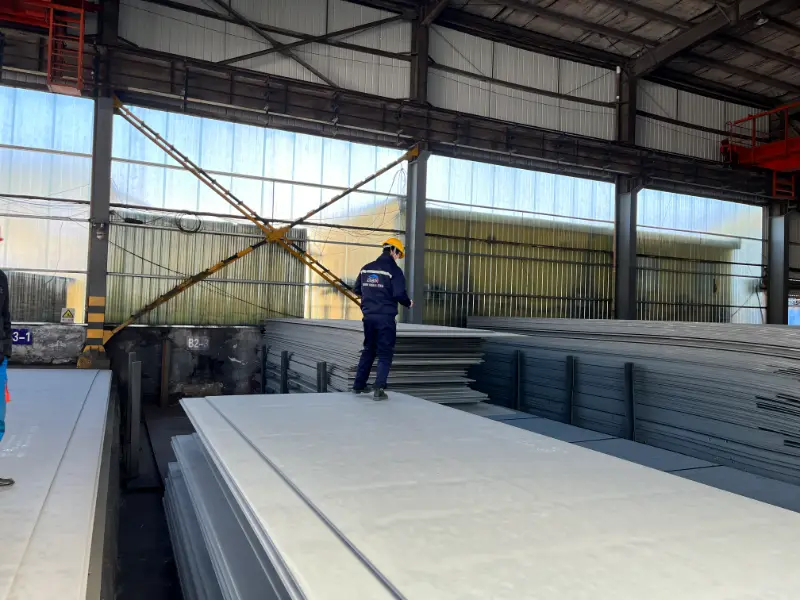
ASME SA514 Grade B High-Strength Steel Plate
ASME SA514 Grade B High-Strength Steel Plate - Properties & Equivalents
Complete material data for ASME SA514/SA514M Grade B carbon and low-alloy high-strength steel: chemical composition, mechanical & physical properties, international equivalents, and applications.
Hot rolling, quenching, tempering, cutting, welding, bending, forming
- Phone : +8618037372205
- Email : [email protected]
- WhatsApp: Contact via Whtsapp
- WeChat: +8618037372205
ASME SA514 Grade B High-Strength Steel Plate Introduction
ASME SA514/SA514M Grade B is a carbon and low-alloy high-strength structural steel plate supplied in the quenched and tempered condition. It provides a minimum yield strength of 100 ksi (690 MPa) with good weldability and formability. Typically produced in thicknesses up to 1¼ in. (32 mm). The alloy design includes chromium, molybdenum, boron, and zirconium for deep hardenability and a fine tempered martensite microstructure. This grade is widely used in welded bridges, heavy machinery, and other structures where a high strength-to-weight ratio is critical. It is also recognized under the identical ASTM A514 Grade B designation.
ASME SA514 Grade B High-Strength Steel Plate Chemical Composition per ASME SA514/SA514M Grade B
The following table lists the specified chemical requirements for Grade B. Boron and zirconium are intentionally added to improve hardenability and toughness. Residual elements are controlled to ensure weldability and mechanical properties.
| Chemical Element | Standard Value (wt%) | Remarks |
|---|---|---|
| Carbon (C) | 0.12 – 0.21 | |
| Manganese (Mn) | 0.70 – 1.00 | |
| Phosphorus (P) | ≤ 0.025 | maximum |
| Sulfur (S) | ≤ 0.025 | maximum |
| Silicon (Si) | 0.20 – 0.35 | |
| Chromium (Cr) | 0.40 – 0.65 | |
| Molybdenum (Mo) | 0.15 – 0.25 | |
| Boron (B) | 0.0005 – 0.005 | |
| Zirconium (Zr) | 0.05 – 0.15 | |
| Iron (Fe) | Balance | approximate remainder |
ASME SA514 Grade B High-Strength Steel Plate Thermal and Electrical Physical Properties
The following physical properties are typical for quenched and tempered high-strength low-alloy steel of this class. They are not mandatory per the material specification but are useful for design calculations and thermal simulations.
| Property | Standard Typical Value | Unit | Test Condition |
|---|---|---|---|
| Density (ρ) | 7.85 | g/cm³ | Room temperature |
| Elastic Modulus (E) | 205 | GPa | Typical for steel |
| Shear Modulus (G) | 80 | GPa | Typical |
| Poisson's Ratio (ν) | 0.29 | – | Typical |
| Thermal Expansion Coefficient (α), 20–100°C | 11.7 × 10⁻⁶ | /°C | Typical |
| Thermal Conductivity (λ) at 20°C | 42.6 | W/(m·K) | Typical |
| Specific Heat Capacity (cp) at 20°C | 475 | J/(kg·K) | Typical |
| Electrical Resistivity (ρe) | 0.17 × 10⁻⁶ | Ω·m | Typical |
ASME SA514 Grade B High-Strength Steel Plate Mechanical Properties
Mechanical properties are determined on transverse test specimens after quenching and tempering. The values depend on plate thickness as indicated. Both metric and imperial units are shown for convenience. Bend test requirements ensure formability without cracking.
| Property | Standard Required Value | Unit | Test Condition |
|---|---|---|---|
| Yield Strength (ReH) | ≥ 690 | MPa | Thickness ≤ 1¼ in. (32 mm) |
| Yield Strength (ReH) | ≥ 100 | ksi | Thickness ≤ 1¼ in. (32 mm) |
| Tensile Strength (Rm) | 760 – 895 | MPa | Thickness ≤ 1¼ in. (32 mm) |
| Tensile Strength (Rm) | 110 – 130 | ksi | Thickness ≤ 1¼ in. (32 mm) |
| Elongation (A) in 2 in. (50 mm) | ≥ 18 | % | Thickness ≤ ¾ in. (20 mm) |
| Elongation (A) in 2 in. (50 mm) | ≥ 17 | % | Thickness > ¾ in. to 1¼ in. (20–32 mm) |
| Bend Test (180°) – Inside Diameter | 2 × thickness | – | Thickness ≤ ¾ in. (20 mm) |
| Bend Test (180°) – Inside Diameter | 3 × thickness | – | Thickness > ¾ in. to 1 in. (20–25 mm) |
| Bend Test (180°) – Inside Diameter | 4 × thickness | – | Thickness > 1 in. to 1¼ in. (25–32 mm) |
ASME SA514 Grade B High-Strength Steel Plate Fully Equivalent Materials
| Country/Region | Standard | Grade | Remarks |
|---|---|---|---|
| USA | ASTM A514/A514M | Grade B | Identical to ASME SA514 Grade B; same chemistry and properties |
ASME SA514 Grade B High-Strength Steel Plate Application Introduction
ASME SA514 Grade B is designed for structural applications demanding high strength, weldability, and toughness. It is suitable for both static and dynamic loads. Typical uses span heavy civil construction, mining, material handling, and transportation. The following lists provide guidance on industries, finished products, and specific components.
Product Applications: Welded bridge girders and box sections, Offshore platform structural components, Excavator booms, arms, and buckets, Heavy-duty truck frames and trailers, Material handling equipment (spreader bars, lifting beams)
Processed into products: Load-bearing structural plates and stiffeners, Welded built-up beams and columns, Flame-cut and machined parts, Reinforcement pads and gussets, Wear-resistant liners (when combined with overlay or cladding)
Application industries: Structural engineering and bridge construction, Heavy machinery and equipment manufacturing, Mining and earthmoving equipment, Crane and lifting equipment, Transportation (truck trailers, rail cars)
ASME SA514 Grade B High-Strength Steel Plate Similar / Comparable Alternative Materials
| Country/Region | Standard | Grade | Remarks |
|---|---|---|---|
| Europe | EN 10025-6 | S690Q (or S690QL) | Comparable high-strength Q&T structural steel; verify thickness limits and welding requirements |
| China | GB/T 16270 | Q690D | Similar yield class, quenched and tempered; check chemical composition for substitution |
| Japan | JIS G3128 | SHY685 | High yield strength steel for welded structures; similar mechanical performance |
Notes:
Material is typically supplied with mill test reports certifying conformance to ASME SA514/SA514M. Welding must use low-hydrogen processes with appropriate preheat and interpass temperatures (typically 100–200°C). Post-weld heat treatment (PWHT) is generally avoided because it can reduce strength and toughness. Preheating and slow cooling are recommended for thick sections to prevent hydrogen cracking. Consult the steel manufacturer for specific welding and forming guidelines.
- Share



