
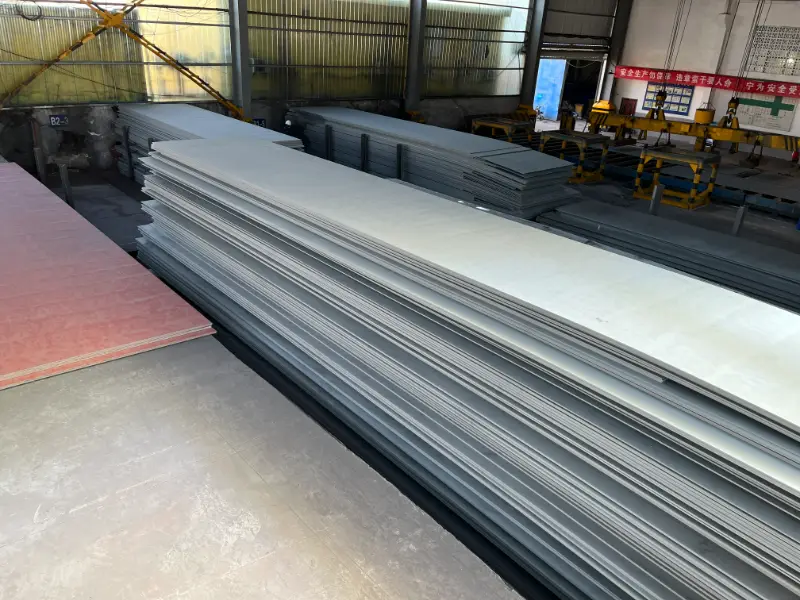
ASME SA514 Grade A High-Strength Structural Steel
ASME SA514 Grade A High-Strength Structural Steel - Properties & Equivalent Grades
Detailed material data for ASME SA514/SA514M Grade A: chemical composition, mechanical and physical properties, international equivalents, and applications of this 690 MPa yield quenched & tempered structural steel plate.
Welding, bending, cutting (plasma, laser, oxy-fuel), machining
- Phone : +8618037372205
- Email : [email protected]
- WhatsApp: Contact via Whtsapp
- WeChat: +8618037372205
ASME SA514 Grade A High-Strength Structural Steel Introduction
ASME SA514/SA514M Grade A is a quenched and tempered high-strength low-alloy (HSLA) steel plate offering a minimum yield strength of 690 MPa (100 ksi) in thicknesses up to 102 mm (4 in.). Designed for welded structures where weight saving and high strength are critical, it exhibits a fine-grained martensitic/bainitic microstructure achieved through controlled heat treatment. The alloying concept relies on precise additions of chromium, molybdenum, and zirconium to ensure deep hardenability and consistent properties across the cross-section. Grade A is supplied with excellent toughness and good formability, meeting the rigorous requirements of the ASME Boiler and Pressure Vessel Code for structural applications. It is commonly employed in heavy-duty weldments such as bridges, building frames, crane booms, and offshore platforms.
ASME SA514 Grade A High-Strength Structural Steel Chemical Composition
The alloy design of SA514 Grade A combines medium carbon with chromium, molybdenum, and zirconium to achieve high hardenability and a minimum 690 MPa yield strength after quenching and tempering. The composition limits are specified according to ASME SA514/SA514M and apply to plate material of all thicknesses.
| Element | Standard Requirement (wt.%) | Remarks |
|---|---|---|
| Carbon (C) | 0.15 – 0.21 | Essential for hardenability |
| Manganese (Mn) | 0.80 – 1.10 | Deoxidizer, contributes to strength |
| Phosphorus (P) | ≤ 0.035 | Maximum allowed |
| Sulfur (S) | ≤ 0.035 | Maximum allowed |
| Silicon (Si) | 0.40 – 0.80 | Deoxidizer |
| Chromium (Cr) | 0.50 – 0.80 | Improves hardenability & corrosion resistance |
| Molybdenum (Mo) | 0.18 – 0.28 | Supports deep hardening & temper resistance |
| Zirconium (Zr) | 0.05 – 0.15 | Grade A specific, grain refinement |
ASME SA514 Grade A High-Strength Structural Steel Thermal and Electrical Physical Properties
The properties below are representative for quenched and tempered high-strength steel at room temperature unless otherwise noted. These values are not specified in ASME SA514 but are typical for Grade A material. They may vary with heat treatment condition and temperature.
| Property | Typical Value | Unit | Test Condition / Remarks |
|---|---|---|---|
| Density (ρ) | 7.85 | g/cm³ | Room temperature |
| Elastic Modulus (E) | 200 | GPa | Room temperature |
| Shear Modulus (G) | 80 | GPa | Room temperature |
| Poisson's Ratio (ν) | 0.3 | — | Room temperature |
| Thermal Expansion Coeff. (α) | 11.7 × 10⁻⁶ | /K | 20 – 100 °C |
| Thermal Expansion Coeff. (α) | 12.5 × 10⁻⁶ | /K | 20 – 200 °C |
| Thermal Conductivity (λ) | 25 | W/(m·K) | at 100 °C |
| Specific Heat Capacity (cp) | 460 | J/(kg·K) | Room temperature |
| Electrical Resistivity (ρe) | 0.25 × 10⁻⁶ | Ω·m | Room temperature |
ASME SA514 Grade A High-Strength Structural Steel Mechanical Properties
Tensile and bend properties are measured on specimens taken transverse to the rolling direction. Minimum values are guaranteed by the standard; actual values often exceed the minimums after proper quenching and tempering. Elongation is measured over a gauge length of 2 in. (50 mm). Bend tests demonstrate cold formability without cracking. D denotes the bend diameter, t the plate thickness.
| Property | Standard Requirement | Unit | Test Condition / Thickness Range |
|---|---|---|---|
| Yield Strength (ReH) | ≥ 690 | MPa | t ≤ 102 mm (4 in.) |
| Yield Strength (ReH) | ≥ 100 | ksi | t ≤ 4 in. |
| Tensile Strength (Rm) | 760 – 895 | MPa | t ≤ 102 mm (4 in.) |
| Tensile Strength (Rm) | 110 – 130 | ksi | t ≤ 4 in. |
| Elongation (A) | ≥ 18 | % | t ≤ 51 mm (2 in.), gauge 2 in. |
| Elongation (A) | ≥ 16 | % | 51 mm < t ≤ 102 mm (2 in. < t ≤ 4 in.), gauge 2 in. |
| Bend Test (180°) | D = 2t | — | t ≤ 19 mm (¾ in.) |
| Bend Test (180°) | D = 3t | — | 19 mm < t ≤ 51 mm (¾–2 in.) |
| Bend Test (180°) | D = 4t | — | 51 mm < t ≤ 102 mm (2–4 in.) |
ASME SA514 Grade A High-Strength Structural Steel Exact Equivalent Grades
| Country/Region | Standard | Grade | Remarks |
|---|---|---|---|
| United States | ASTM A514/A514M | Grade A | Identical composition and mechanical properties; same quenched & tempered condition. SA514 is the ASME adoption of ASTM A514. |
| United States | ASME SA517/SA517M | Grade A | Equivalent chemistry and properties; intended for pressure vessel applications. Interchangeable with SA514 Gr. A. |
ASME SA514 Grade A High-Strength Structural Steel Application Introduction
SA514 Grade A is chosen where high strength-to-weight ratio and good weldability are essential. Typical applications demand thorough engineering of welding procedures, including preheat and interpass temperature control, to avoid hydrogen-induced cracking. The steel performs well in both static and dynamic loading conditions.
Product Applications: Welded plate girders and box girders, Boom sections for mobile and crawler cranes, Offshore platform topside structures, Heavy-haul mining truck frames, Forged and fabricated pressure retaining parts (under SA517)
Processed into products: Longitudinal and transverse bridge stiffeners, Crane boom lacing and chords, Bracket and connection plates in high-load areas, Welded hydraulic cylinder supports, Transition pieces in tubular joints
Application industries: Bridge construction (main girders, orthotropic decks), Building & infrastructure (high-rise columns, trusses), Heavy-duty transportation (trailer frames, rail car components), Offshore & marine (jack-up rig legs, crane pedestals), Mining & earthmoving (dump truck bodies, shovel booms), Pressure vessel & storage tank (when supplied as SA517 Gr. A)
ASME SA514 Grade A High-Strength Structural Steel Similar / Substitute Steels
| Country/Region | Standard | Grade | Remarks |
|---|---|---|---|
| Europe | EN 10025-6 | S690Q / S690QL / S690QL1 | Similar minimum yield strength (690 MPa) and QT condition. Different microalloying concept (Nb, V, Ti), no Zr. S690QL/QL1 offers guaranteed low-temperature toughness. |
| Japan | JIS G3128 | SHY685 | High-yield-strength steel for welded structures. 685 MPa yield minimum; similar hardenability but slightly different chemistry. |
| China | GB/T 16270 | Q690D / Q690E / Q690F | Quenched and tempered high-strength structural steel with 690 MPa yield. Chemical composition may include B, Nb, V; no Zr. Different impact test requirements. |
| International | ISO 4950-3 (withdrawn) | E690DD / E690E | Former international standard for high-yield-strength QT plate; replaced by EN 10025-6. Close in strength but not identical in alloy design. |
Notes:
- Welding: Preheat and controlled heat input are necessary to prevent cold cracking. A low-hydrogen welding process is recommended.
- Stress relieving: Post-weld heat treatment is not normally required for thicknesses up to 2 in., but may be applied by agreement. Over-tempering can reduce strength.
- Through-thickness properties: Can be ordered with supplementary Z-grade testing (e.g., Z25, Z35) for improved lamellar tearing resistance.
- Surface condition: Plate is typically supplied in the as-rolled and QT condition with mill scale; abrasive blasting and primer coating are common before fabrication.
- Thickness range: ASME SA514 Gr. A is available from 3/16 in. (5 mm) up to 4 in. (102 mm), depending on the mill.
- Share



