
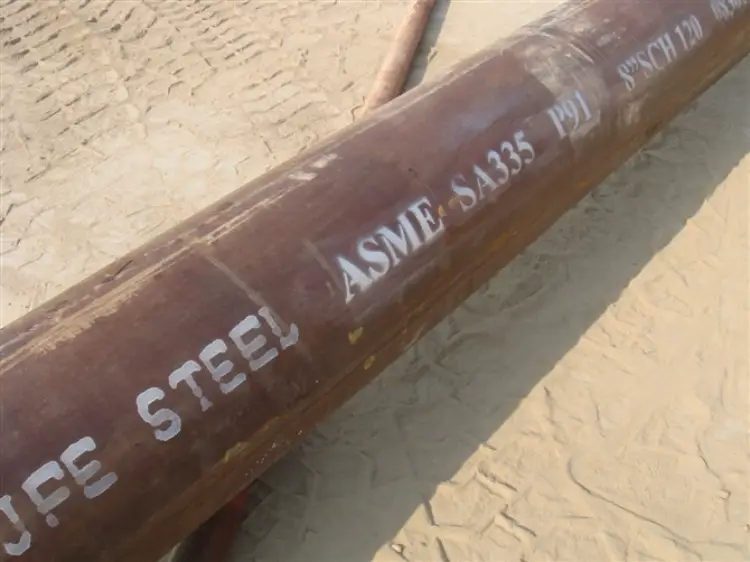
ASME SA335 P91 Tube
ASME SA335 P91 Tube: Premium Creep-Strength Enhanced Ferritic Steel for High-Temperature Service
Comprehensive material data for ASME SA335 P91, a modified 9Cr-1Mo-V-Nb steel for high-temperature boiler and pressure vessel applications.
Hot-finished or cold-finished with subsequent heat treatment (normalizing and tempering). Weldable using matched filler metals with preheat and post-weld heat treatment (PWHT) strictly required.
- Phone : +8618037372205
- Email : [email protected]
- WhatsApp: Contact via Whtsapp
- WeChat: +8618037372205
ASME SA335 P91 Tube Introduction
ASME SA335 P91 is a creep-strength enhanced ferritic (CSEF) steel grade known as modified 9Cr-1Mo-V-Nb, standardized for seamless ferritic alloy-steel pipe intended for high-temperature service. Key attributes include superior oxidation resistance up to approximately 630°C (1166°F), excellent creep-rupture strength due to V/Nb micro-alloying, and enhanced thermal conductivity compared to austenitic stainless steels. This optimized chemistry reduces wall thickness requirements in high-pressure boilers and piping systems while offering improved resistance to thermal fatigue cracking, making it the industry standard for modern supercritical and ultra-supercritical power generation plants.
ASME SA335 P91 Tube Chemical Composition
The chemistry of P91 is precisely controlled to form stable vanadium/niobium carbo-nitrides for creep strength, while maintaining a fully martensitic microstructure after normalizing and tempering. Key control elements include Aluminum (Al) for grain refinement, and restricted Nickel (Ni) and Manganese (Mn) to maintain the desired lower critical transformation temperature.
| Element | Specified Value | Remarks |
|---|---|---|
| Carbon (C) | 0.08 – 0.12 | Core austenite stabilizer; ensures full martensitic structure. |
| Manganese (Mn) | 0.30 – 0.60 | Deoxidizer; restricted to control Ac1 temperature. |
| Phosphorus (P) | ≤ 0.020 | Residual element; controlled for ductility. |
| Sulfur (S) | ≤ 0.010 | Residual element; controlled for cleanliness. |
| Silicon (Si) | 0.20 – 0.50 | Deoxidizer; contributes to oxidation resistance. |
| Chromium (Cr) | 8.00 – 9.50 | Primary element for oxidation and corrosion resistance. |
| Molybdenum (Mo) | 0.85 – 1.05 | Solid solution strengthener; enhances creep resistance. |
| Vanadium (V) | 0.18 – 0.25 | Precipitation strengthener (V/Nb carbonitrides). |
| Niobium (Nb) | 0.06 – 0.10 | Precipitation strengthener (V/Nb carbonitrides). |
| Nitrogen (N) | 0.030 – 0.070 | Essential for nitride/carbo-nitride precipitate formation. |
| Nickel (Ni) | ≤ 0.40 | Controlled residual; excessive Ni lowers Ac1. |
| Aluminum (Al) | ≤ 0.020 | Controlled to promote fine grain structure via N combination. |
| Titanium (Ti) | ≤ 0.01 | Residual element; controlled to avoid interfering with Nb/V. |
| Zirconium (Zr) | ≤ 0.01 | Residual element; similar control rationale as Ti. |
ASME SA335 P91 Tube Physical Properties
Physical properties are critical for thermal stress and heat transfer calculations in boiler design. P91 exhibits a lower coefficient of thermal expansion and higher thermal conductivity than austenitic stainless steels (e.g., 304H), reducing thermal fatigue sensitivity under cyclic operation. The Ac1 critical transformation temperature is a vital datapoint for setting maximum service and tempering temperatures.
| Property | Typical Value | Unit | Test Conditions / Remarks |
|---|---|---|---|
| Density (ρ) | 7.77 | g/cm³ | At 20°C |
| Elastic Modulus (E) | 215 – 218 | GPa | At 20°C |
| Shear Modulus (G) | 83 – 85 | GPa | At 20°C |
| Poisson's Ratio (ν) | 0.27 – 0.29 | – | Room Temperature estimate |
| Coefficient of Thermal Expansion (α) | 11.1 | 10⁻⁶/K | 20°C to 200°C |
| Coefficient of Thermal Expansion (α) | 11.5 | 10⁻⁶/K | 20°C to 400°C |
| Coefficient of Thermal Expansion (α) | 11.8 | 10⁻⁶/K | 20°C to 500°C |
| Coefficient of Thermal Expansion (α) | 12.1 | 10⁻⁶/K | 20°C to 600°C |
| Thermal Conductivity (λ) | 29 | W/(m·K) | At 100°C |
| Thermal Conductivity (λ) | 30 | W/(m·K) | At 300°C |
| Thermal Conductivity (λ) | 30 | W/(m·K) | At 500°C |
| Specific Heat Capacity | 440 | J/(kg·K) | At 20°C |
| Specific Heat Capacity | 620 | J/(kg·K) | At 600°C |
| Electrical Resistivity (ρe) | 0.57 | Ω·mm²/m | At 20°C |
| Electrical Resistivity (ρe) | 0.90 | Ω·mm²/m | At 600°C |
| Ac1 Critical Transformation Temperature | 810 – 830 | °C | Lower critical; sets practical maximum use/tempering limit |
ASME SA335 P91 Tube Mechanical Properties
Mechanical property requirements are specified at room temperature for the required heat treatment condition. The tempered martensitic microstructure yields an exceptional balance of high tensile/yield strength and good ductility. Properties are typical for pipe with wall thicknesses considered under the standard. Hardness is strictly bounded to prevent premature creep damage.
| Property | Required Value | Unit | Test Conditions / Remarks |
|---|---|---|---|
| Tensile Strength (Rm) | ≥ 585 | MPa | Room Temperature; transverse or longitudinal strip/tube specimens |
| Yield Strength (ReH, 0.2% offset) | ≥ 415 | MPa | Room Temperature; valid for the specified delivery condition |
| Elongation (A) in 50mm (2 in.) | ≥ 20 | % | Longitudinal strip test; or round specimen proportional to gauge length |
| Elongation (A) in 50mm (2 in.) - transverse | ≥ 14 | % | Transverse strip test; for calculated minimum wall thickness per standard |
| Hardness | 190 – 250 | HBW | Or Equivalent Rockwell/Vickers; ensures proper Post-Weld Heat Treatment response |
| Hardness | 196 – 265 | HV | Alternative Vickers measurement range |
ASME SA335 P91 Tube Completely Equivalent Material Standards and Substitutable Grades
| Country/Region | Standard | Grade | Remarks |
|---|---|---|---|
| Europe | EN 10216-2 | X10CrMoVNb9-1 | Chemically identical; seamless tubes for pressure purposes. |
| USA (Tube) | ASTM A213 / ASME SA-213 | T91 | Ferritic alloy-steel seamless heat-exchanger and condenser tubes. |
| USA (Forging) | ASTM A182 / ASME SA-182 | F91 | Forged or rolled alloy-steel for flanges and fittings. |
| USA (Plate) | ASTM A387 / ASME SA-387 | Gr. 91 Cl. 1/2 | Pressure vessel plates, alloy steel, chromium-molybdenum. |
| International | ISO 9329-2 | X10CrMoVNb9-1 | Seamless steel tubes for pressure purposes. |
| Japan | JIS G 3458 | STPA 28 | Alloy steel pipes for high temperature service. |
| China | GB/T 5310 | 10Cr9Mo1VNbN | Seamless steel tubes for high-pressure boiler. |
ASME SA335 P91 Tube Application Introduction
ASME SA335 P91 pipe is engineered for high-pressure, high-temperature environments where creep-rupture failure is a dominant design constraint. Its adoption revolutionizes power plant efficiency by enabling higher steam temperatures (typically 580-630°C) and pressures compared to traditional low-alloy Cr-Mo steels. The material's processability allows it to be used for thick-section pipework needing bending, welding, and long-term service in power boilers.
Product Applications: Main steam piping and high-energy reheat piping, Superheater and reheater tube bundles (final stages), High-pressure steam boiler headers and drums, Petrochemical furnace radiant and convection section tubes, Thick-wall high-pressure steam distribution headers, High-temperature y-pieces, reducers, and tees (fabricated from pipe)
Processed into products: Boiler superheater pendants, Reheater tube assemblies, Field-welded main steam line girth welds, Attemperator shells (when made from pipe), Hot reheat line elbows (induction bent pipe), High-temperature pressure vessel nozzles (machined from heavy wall pipe)
Application industries: Fossil fuel power generation (Supercritical and Ultra-Supercritical Boilers), Nuclear power generation (Liquid metal fast breeder reactor steam generators), Petrochemical processing (Refinery fired heaters and catalytic cracker overhead lines), Oil and gas (High-pressure high-temperature piping systems), Waste-to-energy plants (Superheater stages), Concentrated solar power (Molten salt heat exchanger tubing)
ASME SA335 P91 Tube Similar/Near-Substitute Material Recommendations
| Country/Region | Standard | Grade | Remarks |
|---|---|---|---|
| Europe / USA | EN 10216-2 / ASTM A213 | X20CrMoV11-1 / T22 | Lower creep strength; legacy grade with 12%Cr or 2.25Cr-1Mo, requires thicker walls for equivalent P91 service conditions, not a direct design substitute for new high-efficiency plants. |
| Europe | EN 10216-2 | X11CrMoWVNb9-1-1 (E911) | Contains Tungsten (W); slightly higher creep strength than P91, used as an intermediate grade between P91 and P92; compatible processing, used when additional thermal stability is required. |
| Japan / USA | JIS / ASME | STPA29 / P92 | 9Cr-0.5Mo-1.8W-V-Nb; next generation CSEF steel with higher creep-rupture strength exceeding P91, enabling even thinner walls and higher temperatures; welding is more sensitive. |
Notes:
Welding P91 requires strict adherence to a qualified procedure specification (WPS) including a minimum preheat of 200°C (400°F), strict interpass temperature control, and immediate post-weld heat treatment (PWHT) typically at 750-775°C (1380-1425°F) to achieve adequate toughness and reduce residual stress. Improper PWHT can result in tensile properties below minimum standard requirements and extremely low creep ductility. Hardness testing (e.g., 190-250 HBW limit) is universally performed as a quality control proxy for PWHT effectiveness. Material must be protected from wet environments during hydrostatic testing to avoid stress corrosion cracking. Long-term service exposure above the designed metal temperature can accelerate Type IV cracking in the fine-grain heat-affected zone of welded joints.
- Share



