
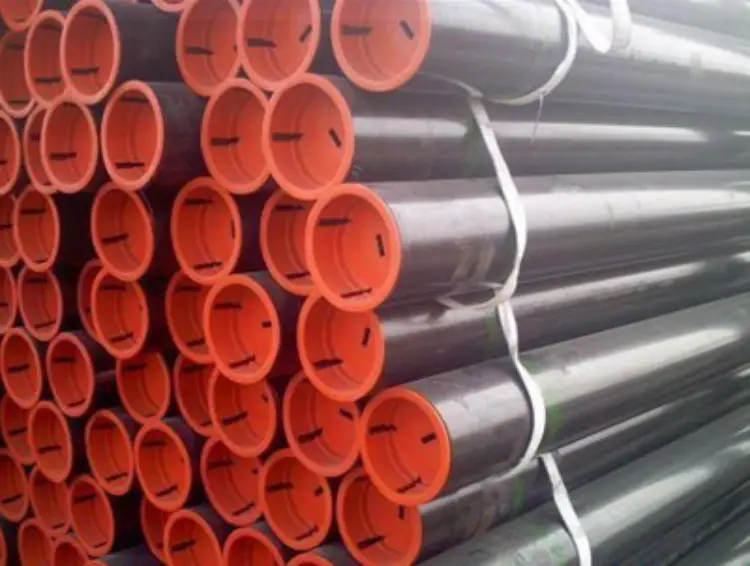
ASME SA312 TP317L Stainless Steel Pipe
ASME SA312 TP317L Stainless Steel Pipe - Full Technical Data & Global Equivalents
Detailed material analysis of ASME SA312 TP317L stainless steel pipe: chemistry, mechanical and physical properties, international equivalent grades, similar materials, and application guidance for pressure and corrosion-resistant piping systems.
Hot‑finished or cold‑finished seamless pipe; welded pipe without filler metal or with filler metal. May be furnished heat‑treated, pickled, or bright annealed.
- Phone : +8618037372205
- Email : [email protected]
- WhatsApp: Contact via Whtsapp
- WeChat: +8618037372205
ASME SA312 TP317L Stainless Steel Pipe Introduction
ASME SA312 TP317L is a low‑carbon austenitic stainless steel pipe grade developed for superior corrosion resistance, particularly in acidic and chloride‑containing environments. It is the low‑carbon version of TP317, offering improved weldability and resistance to intergranular corrosion after welding or stress relieving. The alloy is stabilized with higher contents of chromium, nickel, and molybdenum compared to standard 316L, which gives it enhanced pitting and crevice corrosion resistance.
- Excellent performance in sulfuric acid, phosphoric acid, and flue‑gas desulfurization systems
- Superior resistance to sensitization during welding
- Good high‑temperature strength and oxidation resistance
- Widely used in chemical processing, petrochemical, and power generation industries
This grade conforms to the ASME Boiler & Pressure Vessel Code SA‑312 specification for seamless and welded austenitic stainless steel pipes.
ASME SA312 TP317L Stainless Steel Pipe Chemical Composition
The chemical composition of TP317L as specified in ASME SA312/SA312M (UNS S31703). All values represent ladle analysis limits. The low carbon content (< 0.030 %) prevents chromium carbide precipitation in the heat‑affected zone of welds, maintaining corrosion resistance.
| Element | Standard Value (wt. %) | Remarks |
|---|---|---|
| Carbon (C) | ≤ 0.030 | Low carbon grade – enhances weldability |
| Manganese (Mn) | ≤ 2.00 | |
| Phosphorus (P) | ≤ 0.045 | |
| Sulfur (S) | ≤ 0.030 | |
| Silicon (Si) | ≤ 0.75 | |
| Chromium (Cr) | 18.0 – 20.0 | Key element for corrosion resistance |
| Nickel (Ni) | 11.0 – 15.0 | Stabilizes austenitic structure |
| Molybdenum (Mo) | 3.0 – 4.0 | Improves pitting/crevice resistance |
| Nitrogen (N) | Not specified | Typically < 0.10 % |
| Iron (Fe) | Balance | Remaining composition |
ASME SA312 TP317L Stainless Steel Pipe Thermal & Electrical Physical Properties
The following physical properties are typical values for wrought annealed TP317L (UNS S31703) stainless steel. They are not part of the ASME SA312 specification but are widely accepted engineering data for design calculations. Actual values may vary slightly depending on heat treatment and product form.
| Property | Typical Value | Unit | Test Condition |
|---|---|---|---|
| Density (ρ) | 8.0 | g/cm³ | At 20 °C |
| Modulus of Elasticity (E) | 193 | GPa | Tension, at 20 °C |
| Shear Modulus (G) | 74 | GPa | Typical for austenitic grades, at 20 °C |
| Poisson's Ratio (ν) | 0.30 | – | At 20 °C |
| Thermal Expansion Coefficient (α) | 16.5 | µm/m·°C | 20 – 100 °C |
| Thermal Expansion Coefficient (α) | 17.0 | µm/m·°C | 20 – 300 °C |
| Thermal Expansion Coefficient (α) | 18.0 | µm/m·°C | 20 – 500 °C |
| Thermal Conductivity (λ) | 14.0 | W/m·K | At 100 °C |
| Thermal Conductivity (λ) | 16.0 | W/m·K | At 300 °C |
| Specific Heat Capacity | 500 | J/kg·K | 0 – 100 °C |
| Electrical Resistivity (ρₑ) | 0.74 | µΩ·m | At 20 °C |
ASME SA312 TP317L Stainless Steel Pipe Mechanical Properties
Minimum tensile and yield strength requirements at room temperature for ASME SA312 TP317L pipe in the solution‑annealed condition. Elongation values apply to longitudinal strip tensile specimens (50 mm or 2 in. gauge length). Requirements per SA312/SA312M are valid for wall thicknesses up to specified limits. For actual design, refer to the latest ASME Code allowable stresses.
| Property | Standard Requirement | Unit | Test Condition |
|---|---|---|---|
| Tensile Strength (Rm) | ≥ 515 | MPa | Room temperature |
| Tensile Strength (Rm) | ≥ 75 | ksi | Room temperature |
| Yield Strength (ReH, 0.2 % offset) | ≥ 205 | MPa | Room temperature |
| Yield Strength (ReH, 0.2 % offset) | ≥ 30 | ksi | Room temperature |
| Elongation (A) | ≥ 35 | % | Longitudinal, 50 mm (2 in.) gauge length, standard specimen |
| Hardness | ≤ 90 HRB (or ≤ 200 HBW) | – | Typical maximum, not mandatory by SA312 but often required by purchaser |
ASME SA312 TP317L Stainless Steel Pipe Fully Equivalent Standard Grades & Replaceable Designations
| Country/Region | Standard | Grade/Designation | Remarks |
|---|---|---|---|
| USA | ASME SA312 / ASTM A312 | TP317L (UNS S31703) | Original specification; seamless & welded pipe |
| European Union | EN 10216‑5 / EN 10217‑7 | 1.4438 (X2CrNiMo18‑15‑4) | Seamless (10216) and welded (10217) tube; identical corrosion resistance |
| Japan | JIS G3459 | SUS317LTP | Stainless steel pipes for general corrosion‑resistant applications |
| China | GB/T 14976 | 022Cr19Ni13Mo3 | Seamless stainless steel pipe; similar chemistry |
| International | ISO 1127 | X2CrNiMo18‑15‑4 | Equivalent designation under ISO format |
ASME SA312 TP317L Stainless Steel Pipe Application Introduction
ASME SA312 TP317L pipe is engineered for demanding corrosive conditions where standard austenitic grades (304L/316L) may fail. The combination of high chromium, nickel and especially molybdenum (3‑4 %) provides outstanding resistance to pitting, crevice corrosion, and stress‑corrosion cracking in chloride and acidic environments. Its low carbon content ensures that welding can be performed without sensitization and subsequent intergranular attack. The material is fully solution‑annealed to achieve optimum ductility and toughness.
Common industries and end‑use products include:
Product Applications: Seamless and welded heat exchanger tubes, Pressure vessel shells and piping systems, Pulp digesters and bleaching equipment, Sulfuric acid coolers and distributor pipe, Process instrumentation tubing, FGD outlet ducting and spray headers
Processed into products: Pipe spools, elbows, tees, and reducers (fabricated from SA312 TP317L pipe), Tube‑to‑tubesheet welded joints in shell‑and‑tube heat exchangers, Gasketed flanged connections for chemical lines, Thin‑walled condenser and evaporator tubes, Welded sub‑assemblies for acid regeneration plants
Application industries: Chemical Processing – production and handling of sulfuric, phosphoric, and acetic acids; reactors and storage tanks., Oil & Gas – offshore piping, heat exchangers, and sour‑service lines in refineries and petrochemical plants., Power Generation – flue‑gas desulfurization (FGD) scrubbers, superheater tubes, and boiler components., Pulp & Paper – digester tubes and bleach plant piping where corrosive liquors are present., Food & Pharmaceutical – high‑purity water systems and processing equipment subject to aggressive cleaning media.
ASME SA312 TP317L Stainless Steel Pipe Similar or Related Material Substitutes
| Country/Region | Standard | Grade/Designation | Remarks |
|---|---|---|---|
| USA / Worldwide | ASTM A312 / A269 / A213 | TP316L (UNS S31603) | Lower Mo content (2‑3 %), less resistance to acidic/chloride environments; widely used as a more economical but less corrosion‑resistant alternative |
| USA | ASME SA312 | TP317 (UNS S31700) | Higher carbon version (max 0.08 %), may require post‑weld annealing to avoid sensitization; similar base corrosion resistance |
| European Union | EN 1.4404 | X2CrNiMo17‑12‑2 | Standard 316L; suitable where TP317L's extra alloying is not required |
| Specialty grades | ASTM A312 / A358 | TP317LMN (UNS S31726) | Contains nitrogen for higher strength while retaining low carbon and high Mo; often used as a direct upgrade for TP317L in pressure vessels |
Notes:
Important Considerations:
- While TP317L provides excellent general corrosion resistance, it is susceptible to chloride stress‑corrosion cracking above approximately 60 °C. Design should consider this limitation.
- For service temperatures above about 400 °C, the material's high‑temperature strength gradually decreases; consult the latest ASME Boiler & Pressure Vessel Code Section II Part D for allowable design stresses.
- Welding must be performed with matching filler metal (e.g., ER317L) to maintain corrosion resistance.
- Post‑fabrication cleaning (pickling and passivation) is recommended for optimum surface condition in corrosive service.
- All information is based on published ASME/ASTM standards and widely accepted engineering data; actual material certificates may show slightly tighter ranges.
- Share



