
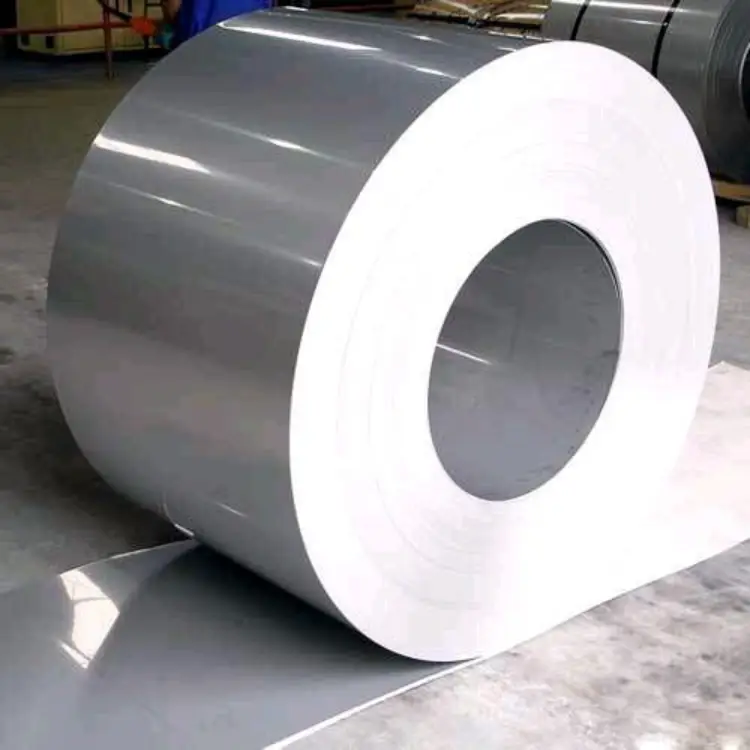
LR FH40 Shipbuilding Steel Coil
LR FH40 Shipbuilding Steel Coil: High-Strength Hull Steel for Polar Vessels
Comprehensive material data for LR FH40 shipbuilding steel coil: chemical composition, mechanical & physical properties, equivalent grades, applications, and processing guide.
Hot rolling, normalizing, thermomechanical controlled rolling (TMCP), cold forming, welding, cutting
- Phone : +8618037372205
- Email : [email protected]
- WhatsApp: Contact via Whtsapp
- WeChat: +8618037372205
LR FH40 Shipbuilding Steel Coil Introduction
LR FH40 is a high-strength fine-grain structural steel grade for shipbuilding, governed by Lloyd's Register (LR) rules. It offers a minimum yield strength of 390 MPa and excellent low-temperature toughness (Charpy impact tested at -60 °C).
- Suitable for critical ship structures, including those operating in polar or ice-infested waters.
- Supplied as coil/plate in normalized (N) or thermomechanically rolled (TMCP) condition.
- Meets IACS UR S requirements; also available under other classification society rules (ABS, DNV, BV, etc.).
- Good weldability when proper procedures are followed.
LR FH40 Shipbuilding Steel Coil Chemical Composition
The chemical composition limits for LR FH40 are based on LR Rules and IACS UR S, designed for fine grain, high strength, and good weldability. All values are weight percent from ladle analysis.
| Chemical Element | Standard Value (max, %) | Remarks |
|---|---|---|
| Carbon (C) | ≤ 0.18 | Ladle analysis |
| Silicon (Si) | 0.10 – 0.50 | Ladle analysis |
| Manganese (Mn) | 0.90 – 1.60 | Ladle analysis; upper limit may vary with thickness |
| Phosphorus (P) | ≤ 0.025 | |
| Sulfur (S) | ≤ 0.025 | |
| Nitrogen (N) | ≤ 0.009 | Unless sufficient Al is present for nitrogen fixation |
| Aluminum (Al total) | ≥ 0.020 | For fine grain practice |
| Niobium (Nb) | ≤ 0.05 | |
| Vanadium (V) | ≤ 0.10 | |
| Titanium (Ti) | ≤ 0.02 | |
| Sum Nb+V+Ti | ≤ 0.12 | Combined microalloy content |
| Copper (Cu) | ≤ 0.35 | |
| Chromium (Cr) | ≤ 0.20 | |
| Nickel (Ni) | ≤ 0.40 | |
| Molybdenum (Mo) | ≤ 0.08 | |
| Carbon Equivalent (Ceq) | ≤ 0.40 | Ceq = C + Mn/6 + (Cr+Mo+V)/5 + (Ni+Cu)/15; for thickness ≤ 50 mm |
LR FH40 Shipbuilding Steel Coil Physical and Thermal Properties
The following physical properties are typical for carbon-manganese shipbuilding steels of this strength class. They are informative and not mandatory per LR rules.
| Property | Typical Value | Unit | Remarks |
|---|---|---|---|
| Density (ρ) | 7850 | kg/m³ | At 20 °C |
| Modulus of elasticity (E) | 205 | GPa | At 20 °C |
| Shear modulus (G) | 80 | GPa | Calculated |
| Poisson's ratio (ν) | 0.3 | — | Typical |
| Thermal expansion coefficient (α) | 12 × 10⁻⁶ | K⁻¹ | Average, 20–100 °C |
| Thermal conductivity (λ) | 50 | W/(m·K) | At 20 °C |
| Specific heat capacity (c) | 460 | J/(kg·K) | At 20 °C |
| Electrical resistivity (ρ_e) | 0.22 | μΩ·m | At 20 °C |
LR FH40 Shipbuilding Steel Coil Mechanical Properties
Mechanical properties for LR FH40 depend on plate thickness, tested in accordance with LR/IACS rules. The table provides minimum yield strength, tensile strength range, elongation, and Charpy V-notch impact energy for various thickness intervals.
| Performance Item | Standard Requirement Value | Unit | Test Condition |
|---|---|---|---|
| Yield strength (ReH) | ≥ 390 | MPa | t ≤ 100 mm |
| Tensile strength (Rm) | 510 – 650 | MPa | t ≤ 100 mm |
| Elongation (A5) | ≥ 20 | % | t ≤ 50 mm |
| Elongation (A5) | ≥ 19 | % | 50 < t ≤ 70 mm |
| Elongation (A5) | ≥ 18 | % | 70 < t ≤ 100 mm |
| Charpy V-notch impact energy (KV₂, longitudinal) | ≥ 27 | J | −60 °C; t ≤ 50 mm |
| Charpy V-notch impact energy (KV₂, longitudinal) | ≥ 34 | J | −60 °C; 50 < t ≤ 70 mm |
| Charpy V-notch impact energy (KV₂, longitudinal) | ≥ 41 | J | −60 °C; 70 < t ≤ 100 mm |
| Charpy V-notch impact energy (KV₂, transverse) | ≥ 20 | J | −60 °C; t ≤ 50 mm |
| Charpy V-notch impact energy (KV₂, transverse) | ≥ 27 | J | −60 °C; 50 < t ≤ 70 mm |
| Charpy V-notch impact energy (KV₂, transverse) | ≥ 34 | J | −60 °C; 70 < t ≤ 100 mm |
LR FH40 Shipbuilding Steel Coil Completely Equivalent Material Standards and Designations
| Country/Region | Standard | Grade | Remarks |
|---|---|---|---|
| International (IACS) | IACS UR S | FH40 | Unified requirement for shipbuilding steels |
| United Kingdom | LR Rules | FH40 | Original classification |
| United States | ASTM A131/A131M | FH40 | Equivalent |
| Norway / International | DNV GL Rules | FH40 | Equivalent |
| France | BV Rules | FH40 | Equivalent |
| China | CCS Rules | FH40 | Equivalent |
| Japan | NK Rules | FH40 | Equivalent |
| South Korea | KR Rules | FH40 | Equivalent |
| Italy | RINA Rules | FH40 | Equivalent |
LR FH40 Shipbuilding Steel Coil Application Introduction
LR FH40 steel is designed for structural components of ships and offshore platforms requiring high strength and excellent low‑temperature toughness. The very low impact test temperature (-60 °C) makes it ideal for Arctic or ice‑strengthened vessels. It can be processed directly from coil into various structural shapes.
Product Applications: Hull plates and shells, Decks and bulkheads, Stiffeners and girders, Ice belts, Rudder and stern structures
Processed into products: Shell plating (side and bottom), Deck plating and stringers, Transverse bulkheads, Longitudinal stiffeners and frames, Brackets and floor plates, Hatch coamings and foundations
Application industries: Shipbuilding, Offshore Oil & Gas, Marine Engineering, Polar & Ice-class Vessels
LR FH40 Shipbuilding Steel Coil Similar/Alternative Materials with Comparable Performance
| Country/Region | Standard | Grade | Remarks |
|---|---|---|---|
| Europe | EN 10025-4 | S460ML (delivery condition +M or +N) | Minimum yield strength 460 MPa, tensile 530–720 MPa, impact test at -50 °C; higher strength, slightly less low‑temperature toughness than FH40 |
| International | ISO 4885 | FH40 | Identical technical requirements to IACS FH40 |
Notes:
Welding: Preheating and low‑hydrogen consumables are recommended. Follow qualified welding procedures to avoid cold cracking.
Certification: Material is certifiable by Lloyd's Register or any IACS member society.
Condition: Fine‑grain practice is mandatory; usually supplied with normalizing or TMCP processing.
- Share



