
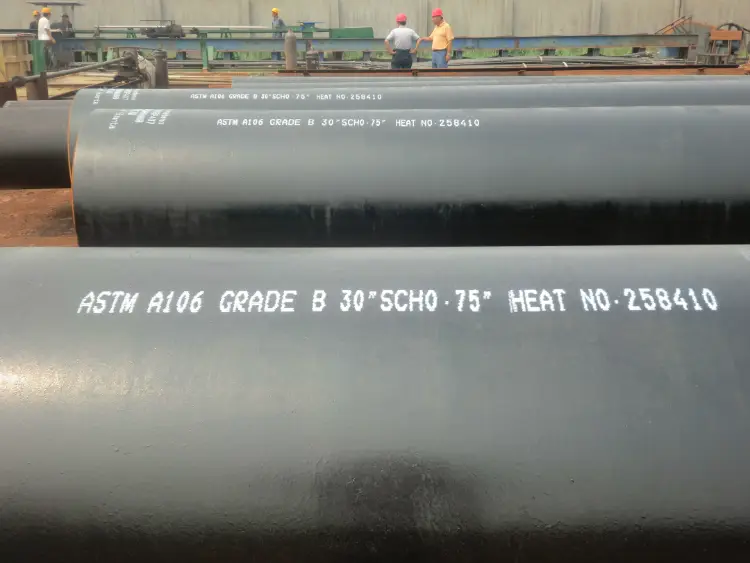
ASME SA106 Grade B Carbon Steel Seamless Pipe
ASME SA106 Grade B Seamless Carbon Steel Boiler Pipe: Properties, Equivalents and Applications
Complete material data for ASME SA106 Grade B boiler pipe including chemical composition, mechanical and thermal properties, international equivalents, and application guidance.
Hot-finished, cold-drawn, normalized, annealed, stress-relieved
- Phone : +8618037372205
- Email : [email protected]
- WhatsApp: Contact via Whtsapp
- WeChat: +8618037372205
ASME SA106 Grade B Carbon Steel Seamless Pipe Introduction
ASME SA106 Grade B (UNS K03006) is a seamless carbon steel pipe intended for high-temperature service in boilers, superheaters, heat exchangers and pressure piping systems. It is manufactured by hot-rolling or cold-drawing followed by heat treatment, typically a full anneal, isothermal anneal, or normalize and temper. The steel offers a good balance of strength, ductility, and weldability. With minimum tensile strength of 60 ksi (415 MPa) and minimum yield strength of 35 ksi (240 MPa), it resists deformation under pressure and thermal cycling. The controlled levels of carbon, manganese, and silicon provide predictable mechanical properties while limiting residual elements ensures sound fabrication. It can be easily formed, expanded, flanged, and welded using standard methods, making it a preferred choice for power plants, refineries, and industrial heating systems. Key features:
- High strength and toughness
- Excellent weldability and formability
- Reliable creep resistance at elevated temperatures
- Proven material for pressure-containing parts
ASME SA106 Grade B Carbon Steel Seamless Pipe Chemical Composition
The chemical composition of ASME SA106 Grade B is tightly controlled to ensure consistent mechanical properties and high-temperature performance. Carbon content is limited to avoid excessive hardness and to maintain weldability. Manganese provides strength and toughness, while silicon acts as a deoxidizer. Phosphorus and sulfur are limited to maximize ductility and cleanliness. Residual elements such as chromium, nickel, molybdenum, copper, and vanadium are restricted to prevent unintended strengthening effects and to ensure predictable service behavior. Note: The sum of Cr, Cu, Mo, Ni, and V shall not exceed 1.00%.
| Element | Content (%) | Remarks |
|---|---|---|
| Carbon (C) | 0.30 max | Heat analysis |
| Manganese (Mn) | 0.29 – 1.06 | Heat analysis |
| Silicon (Si) | 0.10 min | Heat analysis |
| Phosphorus (P) | 0.035 max | Heat analysis |
| Sulfur (S) | 0.035 max | Heat analysis |
| Chromium (Cr) | 0.40 max | Residual element |
| Copper (Cu) | 0.40 max | Residual element |
| Molybdenum (Mo) | 0.15 max | Residual element |
| Nickel (Ni) | 0.40 max | Residual element |
| Vanadium (V) | 0.08 max | Residual element |
| Cr+Cu+Mo+Ni+V | 1.00 max | Combined residual limit |
ASME SA106 Grade B Carbon Steel Seamless Pipe Thermal and Electrical Physical Properties
The physical properties listed are typical for carbon steel of this grade and are suitable for engineering calculations. Density is approximately 7.85 g/cm³. The elastic modulus, shear modulus, and Poisson's ratio describe stiffness and deformation behavior. Thermal expansion coefficient, thermal conductivity, and specific heat capacity are temperature-dependent and important for thermal stress analysis and heat transfer calculations. Electrical resistivity is provided for reference in induction heating or electrical applications.
| Property | Typical Value | Unit | Temperature / Condition |
|---|---|---|---|
| Density (ρ) | 7.85 | g/cm³ | 20 °C |
| Modulus of Elasticity (E) | 200 – 210 | GPa | 20 °C |
| Shear Modulus (G) | 77 – 81 | GPa | 20 °C (calculated) |
| Poisson's Ratio (ν) | 0.30 | — | 20 °C |
| Thermal Expansion Coefficient (α) | 11.5 | 10⁻⁶/K | 20 – 100 °C |
| Thermal Expansion Coefficient (α) | 12.0 | 10⁻⁶/K | 20 – 200 °C |
| Thermal Expansion Coefficient (α) | 12.6 | 10⁻⁶/K | 20 – 300 °C |
| Thermal Expansion Coefficient (α) | 13.1 | 10⁻⁶/K | 20 – 400 °C |
| Thermal Expansion Coefficient (α) | 13.6 | 10⁻⁶/K | 20 – 500 °C |
| Thermal Conductivity (λ) | 51.9 | W/(m·K) | 20 °C |
| Thermal Conductivity (λ) | 51.0 | W/(m·K) | 100 °C |
| Thermal Conductivity (λ) | 48.6 | W/(m·K) | 200 °C |
| Thermal Conductivity (λ) | 46.0 | W/(m·K) | 300 °C |
| Thermal Conductivity (λ) | 42.7 | W/(m·K) | 400 °C |
| Thermal Conductivity (λ) | 39.4 | W/(m·K) | 500 °C |
| Specific Heat Capacity (c) | 486 | J/(kg·K) | 20 °C |
| Specific Heat Capacity (c) | 498 | J/(kg·K) | 100 °C |
| Specific Heat Capacity (c) | 519 | J/(kg·K) | 200 °C |
| Specific Heat Capacity (c) | 540 | J/(kg·K) | 300 °C |
| Specific Heat Capacity (c) | 565 | J/(kg·K) | 400 °C |
| Specific Heat Capacity (c) | 594 | J/(kg·K) | 500 °C |
| Electrical Resistivity (ρ_e) | 0.15 – 0.20 | μΩ·m | 20 °C |
ASME SA106 Grade B Carbon Steel Seamless Pipe Mechanical Properties
Mechanical properties are determined on specimens taken from the finished pipe and represent the minimum requirements per ASME SA-106. Tensile testing is performed at room temperature. The flattening test ensures ductility and integrity of the pipe wall; the pipe is flattened between parallel plates to a prescribed distance without cracking. Hardness values apply only when hardness testing is specified as a supplementary requirement. No impact toughness requirements are mandated unless specifically ordered. Elongation requirements vary with specimen type and wall thickness. For strip tests, the minimum elongation decreases as wall thickness decreases below 5/16 in. (7.94 mm) by 1.5% for each 1/32 in. (0.8 mm) reduction.
| Property | Minimum/Maximum Value | Unit | Test Condition |
|---|---|---|---|
| Tensile Strength (Rm) | ≥ 415 (60) | MPa (ksi) | Room temperature, longitudinal |
| Yield Strength (ReH) | ≥ 240 (35) | MPa (ksi) | 0.5% extension under load or 0.2% offset |
| Elongation (A) – round specimen, 2 in. (50 mm) gauge | ≥ 30 | % | Standard 0.500 in. dia. specimen |
| Elongation (A) – strip specimen, wall ≥ 5/16 in. (7.94 mm) | ≥ 28 | % | 2 in. gauge length |
| Elongation (A) – strip specimen, wall < 5/16 in. (7.94 mm) | Per formula (reduced value) | % | 1.5% deduction per 1/32 in. wall thickness below 5/16 in. |
| Flattening Test | No cracks or breaks | — | Plates brought to a distance H = (1+e)*t / (e + t/D); no cracking permitted |
| Hardness (Brinell or Rockwell) – if specified | ≤ 85 HRBW / ≤ 200 HBW | — | Supplementary requirement S3 |
ASME SA106 Grade B Carbon Steel Seamless Pipe Directly Equivalent Standards and Substitute Grades
| Country/Region | Standard | Grade | Remarks |
|---|---|---|---|
| USA | ASTM A106/A106M | Grade B | Identical chemical and mechanical requirements; ASME SA106 Grade B is the ASME Boiler Code adoption of ASTM A106 Grade B. |
| Europe | EN 10216-2 | 1.0425 P265GH | Common pressure vessel/boiler tube grade with slightly lower tensile strength (410–530 MPa) and minimum yield 235 MPa; widely substituted for A106 Gr B in non-ASME designs. |
| Japan | JIS G3456 | STPT410 | Carbon steel for high-temperature service; minimum tensile 410 MPa, minimum yield 245 MPa; very close match to SA106 Grade B for pressure piping. |
ASME SA106 Grade B Carbon Steel Seamless Pipe Application Introduction
ASME SA106 Grade B pipes are extensively used in high-temperature pressurized systems. Their balanced strength, ductility, and fabricability make them suitable for power generation, petrochemical, and industrial heating applications. The material can be expanded, bent, flanged, and welded by standard procedures. It is commonly specified for boiler and superheater tubes where steam temperatures do not exceed approximately 400–480°C, depending on wall thickness and design code. Typical users include:
- Boiler manufacturers
- Pressure vessel fabricators
- Heat recovery steam generator (HRSG) builders
- Piping contractors
- Engineers designing high-temperature process lines
Product Applications: Boiler waterwall tubes, Superheater tubes and headers, Reheater tubes, Economizer tubes, Steam and feedwater piping, Heat exchanger tubes (shell and tube type), U-bend tubes, High-pressure process lines
Processed into products: Boiler drums and downcomers (as joining pipe), Steam headers and manifolds, Desuperheater injection lines, Blowdown and drain piping, High-temperature condensate return lines, Expansion loops and flexible hose (as tube segments), Continuously welded tube panels
Application industries: Power generation (fossil fuel, nuclear, and combined cycle plants), Petrochemical and refinery, Chemical processing, Pulp and paper (recovery boilers), Heating, ventilation and air conditioning (large industrial boilers), Waste-to-energy plants
ASME SA106 Grade B Carbon Steel Seamless Pipe Similar or Closely Related Material Recommendations
| Country/Region | Standard | Grade | Remarks |
|---|---|---|---|
| China | GB/T 5310 | 20G | Chinese boiler tube carbon steel with similar high-temperature strength; comparable chemistry and often used for similar pressure parts. |
| International | ISO 9329-2 | PH 26 | Seamless steel tubes for pressure purposes; properties close to A106 Gr B, tensile strength ≥ 410 MPa, yield ≥ 245 MPa. |
| Germany | DIN 17175 | St45.8/III | Older standard but still referenced; carbon-manganese steel for elevated temperature; now superseded by EN 10216-2 P265GH. |
Notes:
Fabrication considerations: ASME SA106 Grade B can be readily welded using all common methods such as SMAW, GTAW, SAW, and FCAW. Preheat and post-weld heat treatment should be in accordance with the applicable ASME B31.1 or ASME Boiler and Pressure Vessel Code Section I. The material is normally supplied in the normalized or normalized-and-tempered condition. When cold bending is performed, stress-relief annealing may be required depending on the bend radius and degree of deformation. Corrosion resistance: As plain carbon steel, it offers limited resistance to atmospheric and water corrosion; for aggressive environments, coatings, cladding, or chemical treatment of the medium is recommended. Nondestructive testing: Electric test or hydrostatic test is mandatory per standard; supplementary tests such as ultrasonic, eddy current, or magnetic particle inspection can be specified on order.
- Share



