
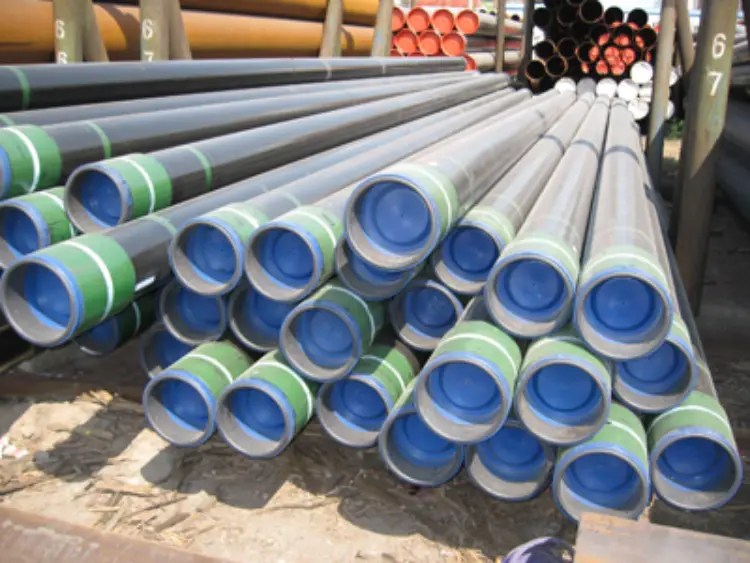
API 5L X65 Pipeline Steel
API 5L X65 Pipeline Steel: In-Depth Composition, Mechanical & Thermal Properties Guide
Comprehensive data sheet for API 5L X65 (L450) pipeline steel covering chemical analysis, mechanical and physical properties, international equivalents, and application guidance according to API 5L standard. Ideal for engineers in oil & gas transmission.
Hot rolling, controlled rolling, TMCP, normalizing (if specified), welding, forming, machining
- Phone : +8618037372205
- Email : [email protected]
- WhatsApp: Contact via Whtsapp
- WeChat: +8618037372205
API 5L X65 Pipeline Steel Introduction
API 5L X65, also designated as L450, is a high-strength low-alloy (HSLA) pipeline steel widely used in oil and gas transportation. It offers a minimum yield strength of 450 MPa (65 ksi) with excellent toughness, weldability, and resistance to crack propagation. The steel is typically produced through controlled rolling or thermo-mechanical controlled processing (TMCP) to achieve a fine-grained ferrite-pearlite or acicular ferrite microstructure.
Key features:
- High strength-to-weight ratio for long-distance pipelines
- Good low-temperature impact toughness for arctic conditions
- Suitable for sour service when appropriate chemistry and testing are specified
- Available in seamless and welded pipe forms with PSL 1 and PSL 2 delivery conditions
API 5L X65 Pipeline Steel Chemical Composition
The chemical composition according to API 5L PSL 2 requirements for welded pipes (maxima unless range is given). Values are based on product analysis with slight variations from heat analysis. Micro-alloying elements such as Nb, V, and Ti are added for grain refinement and precipitation strengthening. Carbon equivalent (CEIIW) is typically restricted to ≤ 0.43% for better weldability.
| Element | Specified Value (max, %) | Remarks |
|---|---|---|
| C | 0.12 | For wall thickness ≤ 25.4 mm; for greater thickness max 0.14 |
| Si | 0.45 | Silicon content aids deoxidation |
| Mn | 1.60 | Manganese provides strength and hardenability |
| P | 0.025 | Phosphorus, maximum for low-temperature toughness |
| S | 0.015 | Sulfur, maximum for improved cleanliness |
| V | 0.05 | Vanadium for grain refinement, part of total V+Nb+Ti |
| Nb | 0.05 | Niobium for grain refinement, part of total V+Nb+Ti |
| Ti | 0.04 | Titanium for inclusion shape control |
| Al (total) | 0.060 | Aluminum for deoxidation and grain refinement |
| N | 0.012 | Nitrogen; addition of Al, V, Ti helps control free N |
| Cu | 0.50 | Copper (max) – may be added for corrosion resistance |
| Ni | 0.50 | Nickel (max) – may be added for toughness |
| Cr | 0.50 | Chromium (max) – may be added for hardenability |
| Mo | 0.50 | Molybdenum (max) – may be added for hardenability |
| CE(IIW) | 0.43 | Carbon equivalent = C + Mn/6 + (Cr+Mo+V)/5 + (Ni+Cu)/15 |
API 5L X65 Pipeline Steel Thermal and Electrical Physical Properties
Physical properties are representative values for low-alloy pipeline steel at ambient temperature, unless a temperature range is specified. These values are essential for finite element analysis (FEA), welding simulation, and pipeline design under thermal loads.
| Property | Typical Value | Unit | Test Condition |
|---|---|---|---|
| Density (ρ) | 7.85 | g/cm³ | 20°C |
| Modulus of Elasticity (E) | 205 | GPa | 20°C; decreases with increasing temperature |
| Shear Modulus (G) | 80 | GPa | 20°C |
| Poisson's Ratio (ν) | 0.30 | – | Elastic range |
| Thermal Expansion Coefficient (α) | 11.7 | 10-6/K | 20–100°C |
| Thermal Expansion Coefficient (α) | 12.2 | 10-6/K | 20–200°C |
| Thermal Expansion Coefficient (α) | 13.8 | 10-6/K | 20–400°C |
| Thermal Conductivity (λ) | 51.9 | W/(m·K) | 20°C |
| Thermal Conductivity (λ) | 46.0 | W/(m·K) | 200°C |
| Specific Heat Capacity (c) | 460 | J/(kg·K) | 20°C |
| Specific Heat Capacity (c) | 520 | J/(kg·K) | 200°C |
| Electrical Resistivity (ρe) | 0.16 | μΩ·m | 20°C |
API 5L X65 Pipeline Steel Mechanical Properties
Mechanical properties refer to base material (pipe body) in the transverse direction unless otherwise noted. Tensile testing is conducted at room temperature per ASTM A370 or ISO 6892-1. Impact testing is mandatory for PSL 2; minimum absorbed energy values depend on pipe diameter and specified temperature (commonly 0°C or -10°C). Bend test ensures no cracks after 180° bending around a specified former diameter.
| Property | Required Value | Unit | Test Condition |
|---|---|---|---|
| Yield Strength (ReH) | 450 - 600 | MPa | Room temperature, 0.5% total extension under load |
| Tensile Strength (Rm) | 535 - 760 | MPa | Room temperature |
| Elongation (A) | Min. according to formula | % | Gauge length 50 mm (2 in) or 5.65√So; typical min. 22% |
| Yield to Tensile Ratio (ReH/Rm) | ≤ 0.93 | – | For some sour service applications |
| Bend Test | No cracks or openings > 3 mm | – | 180° bend around former diameter 5T (T = specimen thickness) |
| Charpy V-notch Impact Energy (KV) | Min. 40 J (average of 3) | J | -10°C or 0°C; transverse specimen; 10×10 mm or 7.5×10 mm subsize |
| Shear Area (DWTT) | Min. 85% | % | Drop weight tear test at 0°C for ductile fracture control |
API 5L X65 Pipeline Steel Full Equivalent Material Standards & Substitutable Grades
| Country/Region | Standard | Designation/Grade | Remarks |
|---|---|---|---|
| International | ISO 3183 | L450 | PSL 2, technically equivalent to API 5L X65 |
| Europe | EN 10208-2 | L450MB | Seamless and welded pipes for combustible fluids; similar chemistry and mechanical requirements |
| China | GB/T 9711 | L450 | Aligned with ISO 3183; commonly used in domestic pipeline projects |
| Russia | GOST R 52079 | K65 | Strength category K65 for gas pipelines; comparable to X65 |
| Canada | CSA Z245.1 | Grade 450 | Pipe steel with minimum yield strength 450 MPa |
API 5L X65 Pipeline Steel Application Introduction
API 5L X65 is primarily utilized in the energy sector for transporting crude oil, natural gas, and petroleum products over long distances. Its balanced combination of strength, toughness, and weldability makes it suitable for both onshore and offshore pipeline systems.
Typical applications include:
Product Applications: Long-distance trunk pipelines, Flowlines and gathering lines, Risers and J-tubes for offshore platforms, Casing and tubing for some structural applications, Spiral-welded and longitudinal-welded pipes
Processed into products: Pipe bends (elbows) – hot induction or cold formed, Tees and wyes, Flanges and flanged fittings, Reducer and expansion joints, Valves and pig launchers/receivers (body material), Girth weld filler metals matching X65 properties
Application industries: Oil and Gas Exploration and Production, Pipeline Transmission (Onshore and Offshore), Petrochemical and Refining, Water and Slurry Transportation, Cryogenic Service (with additional qualification)
API 5L X65 Pipeline Steel Similar or Near-Equivalent Alternative Grades
| Country/Region | Standard | Designation/Grade | Remarks |
|---|---|---|---|
| USA/API | API 5L | X60 (L415) | Lower strength (415 MPa min YS); may be used where full X65 strength is not needed; better formability |
| USA/API | API 5L | X70 (L485) | Higher strength (485 MPa min YS); requires adjusted welding procedures but provides weight savings |
| Europe | EN 10025-3 | S460M/ML | Structural steel with similar yield strength; not part of pipeline standard but can be used in structural pipe applications |
| China | GB/T 1591 | Q460C/D/E | Low alloy structural steel; similar tensile properties but not intended for sour service and transporting fluids |
| International | API 5L | X65 Sour Service (SS) | Same grade with restricted chemistry (e.g., max hardness 248 HV10, S<0.003%) for H&S-containing environments |
Notes:
Special considerations:
- For sour service applications (H&S containing), additional testing such as HIC (Hydrogen Induced Cracking) and SSC (Sulphide Stress Cracking) per NACE MR0175/ISO 15156 is often required. The chemistry is typically restricted to C ≤ 0.10%, S ≤ 0.002%, and CE< 0.39%.
- Welding: Low-hydrogen processes (SMAW, GMAW, SAW) are recommended. Preheat and interpass temperatures should be controlled to avoid hydrogen cracking. The carbon equivalent (CE) helps determine necessary preheat.
- Post-weld heat treatment (PWHT) is not normally required for this thin-walled pipe but may be specified for certain service conditions or heavy wall thicknesses.
- Material should be marked and traceable throughout the supply chain with full mill certificates confirming compliance to API 5L PSL 2.
- Share



