
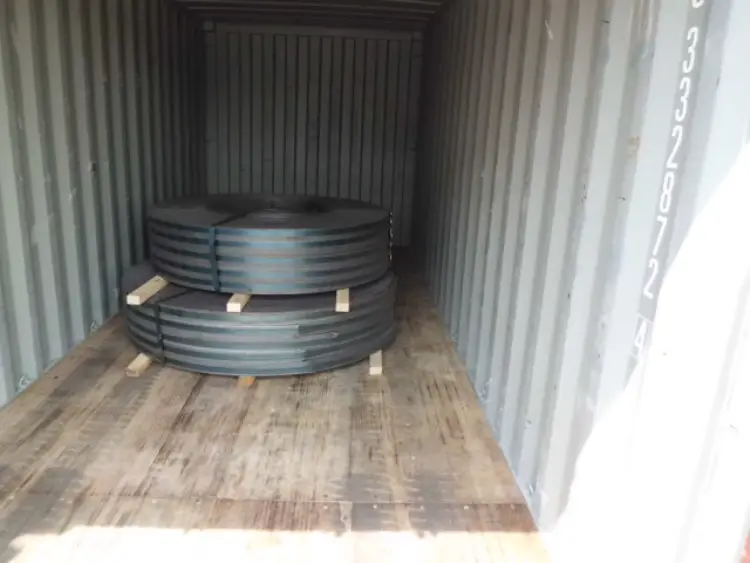
API 5L X56 (L390) Pipeline Steel Coil
API 5L X56 (L390) Pipeline Steel Coil: Technical Data & Global Equivalents
Comprehensive technical data for API 5L PSL1 X56 (L390) pipeline steel coil: chemical composition, mechanical & physical properties, international equivalents, and application guidance.
Cold forming, welding (ERW, SAWH, LSAW), bending, coating
- Phone : +8618037372205
- Email : [email protected]
- WhatsApp: Contact via Whtsapp
- WeChat: +8618037372205
API 5L X56 Pipeline Steel Coil Introduction
API 5L PSL1 X56 (L390) is a high-strength, low-alloy (HSLA) steel grade primarily used in the oil and gas industry for transportation pipelines. It belongs to the API 5L standard, Product Specification Level 1 (PSL1), which defines mandatory quality requirements for line pipe. The designation X56 specifies a minimum yield strength of 56 ksi (approximately 390 MPa), while L390 is the corresponding metric designation in ISO 3183.
The material is supplied as hot-rolled coil and can be formed into welded pipes such as spiral (SAWH) or longitudinal (ERW/LSAW) types. It offers a balanced combination of strength, weldability, and toughness appropriate for moderate-sour service and low-temperature applications when supplementary requirements are invoked. Typical delivery condition is as-rolled or normalized rolled, depending on thickness and final pipe manufacturing process.
API 5L X56 Pipeline Steel Coil Chemical Composition
Chemical requirements per API SPEC 5L, Table 2 for PSL1 pipe grades X42 through X70. The listed elements are mandatory. Microalloying elements such as Nb, V, Ti may be added at the manufacturer's discretion to achieve the required mechanical properties; their individual contents are not limited by the standard for PSL1, but their total sum is typically restricted by the carbon equivalent formula.
| Element | Standard Value (max, %) | Remarks |
|---|---|---|
| C (Carbon) | 0.28 | max |
| Mn (Manganese) | 1.40 | max |
| P (Phosphorus) | 0.030 | max |
| S (Sulfur) | 0.030 | max |
| Nb, V, Ti (sum) | ≤ 0.15* | typical practice; not mandatory for PSL1 chemical analysis |
API 5L X56 Pipeline Steel Coil Physical Properties
The following data are typical for carbon-manganese structural steels similar to X56 grade. They are not specified in API 5L but are commonly used for engineering design. Slight variations may occur depending on exact composition and microstructure.
| Property | Typical Value | Unit | Condition |
|---|---|---|---|
| Density (ρ) | 7.85 | g/cm³ | 20 °C |
| Density (ρ) | 0.284 | lb/in³ | 20 °C |
| Elastic Modulus (E) | 205 | GPa | Tension, ambient |
| Elastic Modulus (E) | 29,700 | ksi | Tension, ambient |
| Shear Modulus (G) | 80 | GPa | Calculated from E and ν |
| Poisson's Ratio (ν) | 0.29 | – | Elastic range |
| Thermal Expansion Coefficient (α) | 11.7 × 10⁻⁶ | K⁻¹ | 20 – 100 °C |
| Thermal Expansion Coefficient (α) | 12.5 × 10⁻⁶ | K⁻¹ | 20 – 300 °C |
| Thermal Conductivity (λ) | 51.9 | W/(m·K) | 20 °C |
| Specific Heat Capacity (cₚ) | 486 | J/(kg·K) | 20 °C |
| Electrical Resistivity (ρ_e) | 0.16 – 0.18 | Ω·mm²/m | 20 °C, typical for low-alloy steel |
API 5L X56 Pipeline Steel Coil Mechanical Properties
Minimum tensile properties for PSL1 X56 pipe body as per API SPEC 5L, Table 3. Elongation values depend on specimen type and wall thickness; the values shown are minimum requirements for longitudinal strip specimens with a gauge length of 2 in. (50 mm) and wall thickness up to 0.500 in. (12.7 mm). Bend test requirements are according to the standard and depend on wall thickness.
| Property | Standard Required Value | Unit | Test Condition / Remarks |
|---|---|---|---|
| Yield Strength (Rt0.5) | 390 – 545 | MPa | Transverse or longitudinal strip specimen, 0.5% total extension under load method |
| Yield Strength (ReH) | 56 – 79 | ksi | Transverse or longitudinal strip specimen |
| Tensile Strength (Rm) | 490 – 760 | MPa | Minimum value applies; maximum is given to assure weldability |
| Tensile Strength (Rm) | 71 – 110 | ksi | Corresponding ksi values |
| Elongation (A) | ≥ 22 | % | Longitudinal, gauge length 2 in. (50 mm), wall thickness ≤ 12.7 mm. Formula-based requirement per API 5L |
| Bend Test | 180° bend, no cracks | – | Mandrel diameter according to wall thickness (e.g., 2× thickness for t ≤ 12.7 mm) |
API 5L X56 Pipeline Steel Coil Completely Equivalent Standards and Substitute Grades
| Country/Region | Standard | Grade/Designation | Remarks |
|---|---|---|---|
| International | ISO 3183:2012 | L390 PSL1 | Identical technical requirements, metric designation |
| Europe | EN 10208-2:2009 | L390QB | PSL1 grade for welded pipes; EN designation L390QB corresponds to X56 PSL1 |
| China | GB/T 9711-2017 | L390 (X56) PSL1 | Chinese national standard for petroleum and natural gas line pipe |
| Canada | CSA Z245.1-18 | Grade 386 Cat I | Yield strength 386 MPa (56 ksi) equivalent to PSL1 level |
| Australia/New Zealand | AS/NZS 2885.1 (materials per API 5L) | API 5L X56 PSL1 | Accepts API 5L grades without modification |
API 5L X56 Pipeline Steel Coil Application Introduction
API 5L X56 (L390) steel coil is specifically designed for the manufacture of welded line pipe used in oil and gas transportation systems. Its combination of high strength and good weldability makes it suitable for large-diameter, high-pressure pipelines. The coil form is primarily used to produce spiral submerged-arc welded (SAWH) pipes, but also for electric-resistance welded (ERW) pipes. Beyond pipeline service, the grade can be applied in structural pipe, piling, and other load-bearing tubular applications where the strength level and cost-efficiency are advantageous.
Product Applications: Spiral submerged-arc welded (SAWH) pipe, Longitudinal submerged-arc welded (LSAW) pipe, Electric resistance welded (ERW) pipe, High frequency welded (HFW) pipe, Cold-formed structural hollow sections, API 5L line pipes with 3LPE/3LPP/FBE coatings, Pipe piles and offshore jacket legs
Processed into products: Line pipe sections (straight and bends), Pipe fittings (elbows, tees, reducers) after hot or cold forming, Flanges and connectors (when qualified), Pressure vessel shells (non-sour moderate service), Tubing for mechanical applications (with supplementary tests), Tubular towers and monopile foundations
Application industries: Oil and gas upstream (gathering lines, transmission pipelines), Oil and gas midstream (cross-country pipelines, compressor stations), Petrochemical (process piping, tank farms), Water/wastewater (high-pressure water transmission, penstocks), Construction and civil engineering (structural pipe, bridge members, piling)
API 5L X56 Pipeline Steel Coil Similar / Alternative Materials for Reference
| Country/Region | Standard | Grade | Remarks |
|---|---|---|---|
| USA/Global | API 5L PSL2 | X56Q / L390Q | PSL2 version with mandatory impact testing and tighter chemical limits; higher quality level, interchangeable if PSL1 is accepted |
| USA/Global | API 5L PSL1 | X52 (L360) | Yield strength 52 ksi (360 MPa) minimum; slightly lower strength but more formable, may be substituted with engineering approval |
| USA/Global | API 5L PSL1 | X60 (L415) | Yield strength 60 ksi (415 MPa) minimum; higher strength grade, requires attention to weldability |
| Europe | EN 10025-3 | S460M | Structural steel with similar strength, not intended for pipeline; limited resistance to sour service, not a direct substitution |
| Japan | JIS G 3106 | SM490YA | Welded structural steel with yield strength 355-490 MPa; usable for non-pipeline structural applications |
Notes:
Note: API 5L PSL1 imposes no mandatory Charpy impact test requirements. If toughness at low temperature or in sour service is required, PSL2 (X56Q) should be specified. For coiled products, the coil break line must be managed during pipe forming to avoid flat spots. Carbon equivalent (CE) is not mandatory for PSL1, but typical limits (CE₂ ≤ 0.43–0.46) are applied by manufacturers. Always confirm product analysis and mechanical properties with the material test certificate (MTC) according to EN 10204 3.1 or equivalent.
- Share



