
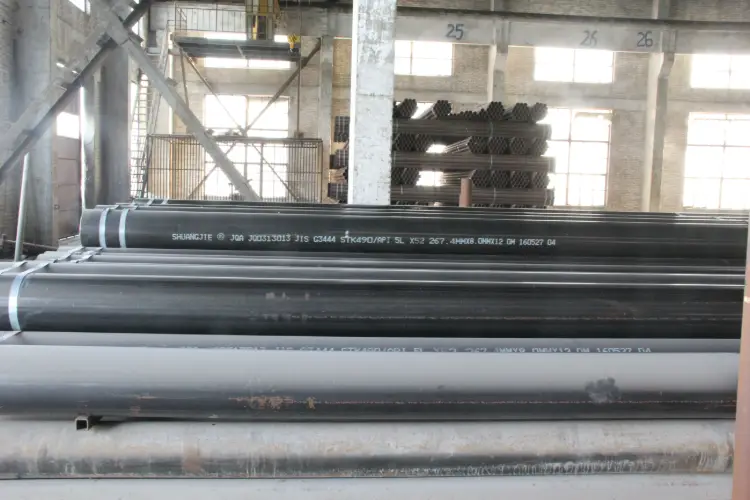
API 5L PSL1 X52 (L360) Pipeline Steel Coil
API 5L PSL1 X52 (L360) Pipeline Steel Coil - Full Material Data & Equivalents
Comprehensive datasheet for API 5L PSL1 X52 (L360) pipeline steel coil including chemical composition, mechanical values, thermal properties, and international equivalent standards.
Welding (ERW, SAW, LSAW), seamless rolling, cold forming, hot rolling
- Phone : +8618037372205
- Email : [email protected]
- WhatsApp: Contact via Whtsapp
- WeChat: +8618037372205
API 5L PSL1 X52 Pipeline Steel Coil Introduction
The API 5L PSL1 X52 (L360) steel is a widely used pipeline material specified by the American Petroleum Institute. It is a low-carbon, micro-alloyed steel with a minimum yield strength of 52 ksi (360 MPa). PSL1 is the base product specification level, providing essential requirements for line pipe used in conveying oil, gas, and water. This steel grade is typically supplied as hot-rolled coil and can be formed into pipes via ERW, SAW, or seamless processes. It offers good weldability and formability, making it suitable for various pipeline and structural applications. The steel is designed to withstand internal pressure and bending stresses in onshore and offshore pipeline systems. Its chemical composition is controlled to ensure consistent mechanical properties, while the absence of impact test requirements in PSL1 makes it cost-effective for moderate service temperatures.
API 5L PSL1 X52 Pipeline Steel Coil Chemical Composition
The chemical composition of API 5L PSL1 X52 is specified as maximum heat analysis values unless otherwise noted. The steel is required to meet these limits to ensure weldability and mechanical properties. The addition of micro-alloying elements such as V, Nb, and Ti is controlled collectively to refine grain structure and increase strength without hardness penalties. Typical residual elements (Cr, Ni, Cu, Mo) are not specified but may be present up to certain limits per supplementary requirements.
| Element | Specified Value (max) | Remarks |
|---|---|---|
| Carbon (C) | 0.28% | Heat analysis |
| Manganese (Mn) | 1.40% | Heat analysis |
| Phosphorus (P) | 0.030% | Heat analysis |
| Sulfur (S) | 0.030% | Heat analysis |
| Vanadium + Niobium + Titanium (V+Nb+Ti) | 0.15% | Sum of micro-alloying elements; applicable for grades ≥ X52 per API 5L Table 5 note b. |
API 5L PSL1 X52 Pipeline Steel Coil Physical & Thermal Properties
The following physical and thermal properties are typical for low-carbon line pipe steel and are not specified in API 5L. They are provided as engineering reference values at room temperature and for common temperature ranges. Variations may occur depending on actual chemistry, processing, and microstructure. These values can be used for design calculations such as heat transfer, thermal expansion, and electrical resistance.
| Property | Typical Value | Unit | Test Condition / Temperature |
|---|---|---|---|
| Density (ρ) | 7.85 | g/cm³ | At 20 °C |
| Modulus of Elasticity (E) | 205 | GPa | At 20 °C |
| Shear Modulus (G) | 80 | GPa | At 20 °C (estimated from E and Poisson ratio) |
| Poisson Ratio (ν) | 0.30 | — | At 20 °C |
| Thermal Expansion Coefficient (α) | 12.0 | 10⁻⁶ / K | 20–100 °C range |
| Thermal Conductivity (λ) | 50 | W/(m·K) | At 20 °C |
| Specific Heat Capacity | 480 | J/(kg·K) | At 20 °C |
| Electrical Resistivity (ρ_e) | 0.18 | µΩ·m | At 20 °C |
API 5L PSL1 X52 Pipeline Steel Coil Mechanical Properties
The mechanical properties are based on API 5L PSL1 requirements for transverse strip tensile specimens taken from the pipe body. Yield strength and tensile strength are expressed as minimum values, while elongation is determined by the formula given in the standard. The minimum elongation depends on specimen cross-sectional area and specified minimum tensile strength; typical values for common wall thicknesses are around 22% (50 mm gauge). Bend tests and impact toughness are not mandatory for PSL1 but may be agreed upon supplementary requirements.
| Property | Specified Value | Unit | Test Condition |
|---|---|---|---|
| Yield Strength (Rt0.5 or ReH) | 360 (52 ksi) min | MPa | Transverse strip test, 0.2% offset or 0.5% total extension under load (depending on pipe type) |
| Tensile Strength (Rm) | 460 (67 ksi) min | MPa | Transverse strip test |
| Elongation (A) | ≥22% (typical, calculated per API 5L formula) | % | 50 mm (2 in) gauge length, transverse strip; exact minimum value calculated as Af = 1940·A^0.2 / U^0.9 where A is cross-sectional area (in²) and U is minimum tensile strength (psi) |
API 5L PSL1 X52 Pipeline Steel Coil Equivalent Standards & Replacement Grades
| Country / Region | Standard | Grade / Designation | Remarks |
|---|---|---|---|
| International (ISO) | ISO 3183 | L360 PSL1 | Identical grade in PSL1; chemical and mechanical requirements match API 5L. |
| Europe (CEN) | EN 10208-2 | L360NB | Typically used for PSL2 equivalent; verify PSL1 supplemental requirements. For PSL1, L360GA may be used. |
| China | GB/T 9711 | L360 | Chinese line pipe standard; corresponds to PSL1 requirements. |
| USA | API 5L | X52 PSL1 | Original standard; also available as PSL2 for more demanding requirements. |
API 5L PSL1 X52 Pipeline Steel Coil Application Introduction
The API 5L PSL1 X52 steel is primarily used in the construction of pipelines for the transportation of oil, natural gas, and water. Its high strength-to-weight ratio and good weldability make it suitable for large-diameter, high-pressure pipelines. The coil form is widely used for the production of spiral-welded and longitudinal-welded pipes. In addition, it finds use in structural applications such as piling, bridge supports, and pressure vessels (when compliant with relevant design codes). The PSL1 designation makes it a cost-effective choice for non-sour service and above-ground or buried pipelines operating at moderate temperatures.
Product Applications: Spiral Submerged Arc-Welded (SSAW) Pipes, Electric Resistance Welded (ERW) Pipes, Seamless Line Pipes, Longitudinal Seam Welded (LSAW) Pipes, Coil for Pipe Production
Processed into products: Main Line Pipes, Flowlines and Gathering Lines, Risers and Export Lines, Casing and Tubing Pipes, Pipe Fittings (elbows, tees, reducers), Structural Hollow Sections, Piling Pipes
Application industries: Oil & Gas (Upstream and Midstream), Water Treatment and Supply, Construction and Infrastructure, Pipe and Tube Manufacturing
API 5L PSL1 X52 Pipeline Steel Coil Nearby Grades for Reference
| Country / Region | Standard | Grade | Remarks |
|---|---|---|---|
| International / USA | API 5L / ISO 3183 | X46 (L320) | Lower strength grade (min yield 320 MPa); often used where less mechanical strength is adequate. |
| International / USA | API 5L / ISO 3183 | X50 (L345) | Intermediate strength between X46 and X52; can be an alternative for less demanding conditions. |
| International / USA | API 5L / ISO 3183 | X56 (L390) | Higher strength grade (min yield 390 MPa); used for higher-pressure pipelines. |
| International / USA | API 5L / ISO 3183 | X60 (L415) | Next step up in strength; may be considered if greater wall thickness reduction is desired. |
Notes:
Additional Notes:n
n
- API 5L PSL1 does not mandate Charpy impact testing. If toughness at low temperatures is required, specify PSL2 (e.g., X52N or X52Q) with impact test requirements.
n- Hydrostatic testing is mandatory for all line pipe; test pressure is calculated based on wall thickness and specified minimum yield strength.
n- For sour service (H2S-containing environments), additional requirements per NACE MR0175 / ISO 15156 may be needed, typically requiring controlled hardness and chemistry (e.g., X52S).
n- Typical delivery condition for coil is hot-rolled; for welded pipe, the base metal retains the hot-rolled or thermo-mechanically rolled condition, while the weld seam may be heat-treated depending on process.
n
- Share



