
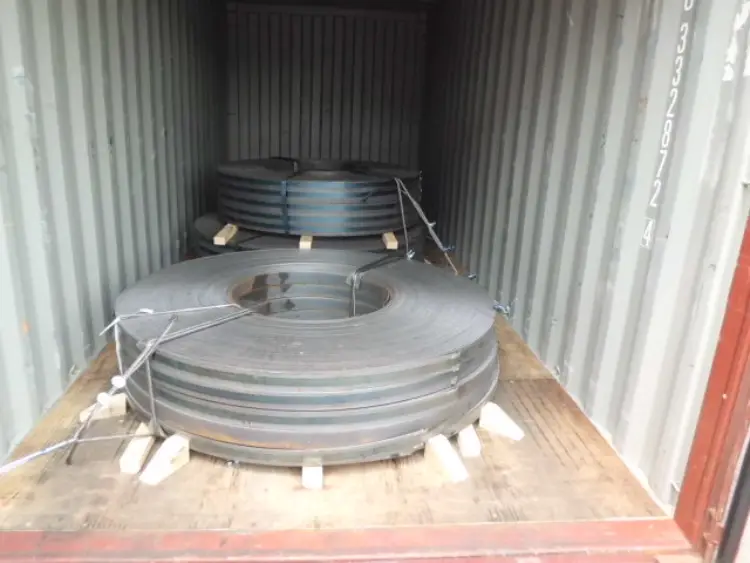
API 5L PSL1 X60 (L415) Pipeline Steel Coil
API 5L PSL1 X60 (L415) Pipeline Steel Coil: Chemical Composition, Mechanical & Physical Properties
Comprehensive material data for API 5L PSL1 X60 (L415) pipeline steel coil including chemical composition, mechanical properties, thermal and electrical physical properties, equivalent standards, similar materials, and application guide.
Cold forming, welding (longitudinal or spiral), bending, coating
- Phone : +8618037372205
- Email : [email protected]
- WhatsApp: Contact via Whtsapp
- WeChat: +8618037372205
API 5L PSL1 X60 Pipeline Steel Coil Introduction
API 5L PSL1 X60 (L415) is a high-strength low-alloy (HSLA) steel grade primarily used for line pipe in oil, gas, and water transportation. It is specified by the American Petroleum Institute's API Specification 5L and belongs to Product Specification Level 1 (PSL1), which represents a standard quality level with mandatory requirements for chemical composition, tensile properties, and dimensional tolerances but without additional mandatory toughness testing unless ordered. The designation L415 indicates a minimum yield strength of 415 MPa (60,200 psi). The steel is supplied in the form of hot-rolled coils and can be processed into longitudinally welded or spirally welded pipes. Typical delivery conditions include as-rolled, normalizing rolled, or thermomechanically rolled states. This material offers good weldability, formability, and a balanced combination of strength and toughness suitable for moderate-service pipeline applications.
API 5L PSL1 X60 Pipeline Steel Coil Chemical Composition
Chemical requirements for X60 PSL1 according to API SPEC 5L. Residual elements are limited to ensure weldability and toughness. The carbon equivalent (CEIIW) for welded pipe shall not exceed 0.43% if agreed. Microalloying elements like niobium, vanadium, and titanium may be added for grain refinement and precipitation strengthening; their total content is limited to 0.15%.
| Element | Maximum Limit (wt%) | Remarks |
|---|---|---|
| Carbon (C) | 0.26 | For seamless pipe; same for welded pipe unless lower C is required for weldability. |
| Manganese (Mn) | 1.35 | Maximum; typical range 1.00 – 1.35. |
| Phosphorus (P) | 0.030 | |
| Sulfur (S) | 0.030 | |
| Silicon (Si) | – | Not specified, typically 0.15 – 0.40 as per mill practice. |
| Niobium (Nb) | – | May be added, total Nb+V+Ti ≤ 0.15%. |
| Vanadium (V) | – | May be added, total Nb+V+Ti ≤ 0.15%. |
| Titanium (Ti) | – | May be added, total Nb+V+Ti ≤ 0.15%. |
| Nitrogen (N) | – | Not specified; typically ≤ 0.012%. |
| Carbon equivalent (CEIIW) | 0.43 | Maximum for welded pipe when agreed. CE = C + Mn/6 + (Cr+Mo+V)/5 + (Ni+Cu)/15. |
API 5L PSL1 X60 Pipeline Steel Coil Thermal and Electrical Physical Properties
Physical properties are representative for low-carbon microalloyed steel in the as-rolled or normalized condition. These values are not specified by API 5L but are provided as typical data for engineering calculations. Variations may occur depending on exact composition and processing.
| Property | Typical Value | Unit | Test Condition / Remarks |
|---|---|---|---|
| Density (ρ) | 7.85 | g/cm³ | At 20 °C |
| Elastic Modulus (E) | 205 | GPa | At 20 °C, tensile loading |
| Shear Modulus (G) | 80 | GPa | Calculated from E and ν |
| Poisson's Ratio (ν) | 0.30 | – | Elastic range |
| Thermal Expansion Coefficient (α) | 12.0 | 10⁻⁶/K | 20 – 100 °C; 13.5 at 20 – 300 °C |
| Thermal Conductivity (λ) | 45 | W/(m·K) | At 20 °C; decreases to ~38 at 300 °C |
| Specific Heat Capacity | 460 | J/(kg·K) | At 20 °C |
| Electrical Resistivity (ρe) | 0.18 | 10⁻⁶ Ω·m | At 20 °C |
API 5L PSL1 X60 Pipeline Steel Coil Mechanical Properties
Mechanical properties are determined on transverse strip specimens from the pipe body or coil, tested at room temperature. PSL1 does not mandate Charpy V-notch impact testing unless specified by the purchaser. Bending test requirements apply to pipe (not coil) per API 5L, but values are included for reference. Elongation values are based on a 2-inch (50.8 mm) gauge length rectangular specimen.
| Property | Typical/Required Value | Unit | Test Condition |
|---|---|---|---|
| Minimum Yield Strength (ReH) | 415 | MPa | Transverse, 0.5% total extension, room temperature |
| Minimum Tensile Strength (Rm) | 520 | MPa | Transverse, room temperature |
| Yield to Tensile Ratio (ReH/Rm) | ≤ 0.93 (typical) | – | Indicative; not mandated for PSL1 |
| Minimum Elongation (A) | 22 | % | Rectangular specimen, gauge length 2 in (50.8 mm) |
| Elongation (alternative) | Calculated by formula | % | e = 1940 × A0.2 / U0.9 (ASTM A370) |
| Bend Test (guided bend) | No cracks >3 mm | – | 180° bend, mandrel diameter 90 mm for wall thickness ≤ 25.4 mm |
| Charpy V-Notch Impact Energy | Not required (PSL1) | J | If ordered: min. avg. 27 J at 0 °C, individual min. 20 J (example) |
| Hardness | ≤ 250 HV10 | – | Typically applicable to welded joint; not mandatory for base metal |
API 5L PSL1 X60 Pipeline Steel Coil Fully Equivalent Material Standards and Replaceable Grades
| Country/Region | Standard | Grade | Remarks |
|---|---|---|---|
| International | ISO 3183 | L415 | PSL1 corresponds to ISO 3183, with identical strength requirements. |
| China | GB/T 9711 | L415 | Chinese standard for line pipe, equivalent to API 5L X60 PSL1. |
| Europe | EN 10208-2 | L415MB | For onshore and offshore pipelines; MB indicates thermomechanically rolled; option for PSL1 level requirements. |
| Europe | EN 10208-2 | L415NB | Normalizing rolled variant. |
| Norway | DNV-OS-F101 | 415 | Offshore standard; strength matching, additional toughness requirements may apply. |
API 5L PSL1 X60 Pipeline Steel Coil Application Introduction
API 5L X60 (L415) PSL1 steel is designed for moderate-pressure pipeline systems where low-temperature toughness is not the primary concern. It is used extensively in onshore and limited offshore applications. The coil form allows efficient spiral or longitudinal pipe production. Typical processing includes spiral welding of coil into pipes, coating with anti-corrosion layers (FBE, 3LPE, etc.), and installation. PSL1 material is not recommended for severe sour service (H2S) unless specifically tested, because it lacks mandatory HIC/SSC requirements.
Product Applications: Transmission pipelines (onshore), Water supply mains, Process piping (non-sour), Steel pipe piles, Flowlines (low H2S risk)
Processed into products: Longitudinal and spiral welded pipes, Line pipe bends and elbows (possible with induction bending), Reducer and tee fittings (from pipe remnants), Pipeline manifolds, Pig launcher/receiver barrels
Application industries: Oil and gas transmission, Water transportation, Slurry pipeline, Petrochemical plants (utility piping), Structural pipe for construction
API 5L PSL1 X60 Pipeline Steel Coil Similar/Close Alternative Material Recommendations
| Country/Region | Standard | Grade | Remarks |
|---|---|---|---|
| USA / International | API 5L PSL2 | X60 (L415) PSL2 | Higher toughness and NDT requirements; chemical composition slightly tighter. Preferred for critical service. |
| USA / International | API 5L | X52 (L360) PSL1 | Lower strength (min. YS 360 MPa) but widely available; may be upgraded in thickness. |
| USA / International | API 5L | X65 (L450) PSL1 | Higher strength (min. YS 450 MPa) if additional capacity required; weldability to be re-evaluated. |
| Europe | EN 10028-3 | P355NL1 | Pressure vessel steel with similar strength range, but not linepipe specific. Suitable for static pressure applications. |
| China | GB/T 1591 | Q420D | High-strength structural plate steel with min. YS 420 MPa; not linepipe-specific but may substitute in structural uses. |
| Japan | JIS G 3106 | SM570 | Rolled steel for welded structure, min. TS 570 MPa; higher strength, requires weldability adjustment. |
Notes:
- API SPEC 5L allows alternative deoxidation practices (killed, semi-killed) unless otherwise agreed.
- PSL1 material does not require through-thickness tensile or drop weight tear testing (DWTT) unless specified in purchase order.
- For welded pipe made from coil, the weld seam is subjected to non-destructive testing (e.g., ultrasonic, X-ray) as per the standard.
- The carbon equivalent (CE) limits shall be applied only when agreed between purchaser and manufacturer.
- All values are based on API 5L 46th edition (2018) and typical industry practice. Actual mill certificates may show slightly different guarantees.
- Share



