
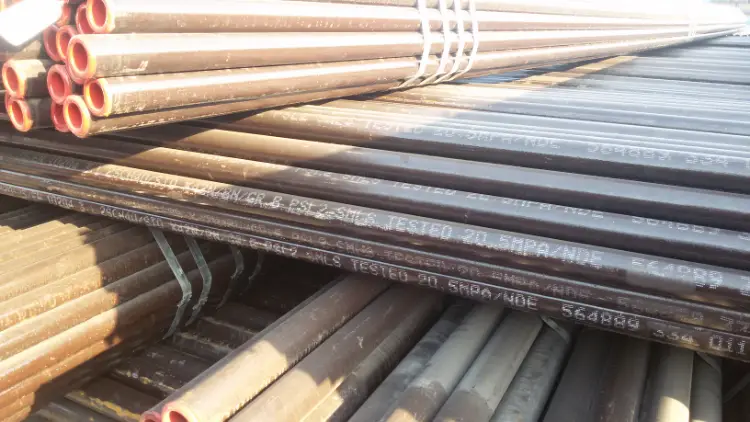
API 5L X42 PSL1 ERW Line Pipe
API 5L X42 ERW Pipe – Reliable Line Pipe for Oil, Gas and Water Transmission
API 5L X42 ERW pipe in PSL1 grade is a widely used carbon steel line pipe for moderate-pressure transmission of petroleum, natural gas and water. It offers a good balance of strength and weldability.
Electric resistance welding (ERW) followed by sizing and optional coating
- Phone : +8618037372205
- Email : [email protected]
- WhatsApp: Contact via Whtsapp
- WeChat: +8618037372205
API 5L X42 PSL1 ERW Line Pipe Introduction
API 5L X42 ERW pipe is a high-frequency electric resistance welded carbon steel pipe produced according to API 5L PSL1 specification. With a minimum yield strength of 290 MPa (42 ksi), this grade provides dependable structural integrity and is suitable for onshore and offshore pipeline systems. The ERW manufacturing process ensures consistent wall thickness and a smooth surface finish, making it ideal for transporting oil, gas, water, and other fluids. As a PSL1 product, it meets standardized requirements for chemical composition, tensile properties and bend tests without mandatory impact testing, which simplifies procurement for non-sour, moderate-temperature applications. Typical applications include flowlines, gathering lines, distribution networks and utility piping. The material is available in various sizes and wall thicknesses, often supplied in bare, black or coated conditions. It can be easily joined by welding or threading and exhibits good formability for pipe fittings. When compared to higher grades, X42 offers an economical solution where high toughness or sour service is not required.
API 5L X42 PSL1 ERW Line Pipe Chemical Composition
The chemical composition of API 5L X42 PSL1 ERW pipe is governed by API 5L Table 2 limits for grade X42. These limits ensure adequate weldability and mechanical properties. Carbon and manganese contents are controlled to achieve the desired strength while maintaining ductility and toughness. Microalloying elements such as niobium, vanadium and titanium may be added to refine grain structure and improve strength without compromising weldability. Phosphorus and sulfur are restricted to low levels to prevent brittleness and hot cracking.
| Element | Standard Value (max, %) | Remarks |
|---|---|---|
| C (Carbon) | 0.28 | Maximum, heat analysis |
| Mn (Manganese) | 1.20 | Maximum, heat analysis |
| Si (Silicon) | 0.40 | Typical maximum, not required by PSL1 but commonly reported |
| P (Phosphorus) | 0.030 | Maximum |
| S (Sulfur) | 0.030 | Maximum |
| V (Vanadium) | 0.05 | Maximum when added |
| Nb (Niobium) | 0.05 | Maximum when added |
| Ti (Titanium) | 0.04 | Maximum when added |
| Others (Ni, Cr, Cu, Mo etc.) | Not specified for PSL1 | Residual elements from melting practice; may be present at low levels without adverse effect |
| CE (Carbon Equivalent) | Typically ≤ 0.40 | Not a mandatory PSL1 requirement but may be agreed for weldability |
API 5L X42 PSL1 ERW Line Pipe Thermal and Electrical Physical Properties
The physical properties listed below are typical for low-carbon steel similar to API 5L X42 at room temperature and ambient conditions. These values are not mandatory in the API 5L standard but are useful for design and engineering calculations. Properties such as thermal conductivity and electrical resistivity can vary with temperature and manufacturing process. The data presented are conservative estimates suitable for modeling heat transfer, stress analysis and electromagnetic applications.
| Property | Typical Value | Unit | Test Condition / Remarks |
|---|---|---|---|
| Density (ρ) | 7.85 | g/cm³ | 20°C |
| Modulus of Elasticity (E) | 205 | GPa | Room temperature, static tensile |
| Shear Modulus (G) | 80 | GPa | Room temperature |
| Poisson's Ratio (ν) | 0.29 – 0.30 | — | Room temperature, elastic range |
| Thermal Expansion Coefficient (α) | 11.7 × 10⁻⁶ | 1/K | 20–100°C mean linear expansion |
| Thermal Expansion Coefficient (α) | 12.5 × 10⁻⁶ | 1/K | 20–200°C |
| Thermal Conductivity (λ) | 48 – 52 | W/(m·K) | At 20°C, typical for carbon steel |
| Specific Heat Capacity (cp) | 470 | J/(kg·K) | 20°C |
| Electrical Resistivity (ρe) | 0.16 – 0.18 | μΩ·m | At 20°C |
API 5L X42 PSL1 ERW Line Pipe Mechanical Properties
API 5L PSL1 X42 pipe mechanical properties are verified by tensile and bend tests on the pipe body. The minimum yield strength is 290 MPa (42.1 ksi) and the minimum tensile strength is 414 MPa (60.1 ksi). Elongation requirements are calculated from a standardized formula based on specimen area and minimum tensile strength. Guided bend tests ensure the weld and heat-affected zone have sufficient ductility. Impact testing is not required for PSL1 unless specified by supplementary agreement. The values below represent the API 5L specification demands for PSL1 X42 line pipe.
| Property | Standard Requirement Value | Unit | Test Condition |
|---|---|---|---|
| Yield Strength (Rt0.5) | 290 – 496 (min) | MPa | Pipe body, transverse or longitudinal specimen, 0.5% total extension under load |
| Tensile Strength (Rm) | 414 – 758 (min) | MPa | Pipe body, transverse or longitudinal specimen |
| Elongation (A) | As per formula (see remarks) | % | 2 in (50.8 mm) gauge length; rectangular specimen; minimum elongation e=625,000 A0.2/U0.9 where A is specimen area (in2) and U is specified minimum tensile strength (psi). A typical value is approximately 22-26% depending on wall thickness. |
| Elongation (A) | As per formula (see remarks) | % | 5.65√S0 gauge length; for round bar specimens; minimum elongation calculated per ISO 2566 or API 5L table; typical range 18-24% |
| Bend Test (Guided Bend) | No cracks > 3 mm in any direction | — | Pipe wall thickness ≤ 19.1 mm; bend angle 180°; bend diameter 1.5T for materials with minimum tensile strength < 455 MPa (66 ksi); specimen width 38 mm |
API 5L X42 PSL1 ERW Line Pipe Identical/Equivalent Material Standards and Substitute Grades
API 5L X42 (PSL1) has direct equivalents in several international pipe standards. These grades share the same minimum yield strength of 290 MPa and similar chemical and mechanical requirements. Users can confidently substitute these grades provided the transport medium and design conditions are compatible with the material specifications.
| Country/Region | Standard | Grade | Remarks |
|---|---|---|---|
| International | ISO 3183 | L290 | Identical strength level; may have slightly different composition ranges |
| Europe | EN 10208-1 | L290MB | Microalloyed steel for pipelines; similar PSL1 requirements |
| China | GB/T 9711 | L290 | Equivalent to ISO 3183; widely used in Chinese pipeline projects |
| Australia | AS 2885.1 | L290 | Adopts ISO 3183; pipe supplied to this standard is interchangeable |
| Russia | GOST 20295 | K42 | Approximate equivalence; check composition for specific project requirements |
API 5L X42 PSL1 ERW Line Pipe Application Introduction
API 5L X42 ERW pipe is predominantly used in the energy sector for transporting oil, gas, water and multiphase fluids. Its favorable strength-to-cost ratio and widespread availability make it a preferred choice for onshore gathering systems, distribution networks and moderate-pressure transmission lines. It is also employed in structural applications such as piling, casing and utility pipelines. The pipe can be readily cut, threaded and welded, enabling fabrication of custom assemblies. Common processing includes hot-dip galvanizing or coating with fusion-bonded epoxy for corrosion protection in buried or submerged service.
Product Applications: Cross-country pipelines for crude oil and refined products, Gas gathering and distribution networks, Flowlines connecting wellheads to processing facilities, Water injection and firewater systems, Conductor casing and surface casing in shallow wells, Structural bollards, sign posts and signboard supports
Processed into products: Pipe bends (induction or cold bent), Flanged and threaded connectors, Tees, reducers and end caps fabricated from pipe, Welded branch outlets and reinforcement pads, Skid-mounted pipe manifold assemblies, Roll-crimped or pressed pipe sections for culverts
Application industries: Oil and gas upstream production, Natural gas transmission and distribution, Water transmission and sewage systems, Petrochemical plants and refineries, Construction and civil engineering (structural pipe), Geothermal and mineral slurry transport
API 5L X42 PSL1 ERW Line Pipe Closely Related or Similar Material Recommendations
Other API 5L grades with slightly different yield strength can be considered when X42 is not available or when a small deviation in strength is acceptable. These materials share a common base chemistry and weldability characteristics but offer different pressure containment and toughness performance. Selection should consider the design factor and operating environment.
| Country/Region | Standard | Grade | Remarks |
|---|---|---|---|
| USA / Global | API 5L PSL1 | X46 | Minimum yield 317 MPa (46 ksi); can replace X42 when higher strength is beneficial, with comparable ductility |
| USA / Global | API 5L PSL1 | X52 | Minimum yield 359 MPa (52 ksi); stronger alternative for higher pressure systems, may require more attention to weld procedures |
| USA / Global | API 5L PSL1 | X42 (PSL2) | PSL2 version of X42 adds impact testing and stricter chemistry; suitable for more demanding service |
| Europe | EN 10208-1 | L245MB | Lower strength (245 MPa min yield); not a direct substitute, but can be used when stress requirements permit |
Notes:
Additional Considerations:
- Impact toughness testing is not mandatory under PSL1, but may be required by supplementary purchase specifications for cold-climate or high-stress applications.
- ERW pipe weld seam shall be subjected to NDT per the standard (e.g., on-line ultrasonic or eddy current inspection for the full length).
- Dimensional tolerances for diameter, wall thickness and straightness are defined in API 5L and should be referenced during procurement.
- When used in sour service (H2S environments), API 5L X42 is typically not qualified without additional HIC and SSC testing unless specifically procured to PSL2 or NACE MR0175 requirements.
- For cold bending or high-strain applications, a steel with guaranteed minimum elongation and strain-aging capacity may be preferred.
- Share



