
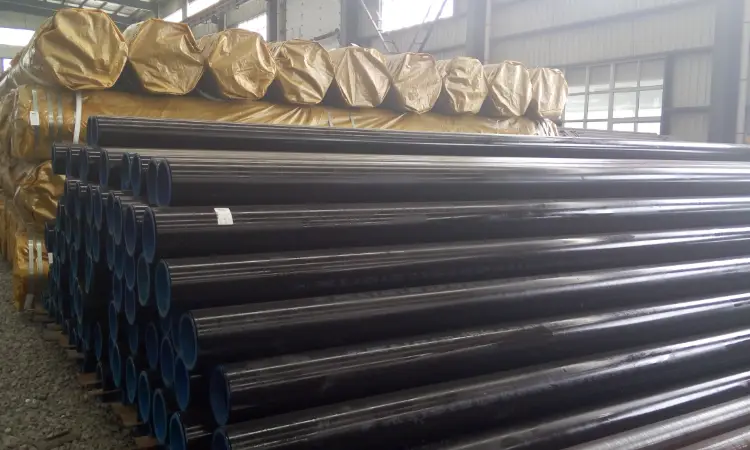
API 5L PSL1 Grade A LSAW Pipe
API 5L PSL1 Grade A LSAW Pipe: Full Material Data and International Equivalents
Comprehensive material analysis of API 5L PSL1 Grade A longitudinal submerged arc welded (LSAW) pipe, including chemical composition, mechanical and physical properties, equivalent grades, and application guidance.
Longitudinal submerged arc welding (LSAW), cold expansion optional, post-weld heat treatment as agreed.
- Phone : +8618037372205
- Email : [email protected]
- WhatsApp: Contact via Whtsapp
- WeChat: +8618037372205
API 5L PSL1 Grade A LSAW Pipe Introduction
API 5L Grade A is a carbon steel grade for line pipe, specified under the American Petroleum Institute standard API 5L. It is intended for the conveyance of oil, gas, and water in the petroleum and natural gas industries. As a PSL1 (Product Specification Level 1) pipe, it meets basic quality requirements without mandatory impact testing. LSAW (Longitudinal Submerged Arc Welded) pipe is manufactured by forming steel plate into a cylinder and welding the longitudinal seam under a flux blanket, which ensures deep penetration and a sound weld. The material offers a minimum yield strength of 205 MPa (30 ksi) and good weldability, making it suitable for low-pressure transmission, gathering lines, and structural applications. Typical delivery conditions are as-rolled or normalized, contributing to its cost-effectiveness. The pipe can be supplied in various diameters and wall thicknesses according to the standard.
API 5L PSL1 Grade A LSAW Pipe Chemical Composition
Chemical requirements per API 5L PSL1 for Grade A. Only the elements with specified limits are shown. Other elements (Nb, V, Ti) may be added by agreement, but no standard limits apply unless the Mn content exceeds 1.20%, which is not the case for Grade A.
- C.E. (Carbon Equivalent) calculation may be required per supplementary requirements.
- All values are maximum unless stated otherwise.
| Element | Standard Value (%) | Remarks |
|---|---|---|
| C | ≤ 0.22 | Heat analysis |
| Mn | ≤ 0.90 | Heat analysis |
| P | ≤ 0.030 | Heat analysis |
| S | ≤ 0.030 | Heat analysis |
API 5L PSL1 Grade A LSAW Pipe Thermal and Electrical Physical Properties
The following physical properties are typical for carbon‑manganese steels similar to API 5L Grade A and are not mandatory requirements of API 5L. They serve as engineering reference data.
- Values apply at ambient temperature unless otherwise noted.
- Actual values may vary with composition and heat treatment.
| Property | Typical Value | Unit | Condition |
|---|---|---|---|
| Density (ρ) | 7.85 | g/cm³ | At 20 °C |
| Modulus of elasticity (E) | 205 | GPa | At 20 °C |
| Shear modulus (G) | 80 | GPa | Calculated from E and ν |
| Poisson's ratio (ν) | 0.29 | — | At 20 °C |
| Thermal expansion coefficient (α) | 11.7 | 10⁻⁶/K | 20 °C – 100 °C |
| Thermal conductivity (λ) | 51.9 | W/(m·K) | At 100 °C |
| Specific heat capacity (cp) | 486 | J/(kg·K) | At 20 °C |
| Electrical resistivity (ρe) | 0.142 | 10⁻⁶ Ω·m | At 20 °C |
API 5L PSL1 Grade A LSAW Pipe Mechanical Properties
Mechanical requirements for the pipe body in accordance with API 5L PSL1 Grade A. Testing is performed on transverse or longitudinal strip test pieces. Elongation is determined using a formula based on the specimen area and the actual tensile strength. Bend testing requires no cracks.
- Impact testing is not mandatory for PSL1; values may be agreed upon for specific projects.
- Weld seam properties must also meet these requirements.
| Property | Value | Unit | Condition |
|---|---|---|---|
| Yield Strength (Rt0.5) | ≥ 205 | MPa | Transverse or longitudinal; 0.5% total extension (or ReL as agreed) |
| Tensile Strength (Rm) | ≥ 331 | MPa | Transverse or longitudinal |
| Elongation after fracture (A) | min = 1940 × Ac0.2 / Rm0.9 | % | Strip specimen; Ac = cross-sectional area in mm²; Rm in MPa |
| Bend test (Mandrel diameter) | No cracks | — | 180° bend; mandrel diameter as per Table 17 of API 5L |
| Charpy V‑impact energy | Not required for PSL1 | J | May be specified by supplement |
API 5L PSL1 Grade A LSAW Pipe Exact Equivalent Material Standards and Substitutable Grades
| Country/Region | Standard | Grade | Remarks |
|---|---|---|---|
| International | ISO 3183 | L210A (PSL1) | Direct equivalent for welded pipe; same strength level. |
| China | GB/T 9711 | L210 (PSL1) | Matched to API 5L Grade A, for welded line pipe. |
| Europe | EN 10208-1 | L210GA | Close equivalent, though EN standard may have slight differences in chemistry. |
| USA | ASTM A53 | Grade A | May be substituted for some structural and low‑pressure piping, but manufacturing standard differs. |
API 5L PSL1 Grade A LSAW Pipe Application Introduction
API 5L PSL1 Grade A LSAW pipe is widely used where moderate mechanical requirements, low cost, and reliable weldability are needed. It is particularly suited for onshore and offshore pipeline systems conveying non‑sour, low‑pressure fluids. The pipe can be readily cut, welded, and formed into various components.
Product Applications: On‑land oil flowlines, Gas distribution mains, Water trunk pipes, Slurry transport pipelines, Steel pipe piles
Processed into products: Straight pipe spools, Elbows, tees, and reducers (fabricated from pipe or plate), Flanges (slip‑on or weld‑neck), Pipeline casings and crossings, Structural tubular members (columns, braces)
Application industries: Oil and gas transmission (low‑pressure gathering systems), Water distribution and wastewater networks, Construction and structural engineering (piling, bracing), Fire‑fighting piping systems, Hollow structural sections (secondary market)
API 5L PSL1 Grade A LSAW Pipe Similar/Alternative Material Recommendations
| Country/Region | Standard | Grade | Remarks |
|---|---|---|---|
| Global | API 5L | Grade B (PSL1) | Higher strength (min YS 241 MPa); more common for moderate pressure lines. Suitable upgrade if wall thickness can be reduced. |
| USA | ASTM A106 | Grade A | Seamless carbon steel pipe for high‑temperature service; similar strength but different manufacturing process. |
| China | GB/T 3091 | Q195 | Low‑pressure fluid welded pipe; slightly lower strength but comparable for non‑critical structural use. |
| Europe | EN 10217-1 | P235TR1 | Welded pressure pipe; yield strength ~235 MPa, close and with good weldability; needs design verification. |
Notes:
Additional remarks:
- Welding consumables should be selected to match the low‑strength base metal; ER70S‑3 or similar GMAW wire is typical.
- Coating and lining systems (FBE, 3‑LPE, cement mortar) are often applied for corrosion protection in buried or submerged service.
- The pipe is generally not recommended for sour service (H₂S‑containing environments) because PSL1 does not guarantee resistance to sulfide stress cracking; for such applications, PSL2 grades with controlled hardness are specified.
- Charply impact testing is optional in PSL1 and can be added by specification if required for low‑temperature toughness.
- Share



