
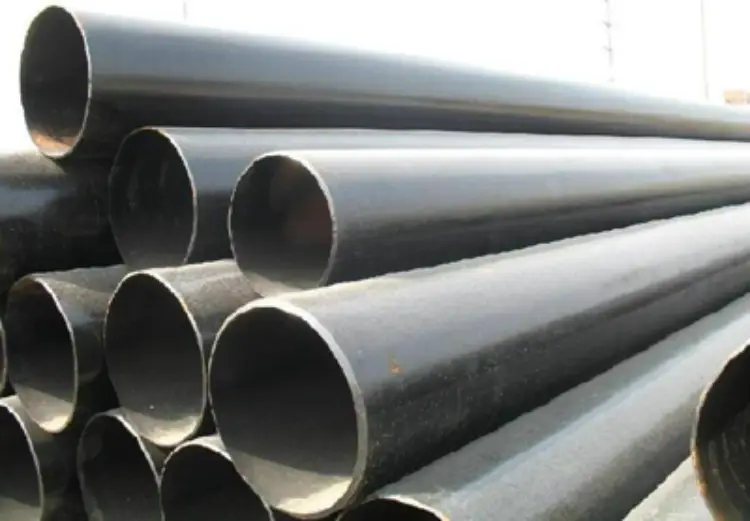
API 5L PSL1 Grade A ERW Pipe
API 5L PSL1 Grade A ERW Pipe: Carbon Steel Line Pipe for Low-Pressure Fluid Transmission
Comprehensive material data for API 5L PSL1 Grade A ERW pipe, including chemical composition, mechanical properties, physical properties, international equivalents, and application guidance.
Electric Resistance Welding (ERW), suitable for cold forming, bending, cutting, and welding (fabrication). Pipe ends can be plain, beveled, or threaded.
- Phone : +8618037372205
- Email : [email protected]
- WhatsApp: Contact via Whtsapp
- WeChat: +8618037372205
API 5L PSL1 Grade A ERW Pipe Introduction
API 5L PSL1 Grade A is a carbon steel line pipe grade specified in the American Petroleum Institute (API) standard API 5L for pipe used in conveying gas, water, and oil in the petroleum and natural gas industries. As a PSL1 (Product Specification Level 1) product, it represents the basic quality level with standard testing and nondestructive examination requirements. Manufactured by the Electric Resistance Welded (ERW) process, this pipe offers a favorable combination of weldability, formability, and cost-effectiveness for low-pressure and moderate-temperature service. It features a minimum yield strength of 210 MPa (30 ksi) and is commonly used in gathering lines, distribution systems, and structural applications.
API 5L PSL1 Grade A ERW Pipe Chemical Composition
The chemical composition limits specified for API 5L PSL1 Grade A are basic for carbon steel. Maximum limits apply to carbon, manganese, phosphorus, and sulfur. No other alloying elements are intentionally added. The values reflect the standard's requirements for heat analysis. For product analysis, slightly higher deviations are permitted per API 5L Table 4.
| Element | Standard Value (max, %) | Remarks |
|---|---|---|
| C (Carbon) | 0.22 | For Grade A, carbon content may be reduced by agreement for improved weldability. |
| Mn (Manganese) | 0.90 | Minimum not specified for PSL1; typical range 0.30–0.90. |
| P (Phosphorus) | 0.030 | For PSL1, the limit is 0.030% max. |
| S (Sulfur) | 0.030 | For PSL1, the limit is 0.030% max. |
| Others | — | No other elements specified; residual elements (Cu, Ni, Cr, Mo) allowed but not required. |
API 5L PSL1 Grade A ERW Pipe Thermal and Electrical Physical Properties
The physical properties listed below are typical for low-carbon steel similar to API 5L Grade A. They are not mandatory in the API 5L specification but are provided for design and engineering purposes. Properties are valid for ambient temperature unless noted. Exact values can vary slightly depending on the specific chemistry and heat treatment.
| Property | Typical Value | Unit | Test Condition / Remarks |
|---|---|---|---|
| Density (ρ) | 7.85 | g/cm³ | At 20°C |
| Elastic Modulus (E) | 205 | GPa | At room temperature |
| Shear Modulus (G) | 80 | GPa | Calculated from E and ν |
| Poisson's Ratio (ν) | 0.29 | — | In elastic range |
| Thermal Expansion Coefficient (α) | 11.7 (0–100°C); 12.5 (0–200°C); 13.5 (0–400°C) | 10⁻⁶ / K | Mean coefficient between 20°C and indicated temperature range |
| Thermal Conductivity (λ) | 52 (at 20°C); 48 (at 200°C); 42 (at 400°C) | W/(m·K) | Typical for mild steel |
| Specific Heat Capacity (Cp) | 470 (at 20°C); 530 (at 200°C); 610 (at 400°C) | J/(kg·K) | Typical for mild steel |
| Electrical Resistivity (ρ_e) | 0.15–0.20 | µΩ·m | At 20°C; varies with composition |
API 5L PSL1 Grade A ERW Pipe Mechanical Properties
The mechanical properties of API 5L PSL1 Grade A pipe are determined by transverse or longitudinal strip tensile tests (for ERW pipe) and, if applicable, flattening or bend tests. The values below represent the standard minimum requirements for pipe body yield and tensile strength. No impact testing is required for PSL1. Elongation is not specified in API 5L; instead, the minimum elongation can be calculated from the formula given in Table 7, based on tensile specimen area. The values provided here are typical for a standard rectangular specimen.
| Property | Standard Requirement | Unit | Test Condition / Remarks |
|---|---|---|---|
| Yield Strength (Rt0.5) | ≥ 210 (30) | MPa (ksi) | Transverse strip test, 0.5% total extension (PSL1) |
| Tensile Strength (Rm) | ≥ 335 (48.6) | MPa (ksi) | Transverse strip test |
| Elongation after fracture (A) | ≥ 23 (typical for 38.1 mm gauge length) | % | Calculated per API 5L Table 7; value depends on specimen area. For a 300 mm² area, Af ≈ 23%. |
| Bend Test (Flattening) | No opening or crack shall occur when flattened | — | Flattening test for ERW pipe is performed in accordance with ASTM A370 or ISO 8492; weld ductility verified. |
| Hydrostatic Test | ≥ 60% specified minimum yield strength for 5 seconds, or as per design pressure | — | Standard mill test, or NDE alternative for PSL1 (per agreement) |
API 5L PSL1 Grade A ERW Pipe Fully Equivalent Material Standards and Substitutable Grades
| Country/Region | Standard | Grade/Designation | Remarks |
|---|---|---|---|
| International (ISO) | ISO 3183:2019 | PSL1 L210 | Identical technical requirements; L210 corresponds to API 5L Grade A. |
| Europe | EN 10208-1:2009 | L210GA | Steel pipes for pipelines for combustible fluids; Grade L210GA is equivalent to API 5L Grade A PSL1. |
| China | GB/T 9711-2017 | L210 | Petroleum and natural gas industries – steel pipe for pipelines; L210 matches API 5L Grade A PSL1. |
| Russia/EAC | GOST 20295-85 | K34 or K38 (by negotiation) | Seamless and welded steel pipes for trunk oil and gas pipelines; strength level ≈ 210 MPa may be available under K34. |
API 5L PSL1 Grade A ERW Pipe Application Introduction
API 5L PSL1 Grade A ERW pipe is widely utilized in applications where cost efficiency and reliable performance under moderate conditions are paramount. Its good formability and weldability simplify fabrication and installation. Common uses span across oil and gas, water transmission, civil engineering, and industrial services.
Product Applications: Low-pressure natural gas distribution lines, Oil well flow lines (where strength and corrosion conditions are mild), Water injection pipelines, Structural columns and bollards, Agricultural irrigation pipes, Compressed air and utility piping, Fencing, sign supports, and light poles
Processed into products: Straight pipe sections and fabricated fittings (elbows, tees, reducers), Pipeline end connections (flanges, threaded ends), Pipe supports and clamps, Custom-fabricated manifolds and headers, Bent or cold-formed tubular sections for structural frames, Sleeves and casing pipes
Application industries: Oil and Gas (onshore gathering lines, flowlines), Water Transportation and Distribution, Civil and Structural Engineering (piling, scaffolding, handrails), Mining (slurry transport), Irrigation and Agriculture, HVAC and Fire Protection systems (when acceptable under relevant codes)
API 5L PSL1 Grade A ERW Pipe Recommended Similar/Alternative Materials
| Country/Region | Standard | Grade/Designation | Remarks |
|---|---|---|---|
| USA | API 5L | PSL1 Grade B | Higher strength (YS ≥ 245 MPa) but similar weldability; often used for higher pressure applications. |
| USA | ASTM A53 | Grade A Type E (ERW) | General transportation and structural pipe; similar strength and chemistry, but product scope differs. |
| Europe | EN 10217-1 | P235TR1 (ERW) | Welded steel tubes for pressure purposes; comparable strength (YS 235 MPa), suitable for utility and structural use. |
| Japan | JIS G 3452 | SGP | Carbon steel pipe for ordinary piping; lower strength, but for non-critical conveyance and structures. |
| International | API 5L | PSL2 Grade A | Same base chemistry but with tighter control and mandatory impact testing; suitable when higher integrity is needed. |
Notes:
- API 5L PSL1 Grade A pipe is not intended for sour service; if hydrogen sulfide (H2S) is present, additional requirements per NACE MR0175/ISO 15156 should be agreed upon.
- For ERW pipe, the weld seam is typically subjected to in-line heat treatment (normalizing or annealing) to refine the microstructure and enhance toughness, unless otherwise specified.
- Supplementary testing (e.g., ultrasonic inspection of weld seam, dimensional checks, drift test) may be invoked by the purchaser as optional requirements in the purchase order.
- The pipe can be supplied with external coatings (e.g., black lacquer, galvanizing, FBE, 3LPE) and internal linings for specific service environments.
- Share



