
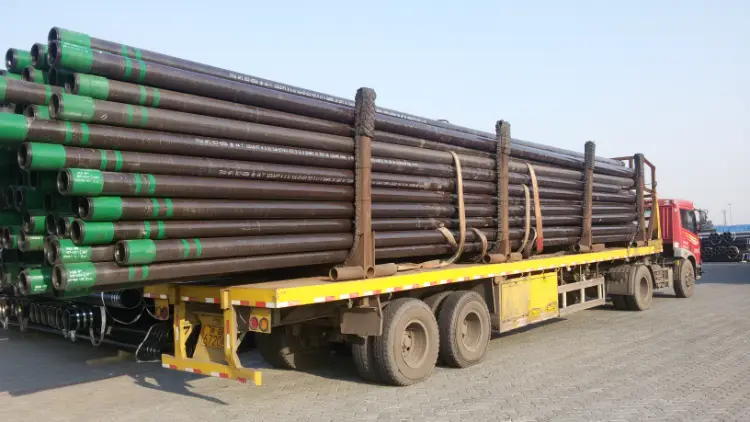
API 2B Grade 2W SSAW Pipe
API 2W Grade 50 SSAW Pipe – Offshore Structural Steel & Spiral Weld Application
In-depth reference for API 2B fabricated SSAW pipe using API 2W Grade 50 steel plate: chemical composition, mechanical properties, thermal and electrical data, equivalent grades, and application guide.
Thermo-Mechanical Control Process (TMCP), spiral submerged arc welding, cold forming, hot forming, welding
- Phone : +8618037372205
- Email : [email protected]
- WhatsApp: Contact via Whtsapp
- WeChat: +8618037372205
API 2B Grade 2W SSAW Pipe Introduction
API 2B SSAW pipe produced from API 2W Grade 50 steel is a high-strength structural tubular product designed for offshore construction. The base material conforms to API Specification 2W, which covers thermomechanically controlled processed (TMCP) steel plates for fixed offshore structures.
- Minimum yield strength of 50 ksi (345 MPa) with excellent weldability and notch toughness.
- Supplied in spiral submerged arc welded (SSAW) form per API 2B fabrication requirements.
- Ideally suited for jackets, decks, piles, and bracing members in marine environments.
API 2B Grade 2W SSAW Pipe Chemical Composition
Typical ladle analysis limits for API 2W Grade 50 TMCP steel plate. Values are maximum unless a range is specified. Slight variations may occur depending on product thickness and supplementary requirements. Elements not listed are intentionally minimized.
| Element | Standard Value (max, %) | Remarks |
|---|---|---|
| Carbon (C) | 0.12 | 0.14 max for thickness ≤ 40 mm; for CEIIW control |
| Manganese (Mn) | 1.60 | Typical range 1.15 – 1.60% |
| Silicon (Si) | 0.50 | 0.15 – 0.50% |
| Phosphorus (P) | 0.020 | Low P for toughness |
| Sulfur (S) | 0.010 | Low S for HIC resistance |
| Aluminum (Al) total | 0.020 – 0.050 | Fine grain practice |
| Niobium (Nb) | 0.05 | Microalloying typical 0.02 – 0.05% |
| Vanadium (V) | 0.10 | May be added with Nb |
| Titanium (Ti) | 0.02 | 0.005 – 0.02% for grain refinement |
| Copper (Cu) | 0.35 | Optional for weathering resistance |
| Nickel (Ni) | 0.50 | For thicknesses > 30 mm typical |
| Chromium (Cr) | 0.25 | Residual element |
| Molybdenum (Mo) | 0.10 | Residual element |
| Nitrogen (N) | 0.012 | Bounded by Al and Ti |
| CEIIW (Ceq) | 0.43 | Carbon equivalent for weldability, typically ≤ 0.43 |
API 2B Grade 2W SSAW Pipe Thermal and Electrical Physical Properties
Representative physical properties for low-alloy TMCP structural steel similar to API 2W Grade 50. Values may vary with actual composition and temperature. These data serve for engineering calculations in offshore design.
| Property | Standard Value | Unit | Test Condition |
|---|---|---|---|
| Density (ρ) | 7850 | kg/m³ | Room temperature |
| Modulus of Elasticity (E) | 205 – 210 | GPa | Room temperature |
| Shear Modulus (G) | 80 | GPa | Room temperature, calculated from E and ν |
| Poisson's Ratio (ν) | 0.29 – 0.30 | — | Room temperature |
| Coefficient of Thermal Expansion (α) | 11.1 × 10⁻⁶ | 1/K | 20–100°C |
| Coefficient of Thermal Expansion (α) | 11.7 × 10⁻⁶ | 1/K | 20–200°C |
| Coefficient of Thermal Expansion (α) | 12.5 × 10⁻⁶ | 1/K | 20–400°C |
| Thermal Conductivity (λ) | 42 | W/(m·K) | Room temperature |
| Thermal Conductivity (λ) | 38 | W/(m·K) | 200°C |
| Specific Heat Capacity (c) | 460 – 480 | J/(kg·K) | Room temperature |
| Electrical Resistivity (ρ_e) | 0.22 – 0.25 | ×10⁻⁶ Ω·m | Room temperature |
API 2B Grade 2W SSAW Pipe Mechanical Properties
Tensile and impact properties for API 2W Grade 50 TMCP plate used to manufacture SSAW pipe per API 2B. Tests are performed on transverse specimens. Minimum requirements are per API 2W; pipe properties may slightly vary due to forming and welding.
| Property | Standard Requirement | Unit | Test Condition |
|---|---|---|---|
| Yield Strength (ReH) | 345 – 517 | MPa | Transverse, 0.2% offset, room temperature |
| Tensile Strength (Rm) | 483 – 620 | MPa | Transverse, room temperature |
| Elongation (A) | 21 (min) | % | 50 mm gauge length (2 in.) |
| Yield-to-Tensile Ratio | 0.85 (max) | — | Transverse |
| Charpy V-notch Impact Energy | 50 (longitudinal) / 40 (transverse) | J | At -40°C (-40°F), average of 3 specimens |
| Charpy V-notch Impact Energy | 34 (individual minimum) | J | At -40°C |
| Charpy V-notch Impact Energy (alternate) | 100 (longitudinal) / 80 (transverse) | J | At -20°C (-4°F), for certain applications |
| Bend Test (Mandrel Diameter) | 3t (bend through 180°) | — | Thickness < 25 mm, no cracks |
| Through-Thickness (Z-direction) | Reduction of area ≥ 35% | % | When specified (Z-quality) |
| Hardness (weld HAZ) | 325 HV10 | HV | Maximum in heat-affected zone |
API 2B Grade 2W SSAW Pipe Complete Equivalent Material Standards and Replaceable Grades
| Country/Region | Standard | Grade | Remarks |
|---|---|---|---|
| Europe | EN 10025-4 | S355MLO / S355G10+M | TMCP offshore structural steel, yield 355 MPa, Charpy at -40°C. |
| International | ISO 3183 (API 5L for pipe) | L360 / X52 | For pipeline application; yield 360 MPa, but different weldability focus. |
| UK | BS 7191 | 355EM | Extra high strength TMCP steel for offshore structures. |
| Norway | NORSOK M-120 | Y35 | Yield 350 MPa, category A for fixed structures. |
| France | NF A 36-231 | E355R | Steel for welded constructions, similar strength level. |
| Japan | JIS G 3106 | SM490YB | Welded structural steel with TMCP, yield 365 MPa. |
API 2B Grade 2W SSAW Pipe Application Introduction
API 2W Grade 50 SSAW pipe combines the fabrication efficiency of spiral welding with the exceptional toughness and weldability of TMCP offshore steel. It is intended primarily for permanent offshore installations subjected to dynamic loads, fatigue, and low-temperature service.
- Optimized carbon equivalent ensures field weldability without excessive preheat.
- Impact properties at -40°C provide ductile fracture resistance in critical joints.
- Spiral welded pipe (SSAW) enables large diameters and long lengths, reducing girth weld numbers and installation time.
Product Applications: Jacket legs and bracing members, Deck trusses and stiffened panels, Conductor pipes and pile sleeves, Caisson and riser support tubes, Offshore wind monopiles and transition pieces
Processed into products: Tubular joints (Y-, K-, T-connections), Pile clusters and battered pile assemblies, Launch runners and skid beams, Module support frames (MSF), Subsea structural nodes and templates, Conductor guide funnels and centralizers
Application industries: Offshore Oil & Gas fixed platform construction, Marine and harbor structures (dolphins, berthing piles), Wind energy – offshore wind turbine foundations (monopiles, jackets), Bridge construction (caissons, large-diameter piles), Industrial plant structural framing in marine environments
API 2B Grade 2W SSAW Pipe Similar / Close Alternative Material Recommendations
| Country/Region | Standard | Grade | Remarks |
|---|---|---|---|
| USA | ASTM A572 / A709 | Grade 50 (345 MPa) | General structural steel; lacks specific toughness requirements for offshore; can substitute with supplementary Charpy testing. |
| USA | API 5L | X52 (PSL2) | Line pipe steel, yield 360 MPa; suitable for pipe form but not covered by API 2W structural requirements. |
| USA | ASTM A516 | Grade 70 | Pressure vessel steel with good low-temperature toughness; used in structural pipe where notch toughness is critical. |
| Europe | EN 10025-3 | S355NL | Normalized fine-grain steel, yield 355 MPa, Charpy at -50°C; good alternative for non-TMCP option. |
| Europe | EN 10225 | S355G10+N | Weldable structural steel for offshore, fixed structures. |
Notes:
Note: The data provided correspond to the base metal (API 2W Grade 50 plate) used for SSAW pipe manufactured per API 2B. The delivered pipe properties may be influenced by the welding process and forming strains.
- Pipe-specific mechanical testing (flattening, guided bend, weld tensile) shall be carried out in accordance with API 2B.
- Additional requirements such as CTOD (Crack Tip Opening Displacement) testing, through-thickness tensile, or specific hardness limits may be invoked by the purchaser's specification.
- The chemical composition shown is a typical ladle analysis; product analysis tolerances apply per API 2W.
- Always refer to the latest edition of API 2W and API 2B for mandatory limits and qualification procedures.
- Share



