
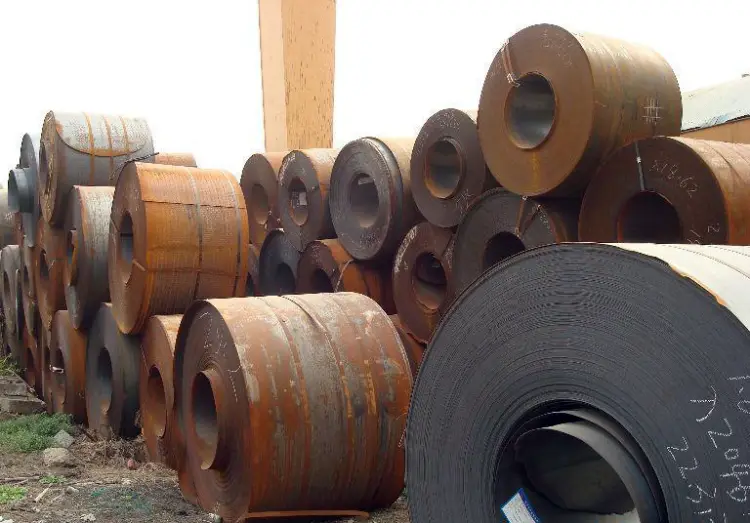
ABS Grade FQ56 Shipbuilding Steel Coil
ABS Grade FQ56 Shipbuilding Steel Coil - High Strength Quenched and Tempered Offshore Structural Steel
Complete data sheet for ABS Grade FQ56 steel coil, including chemical composition, mechanical properties, physical properties, international equivalents, and application guide.
Hot rolling, Quenching and Tempering (Q&T)
- Phone : +8618037372205
- Email : [email protected]
- WhatsApp: Contact via Whtsapp
- WeChat: +8618037372205
ABS Grade FQ56 Shipbuilding Steel Coil Introduction
ABS Grade FQ56 is a high strength quenched and tempered structural steel governed by the American Bureau of Shipping (ABS) Rules for Materials and Welding. It is designed for shipbuilding and offshore structures requiring a minimum yield strength of 560 MPa and excellent notch toughness at temperatures down to -60°C. Key features
- Superior strength-to-weight ratio enabling lighter designs.
- Excellent low-temperature impact toughness (F-class: -60°C).
- Good weldability with proper preheat and consumables.
- Through-thickness properties available under specific approval.
- Supplied in coil, plate, and sheet forms after quenching and tempering.
The steel complies with strict classification society requirements, ensuring high purity, controlled chemistry, and consistent mechanical performance. Typical applications include hull plating for Arctic vessels, offshore platform legs, heavy-lift crane booms, and critical structural members in ice-class ships.
ABS Grade FQ56 Shipbuilding Steel Coil Chemical Composition
Chemical composition limits as specified in ABS Rules Part 2, Chapter 1, Section 3, Table 3 for Grade FQ56. All values are maximum unless otherwise noted.
- Tight control of P and S ensures good toughness and weldability.
- Microalloying elements (Nb, V, Ti) refine grain size and improve strength.
- Ceiling on carbon equivalent (CEV) is often required to guarantee weldability; typical maximum CEV = 0.45%.
| Element | Standard Value (wt%) | Remarks |
|---|---|---|
| Carbon (C) | ≤ 0.18 | |
| Silicon (Si) | 0.10 – 0.55 | |
| Manganese (Mn) | 0.90 – 1.60 | |
| Phosphorus (P) | ≤ 0.025 | Stringent limit for toughness |
| Sulfur (S) | ≤ 0.025 | Stringent limit for toughness |
| Copper (Cu) | ≤ 0.35 | |
| Chromium (Cr) | ≤ 0.20 | |
| Nickel (Ni) | ≤ 0.40 | |
| Molybdenum (Mo) | ≤ 0.08 | |
| Niobium (Nb) | ≤ 0.06 | Columbium |
| Vanadium (V) | ≤ 0.10 | |
| Titanium (Ti) | ≤ 0.02 | |
| Aluminum (Al) total | ≥ 0.015 | Minimum required for grain refinement |
| Nitrogen (N) | ≤ 0.009 | If not Ti or Nb treated |
| Carbon Equivalent (CEV) | ≤ 0.45 (typical) | CEV = C+Mn/6+(Cr+Mo+V)/5+(Ni+Cu)/15 |
ABS Grade FQ56 Shipbuilding Steel Coil Thermal and Electrical Physical Properties
Typical physical properties for FQ56 steel at room temperature (20°C) unless otherwise indicated. These values are representative for quenched and tempered low-alloy steels and are suitable for engineering calculations.
- Properties may vary slightly depending on exact chemical composition and heat treatment.
- Thermal properties influence preheating requirements and heat transfer analysis.
| Property | Standard Value | Unit | Test Condition |
|---|---|---|---|
| Density (ρ) | 7850 | kg/m³ | At 20°C |
| Elastic Modulus (E) | 205 | GPa | At 20°C |
| Shear Modulus (G) | 80 | GPa | At 20°C |
| Poisson's Ratio (ν) | 0.3 | At 20°C | |
| Thermal Expansion Coefficient (α) | 11.5 x 10⁻⁶ | /K | 20°C to 100°C |
| Thermal Conductivity (λ) | 50 | W/(m·K) | At 20°C |
| Specific Heat Capacity (cp) | 460 | J/(kg·K) | At 20°C |
| Electrical Resistivity (ρ_e) | 0.20 x 10⁻⁶ | Ω·m | At 20°C (approximate) |
ABS Grade FQ56 Shipbuilding Steel Coil Mechanical Properties
Mechanical properties determined on transverse test specimens taken from quenched and tempered plates/coils. Values vary with product thickness. All tests performed according to ABS requirements.
- Yield and tensile tests at room temperature.
- Impact (Charpy V-notch) tests at -60°C for F-grade.
- Bend tests to evaluate cold formability and absence of defects.
| Property | Standard Requirement | Unit | Test Condition |
|---|---|---|---|
| Yield Strength (ReH) | ≥ 560 | MPa | Thickness ≤ 50 mm |
| Yield Strength (ReH) | ≥ 550 | MPa | 50 < thickness ≤ 100 mm |
| Yield Strength (ReH) | ≥ 540 | MPa | 100 < thickness ≤ 150 mm |
| Tensile Strength (Rm) | 670 – 830 | MPa | Thickness ≤ 100 mm |
| Tensile Strength (Rm) | 660 – 820 | MPa | 100 < thickness ≤ 150 mm |
| Elongation (A, 5.65√S0) | ≥ 16 | % | Transverse, all thicknesses (min. value) |
| Impact Energy (KV2) | ≥ 34 (average) | J | Charpy V-notch, -60°C, 10x10 mm specimen |
| Impact Energy (KV2) | ≥ 24 (individual) | J | Charpy V-notch, -60°C, 10x10 mm specimen |
| Bend Test | 180°; mandrel dia. 3a | Thickness ≤ 25 mm, a = specimen thickness | |
| Bend Test | 180°; mandrel dia. 4a | Thickness > 25 mm, a = specimen thickness |
ABS Grade FQ56 Shipbuilding Steel Coil Equivalent Standards and Replaceable Grades
| Country/Region (Class Society) | Standard | Grade | Remarks |
|---|---|---|---|
| American Bureau of Shipping (ABS) | ABS Rules Part 2 Chapter 1 | FQ56 | Base specification |
| DNV GL (Norway/Germany) | DNVGL Rules Pt.2 Ch.2 | FQ56 | Identical requirements |
| Lloyd's Register (UK) | LR Rules Ch.3 | FQ56 | Identical requirements |
| Bureau Veritas (France) | BV Rules Pt.B Ch.2 | FQ56 | Identical requirements |
| China Classification Society (CCS) | CCS Rules Pt.1 Ch.3 | FQ56 | Identical requirements |
| Nippon Kaiji Kyokai (ClassNK) | NK Rules Pt.K | FQ56 | Identical requirements |
| Korean Register (KR) | KR Rules Pt.2 Ch.1 | FQ56 | Identical requirements |
| Registro Italiano Navale (RINA) | RINA Rules Pt.C Ch.2 | FQ56 | Identical requirements |
ABS Grade FQ56 Shipbuilding Steel Coil Application Introduction
ABS Grade FQ56 is specifically designed for demanding marine and offshore structures where high strength, excellent low-temperature toughness, and reliable through-thickness properties are essential.
- Ideal for Arctic and ice-class vessels due to F-grade impact test at -60°C.
- Quenching and tempering provide a fine bainitic/martensitic microstructure with uniform properties across thickness.
- Used in both new-building and repair/upgrade projects.
Product Applications: Hull plates for Arctic tankers, LNG carriers, icebreakers, Deck and bottom shell plates, Side shell and longitudinal bulkhead plating, Offshore platform legs, nodes, and deck structures, Heavy-lift crane booms and pedestals, Jack-up rig leg chords and racking, Semi-submersible column and pontoon structures
Processed into products: Deck plates, Bottom plates, Side shell plates, Longitudinal stiffeners, Transverse web frames, Bilge keels, Hatch coamings, Deckhouse panels, Jack-up rig leg chords, Semi-submersible column stiffeners, Ice belt plating, Crane pedestal shells
Application industries: Shipbuilding (commercial, naval, ice-class), Offshore Oil and Gas (platforms, FPSO modules), Marine Engineering (heavy lift vessels, crane barges), Structural Engineering (bridges, heavy industrial structures)
ABS Grade FQ56 Shipbuilding Steel Coil Similar or Approximate Substitute Materials
| Country/Region | Standard | Grade | Remarks |
|---|---|---|---|
| EU | EN 10025-6 | S690QL | Higher yield strength (≥690 MPa), quenched & tempered; good toughness; not a direct shipbuilding standard. |
| USA | ASTM A514/A514M | Grade Q | Yield strength ≥690 MPa, used in structural applications; higher strength and different notch toughness requirements. |
| USA | API 2W | Grade 60 | Yield strength 415 MPa; significantly lower strength, but used in similar offshore environments. |
| International | ABS Rules | FH36 | Lower strength (355 MPa min yield) shipbuilding steel; not quenched & tempered; suitable for less demanding structural parts. |
Notes:
Certification: Must be supplied with ABS inspection certificates, including ladle analysis, tensile, impact, and bend test results. Welding: Appropriate low-hydrogen welding consumables and preheat/interpass temperature control are required to avoid cold cracking. Post-weld heat treatment (PWHT) may be needed for thick sections. Strain ageing: Cold forming should be limited; if critical, strain ageing tests may be required. Through-thickness properties: For tension loading in Z-direction, steel with improved through-thickness properties (Z35) can be ordered under separate specification. Always consult the latest ABS Rules and approved welding procedure specifications for fabrication.
- Share



