
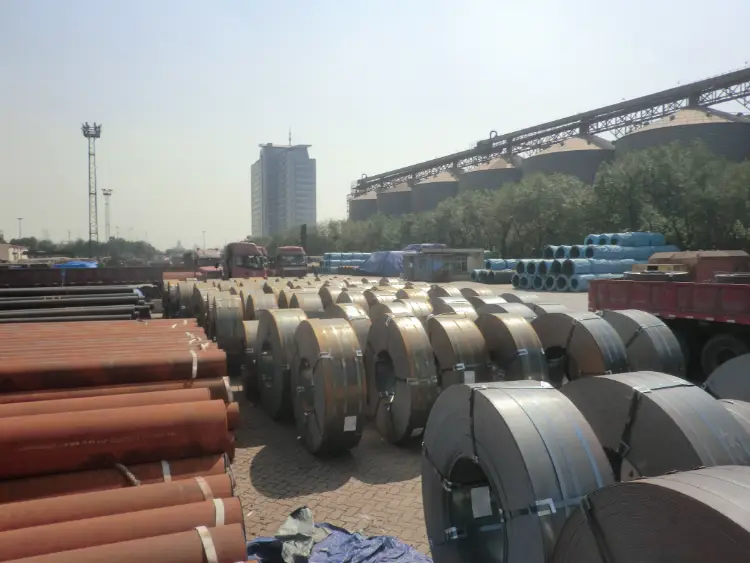
ABS Grade AQ63 Shipbuilding Steel Coil
ABS Grade AQ63 Shipbuilding Steel Coil - Quenched & Tempered High Strength Marine Steel
Comprehensive data sheet for ABS Grade AQ63 quenched and tempered shipbuilding steel coil. Chemical composition, mechanical and physical properties according to ASTM A131/ABS Rules.
Quenching and tempering, hot rolling, cold forming, welding, machining
- Phone : +8618037372205
- Email : [email protected]
- WhatsApp: Contact via Whtsapp
- WeChat: +8618037372205
ABS Grade AQ63 Shipbuilding Steel Coil Introduction
ABS Grade AQ63 is a high strength quenched and tempered shipbuilding structural steel defined by the American Bureau of Shipping and ASTM A131/A131M. It offers a minimum yield strength of 434 MPa (63 ksi) and tensile strength in the range 585–760 MPa, combined with excellent notch toughness at 0°C (Grade A).
This steel is primarily supplied as coils and plates for critical hull and offshore structures where weight reduction and high load capacity are essential. The quenched and tempered (Q+T) condition delivers a fine martensitic/bainitic microstructure, ensuring superior strength, ductility and crack arrest properties. AQ63 is widely recognized by all major classification societies, with equivalent designations such as LR AQ63, DNV AQ63, BV AQ63 and CCS AQ63.
Typical applications include
- Shell, deck and bottom plates of large container ships, bulk carriers and tankers
- Jack-up rig legs
- Heavy lift crane booms
- Pressure hulls for submarines and other naval vessels
Supply condition is quenched and tempered (Q+T), and the steel can be formed, welded and machined with appropriate procedures adapted to its high strength level.
ABS Grade AQ63 Shipbuilding Steel Coil Chemical Composition
The chemical composition of ABS Grade AQ63 steel is governed by ASTM A131/A131M (Table 4 for quenched and tempered grades). Carbon equivalent (CE) is typically limited to 0.45% to ensure good weldability. Grain refining elements such as niobium, vanadium and titanium are added singly or in combination, with their total content restricted to 0.23% max. The steel is fully killed and fine grain treated, with a minimum acid soluble aluminium content of 0.015%.
| Element | Standard Value (wt.%) | Remarks |
|---|---|---|
| Carbon (C) | ≤ 0.20 | max |
| Manganese (Mn) | 1.00 – 2.00 | range |
| Silicon (Si) | ≤ 0.55 | max |
| Phosphorus (P) | ≤ 0.035 | max |
| Sulfur (S) | ≤ 0.035 | max |
| Nickel (Ni) | ≤ 1.50 | max |
| Chromium (Cr) | ≤ 0.25 | max |
| Molybdenum (Mo) | ≤ 0.20 | max |
| Copper (Cu) | ≤ 0.35 | max |
| Niobium (Nb) | ≤ 0.05 | max (or V+Nb+Ti ≤ 0.23) |
| Vanadium (V) | ≤ 0.10 | max (part of V+Nb+Ti ≤ 0.23) |
| Titanium (Ti) | ≤ 0.02 | max (part of V+Nb+Ti ≤ 0.23) |
| Aluminium (Al, acid sol.) | ≥ 0.015 | min, fine grain practice |
| Nitrogen (N) | ≤ 0.012 | max |
ABS Grade AQ63 Shipbuilding Steel Coil Thermal and Electrical Physical Properties
The values below are typical for low‑alloy quenched and tempered steels with a nominal density of 7.85 g/cm³ at room temperature. Thermal expansion and conductivity vary with temperature; the figures given are average data in the 20–100°C range. All values are for reference and may slightly differ depending on exact chemical composition and heat treatment.
| Property | Typical Value | Unit | Test Condition |
|---|---|---|---|
| Density (ρ) | 7.85 | g/cm³ | At 20 °C |
| Modulus of elasticity (E) | 205 | GPa | At 20 °C |
| Shear modulus (G) | 79.3 | GPa | At 20 °C |
| Poisson's ratio (ν) | 0.3 | – | At 20 °C |
| Thermal expansion coefficient (α) | 12.0 | 10⁻⁶ /K | 20 – 100 °C |
| Thermal conductivity (λ) | 52 | W/m·K | At 100 °C |
| Specific heat capacity (cp) | 480 | J/kg·K | At 20 °C |
| Electrical resistivity (ρe) | 0.16 | μΩ·m | At 20 °C |
ABS Grade AQ63 Shipbuilding Steel Coil Mechanical Properties
The following mechanical properties reflect requirements of ASTM A131 Grade AQ63 for as-delivered quenched and tempered condition. Values depend on thickness: data below are applicable to products with thickness ≤25.4 mm (1 in.). For greater thicknesses, slight reductions in yield and tensile strength may apply as specified in the material standard. The Charpy V‑notch impact test is mandatory for all A grades at 0°C.
| Property | Required Value | Unit | Test Condition |
|---|---|---|---|
| Yield strength (ReH) | ≥ 434 (63) | MPa (ksi) | Transverse / longitudinal, t ≤ 25.4 mm |
| Tensile strength (Rm) | 585 – 760 (85 – 110) | MPa (ksi) | Transverse / longitudinal, t ≤ 25.4 mm |
| Elongation (A200) | ≥ 17 | % | Gauge length 200 mm, t ≤ 25.4 mm |
| Elongation (A50) | ≥ 21 | % | Gauge length 50 mm, t ≤ 25.4 mm |
| Bend test (180°) | d = 2a (diameter = 2 × thickness) | – | No cracks on outer surface, t ≤ 25.4 mm |
| Charpy V‑notch impact (KV₂, longitudinal) | ≥ 34 (average), ≥ 24 (single) | J | At 0 °C (Grade A) |
| Charpy V‑notch impact (KV₂, transverse) | ≥ 24 (average), ≥ 17 (single) | J | At 0 °C (Grade A, when specified) |
ABS Grade AQ63 Shipbuilding Steel Coil Fully Equivalent Material Standards and Substitutable Grades
| Country / Region | Standard | Grade | Remarks |
|---|---|---|---|
| USA / International | ASTM A131 / A131M | AQ63 | Original specification; Grade A impact test at 0°C |
| American Bureau of Shipping | ABS Rules | AQ63 | Equivalent application by all IACS members |
| Lloyd's Register | LR Rules | AQ63 | Acceptance according to LR Rules for Marine Materials |
| DNV | DNV Rules (former) / DNVGL | AQ63 | Now part of DNV rules for steel |
| Bureau Veritas | BV Rules | AQ63 | Equivalent to AF63 in some BV documents |
| China Classification Society | CCS Rules | AQ63 | Recognition of ASTM A131 grade |
| ClassNK | NK Rules | AQ63 | Japanese class society acceptance |
| Korean Register | KR Rules | AQ63 | South Korean flag requirement acceptance |
| RINA | RINA Rules | AQ63 | Italian ship class society |
| Russian Maritime Register | RS Rules | AQ63 | Russian flag acceptance |
ABS Grade AQ63 Shipbuilding Steel Coil Application Introduction
ABS Grade AQ63 steel is designed for highly stressed structural components in marine and offshore environments. Its high strength permits weight reduction while maintaining structural integrity. The steel is typically delivered as quenched and tempered coils, which can be cut, formed and welded into final parts.
- All welding must follow approved procedures with low‑hydrogen consumables and controlled heat input.
- Cold forming may require minimum bending radii due to the steel's high strength; stress relief treatment may be necessary.
- The steel can be machined using carbide tooling at reduced speeds compared to mild steel.
Product Applications: Ship outer shell and deck plating, Longitudinal stiffeners and web frames, Watertight bulkheads and tank walls, Jack-up leg chords and rack materials, Crane boom chords and lattice arms, Submarine pressure hulls
Processed into products: Cut, bent and welded plates for hull shell strakes, Flame‑cut and machined rack chocks for jack‑up rigs, Flanged and rolled stiffeners (angles, Tee bars), Heavy‑duty brackets and gusset plates, Structural inserts for lifting and towing points
Application industries: Shipbuilding (container ships, bulk carriers, tankers, naval vessels), Offshore oil and gas (jack-up rigs, production platforms, FPSO modules), Heavy engineering (heavy lift cranes, harbour equipment), Renewable energy (fixed and floating wind turbine substructures)
ABS Grade AQ63 Shipbuilding Steel Coil Similar / Alternative Materials for Reference
| Country / Region | Standard | Grade | Remarks |
|---|---|---|---|
| European Union | EN 10025-6 | S460Q (1.8908) | Similar yield strength (460 MPa min), Q+T condition; CVN values typically -20°C; marine application requires additional qualification. |
| European Union | EN 10025-6 | S460QL (1.8906) | Low temperature variant with improved toughness down to -40°C; can be an alternative if low temp impacts are needed. |
| Japan | JIS G 3128 | SHY685 | Higher strength (685 MPa YS) Q+T steel; may be used with adjusted design if strength overmatch is allowed. |
| USA | ASTM A709 / A709M | Grade 100 (690) Type Q | Structural steel for bridges, Q+T; comparable tensile range but not specifically approved for marine classification. |
Notes:
AQ63 is normally supplied with mill test certificates (EN 10204 type 3.1 or 3.2). Ultrasonic testing to class requirements (e.g., ASTM A578/A578M, EN 10160) is mandatory for thicknesses above 20 mm in many offshore applications. Surface condition: descaled, oiled, or as‑rolled depending on subsequent processing. When using AQ63 in sour service (H₂S), additional hardness and hydrogen‑induced cracking (HIC) tests should be considered, despite the grade not being specifically certified for sour environments.
- Share



